How to Start Vintage Reselling with €1,000: The Honest Guide (2026)
Starting vintage reselling with €1,000 is realistic if you buy strategically from a reputable wholesale supplier, choose one platform, and reinvest quickly. Focus on a…
By Patrick Libanon — founder, Excellent Vintage · Bovenkarspel, since 2012

Starting vintage reselling with €1,000 is realistic if you buy strategically from a reputable wholesale supplier, choose one platform, and reinvest quickly. Focus on a single brand category, learn the grading system, and build from your first bale before expanding.
Most guides about vintage reselling start with the success story: someone who turned a €50 thrift haul into €800 profit on Depop. Those stories exist. They're also not a business model.
What does a real start look like, with real money, real constraints, and real margins? That's what this guide covers.
Patrick has been running Excellent Vintage in Bovenkarspel, Netherlands, since 2012 — one of the country's original vintage wholesale suppliers. In over three decades in the industry, he's seen hundreds of resellers walk through his 2,500 m² warehouse. Some build solid businesses. Others burn through their first bale and quit. The difference isn't luck.
This guide is built on what actually separates the two.
Why €1,000 Is the Right Entry Point
€1,000 isn't an arbitrary number. In vintage wholesale, it's roughly the threshold where you can buy enough volume to make the economics work per piece — and where most Dutch wholesalers set their minimum order.
Below €500, you're buying too little to learn properly. You get one small bag, sell it at variable margins, and have too little data to draw conclusions. Above €2,000 on your first order, you're likely buying more than you can sell quickly — and cash tied up in slow-moving inventory is a drag.
€1,000 forces you to make choices. That constraint is valuable. It tells you: one brand category, one main format, one platform to start. Learn that combination before expanding.
At Excellent Vintage, €1,000 places you in what Patrick calls the Starter category: typically one to two bales depending on category and quality tier, or a combination of bags if you prefer smaller formats. Enough to have real inventory. Enough to move it, learn from it, and reinvest.
Volume play vs. niche play: pick one
Before you spend anything, decide which of these two approaches fits you:
Volume play — You buy mono-brand or mono-category at scale. A 45 kg bale of T-shirts or light shirts runs roughly 180–225 pieces by weight (~4–5 pieces per kilo); Ralph Lauren shirt bales are sold by piece count (~200 shirts) rather than by weight. Your audience is broad — Vinted, Depop, Whatnot. Lower margin per piece, higher total turnover. This is the systematic path: predictable sourcing, predictable sell-through, scalable.
Niche play — You buy a specific category, premium quality. A 25 kg "mix premium US" bag of Hawaiian shirts runs around 90% Grade A. Your audience is smaller but willing to pay more. Slower ramp-up, higher per-piece margin, deeper category expertise. This suits resellers who genuinely know a category and want to build a reputation in it.
With €1,000, you can start either way. You can't do both at once.
How Vintage Wholesale Works: The Supply Chain You're Buying Into
Most resellers buying from thrift shops or charity stores are buying retail or near-retail, piece by piece. Wholesale is different.
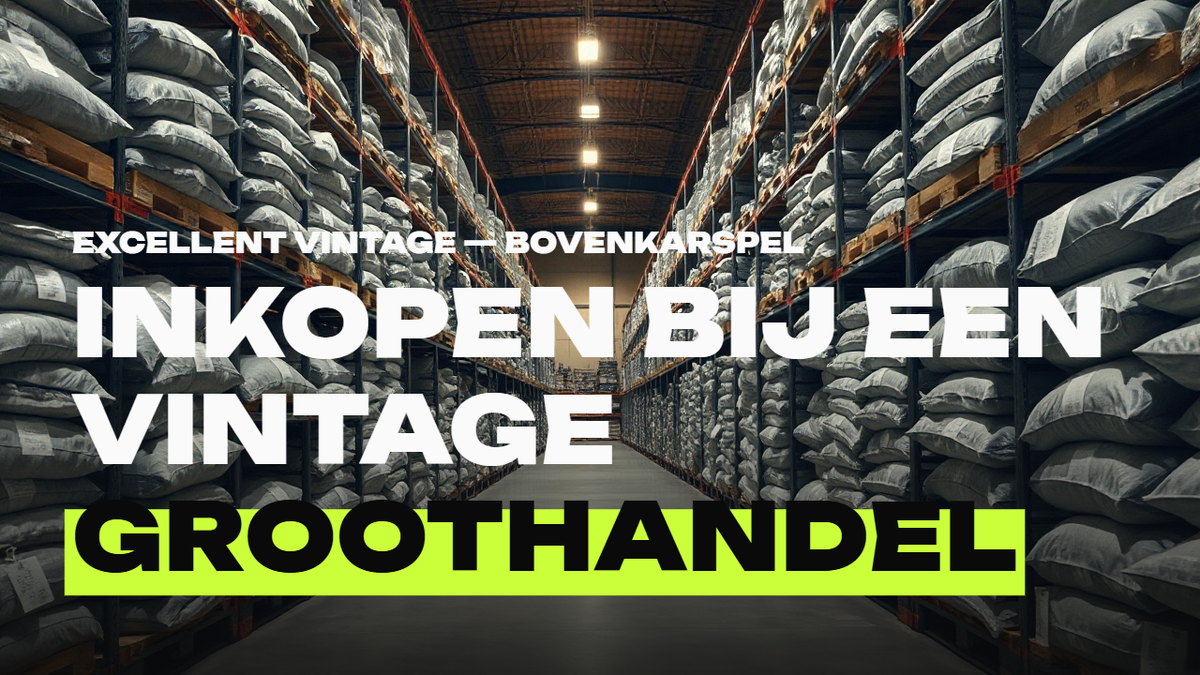
A vintage wholesale supplier like Excellent Vintage operates upstream. They source containers — in Excellent Vintage's case, 14 containers per year from 3 US partners (East, South, West coasts) and 6 European partners across the Netherlands, Germany, UK, France, Italy, and Spain. Each container holds 8 to 14 tonnes of clothing. It arrives at the warehouse, gets sorted by brand and category, gets baled, and is sold to resellers like you.
What you're buying isn't "random used clothing." It's a sorted, graded batch of a specific brand or category, pre-organised so you can sell it systematically.
The four formats
At most Dutch wholesale suppliers, you'll encounter these four purchase formats:
- Half-bag (12.5 kg) — smallest entry, useful for testing a new category
- Bag (25 kg) — most popular for Vinted specialists and friperies
- Curon (50 kg) — larger volume, typically carton format
- Bale (45 kg) — the classic wholesale format for volume resellers
Important: always ask whether a bale is sold by weight or by piece. Some categories — Ralph Lauren shirts (~200 pieces), Levi's denim — are sold as a fixed piece count. The weight isn't necessarily 45 kg for those. Using kg-to-pieces math on a per-piece bale gives you completely wrong numbers.
Understanding grading: A, B, and C
Every item in a bale at Excellent Vintage is graded:
A standard 45 kg bale averages 70% Grade A / 30% Grade B. A 25 kg "mix premium US" bag runs 90% Grade A / 10% Grade B. Grade C items aren't part of standard bales at all — they're handled separately.
Grade B isn't a problem if you price honestly. It becomes a problem if you list it as Grade A and a buyer opens a dispute. Accurate descriptions protect your review score.
Full guide to buying your first vintage clothing bale →
The Brands Worth Knowing
Your first bale decision is your first brand decision. Here's how Excellent Vintage's inventory breaks down by category, and what each cluster means for a reseller:
Heritage brands — the reliable foundation
Ralph Lauren, Tommy Hilfiger, Burberry, Barbour. These sell year-round, across platforms, to the widest audience. Demand is consistent. Pricing on Vinted is relatively stable. For a first bale, Heritage is the lowest-risk entry — you learn the process without worrying about trend cycles.
Ralph Lauren is especially forgiving for beginners: high brand recognition, active buyer base on every platform, and a range of sub-categories (polo shirts, sweatshirts, Oxford button-downs, polo bear) that let you discover which your buyers prefer.
Workwear & outdoor — the fastest movers
Carhartt, Levi's, Patagonia. These are what Whatnot streamers load their carts with. Carhartt Detroit jackets and chore coats, Levi's 501s and 517s, Patagonia Synchilla fleece — they go fast if you price them correctly. Demand peaks in autumn-winter but stays active year-round in the right sub-categories.
Patrick keeps Carhartt and Levi's bales moving week by week. On busy weeks, demand outpaces availability. If you're interested in these categories, call ahead or check WhatsApp for what's currently in.
Sport & techwear — the explosive upside
Nike (Tech Fleece, ACG, Jordan), Adidas (Originals, Y2K), The North Face (Nuptse, Denali). The youngest audience, the most activity on TikTok Shop and Whatnot, and the highest per-piece ceiling on individual standout items.
The challenge: sport and techwear bales are more variable in quality and composition than Heritage. Less predictable for beginners. Patrick's recommendation: start with Heritage, build your system, add sport as your second or third bale. By then you'll know how to sort fast and spot value.
The Polo Bear rule: one Ralph Lauren Polo Bear sweater in good condition can stop a Whatnot stream. It draws comments, attention, and it carries the rest of the stream with it. Knowing which piece in a bale is the anchor is the skill that separates a $200 stream from a $2,000 stream.
Choosing Your Platform: Where to Sell
The platform question depends entirely on what you're selling and how you work.
Vinted: largest market, lowest barrier
Vinted is the dominant second-hand clothing marketplace in the Netherlands, Belgium, and increasingly in Germany and France. Its advantages: massive reach, active community, simple listing process, and a built-in trust system (reviews, verified payments).
For beginners with a Heritage bale, Vinted is the obvious starting point. The algorithm rewards activity — consistent uploads, fast replies, and a growing review profile all help your listings appear earlier in search. One listing a day is better than ten listings per week.
The downside: price competition is real. Vinted skews toward buyers who are looking for a deal. That's fine for volume plays; it means niche specialists sometimes find Depop more profitable for higher-end items.
Depop: the brand-conscious buyer
Depop's user base is younger, more international, and more willing to pay for the right piece at the right price. Carhartt, Levi's vintage denim, Patagonia — these perform strongly on Depop because the buyers are seeking them out specifically.
Depop rewards visual consistency. Your shop "looks" like something — a brand, a vibe, a curation. That takes more effort than Vinted, but it pays back in higher per-piece margins and a loyal following.
Whatnot: live selling for the energetic reseller
Whatnot is livestream commerce. You're on camera, you're selling in real time, and the unboxing experience is the product. For Carhartt, Nike, Ralph Lauren Polo Bear, and similar high-recognition pieces, a well-run Whatnot stream can move an entire bale in a single evening.
The barrier: it requires presence, energy, good lighting, and consistency. Viewers return if you're on the same schedule each week. But a Whatnot reseller with workwear bales and a 200-person audience can generate serious weekly income.
For most beginners: start on Vinted, learn the basics, add a second platform at month two or three.
The Economics: What Does a Vintage Bale Actually Return?
We don't publish prices. The reason is practical: bale prices vary by category, season, and demand — quoting a price that's six months old would mislead you. Everything pricing-related → book a call or WhatsApp Patrick directly.
What we can explain is the structure.
Use the vintage bale profit calculator for honest numbers →
Your return on a bale comes down to three variables:
- Cost per piece (determined by your inkoopprijs with the wholesaler)
- Average sale price per piece (determined by brand, grade, platform, and your photography)
- Sell-through rate (what percentage you successfully sell vs. donate/discard)
For a standard Heritage bale with 70/30 A/B mix:
- Your Grade A items (70%) sell at market rate
- Your Grade B items (30%) sell at a lower rate but still sell, if you describe them honestly
- The few pieces that don't move either go to a market stall, a friperie connection, or donation
The seller who earns the most from the same bale isn't the one who bought the best bale. It's the one who photographs clearly, describes honestly, prices competitively, and uploads consistently.
See how much you can earn reselling vintage clothing →
The Grade B reality
New resellers often calculate their margins only on Grade A pieces and treat Grade B as "loss." This is the wrong mental model. Grade B items have a buyer — as long as you're honest in your listing.
A shirt with a small sleeve flaw sells for less. That's not a loss; it's a lower margin. The loss only happens if you try to pass it as Grade A and the buyer disputes it. One disputed sale on Vinted can set your review score back three months.
Price Grade B accurately, describe the flaw specifically ("small pull on right sleeve hem, see photo 3"), and you'll sell it. It's simply less profitable per piece — and that's been factored into wholesale pricing.
Operations: Building a System That Scales
Buying is one thing. Turning a bale into cash efficiently is another skill entirely. Resellers who grow fast treat this like a small logistics operation.
Receiving and first sort
When your bale arrives or you bring it home from the warehouse, do a first pass:
- Ready to photograph: Grade A, no prep needed
- Quick refresh: minor creasing, mild storage smell — a short hang or light hand wash
- Assess carefully: Grade B — determine your honest price before photographing
Don't list anything directly out of the bale on the same day you receive it. Even the best pieces benefit from twenty-four hours of hanging and airing.
Storage: think rotation, not stacking
A 45 kg bale takes up more physical space than most beginners expect. The mistake: pile everything together and "sort later." What actually happens: items get forgotten, seasonal pieces miss their window, your overview disappears.
Use either a simple spreadsheet or a physical labelling system: what's in stock, what's uploaded, what's been sitting for more than three weeks. Three weeks without movement? Lower the price or move the item to a different context (market stall, bundle listing).
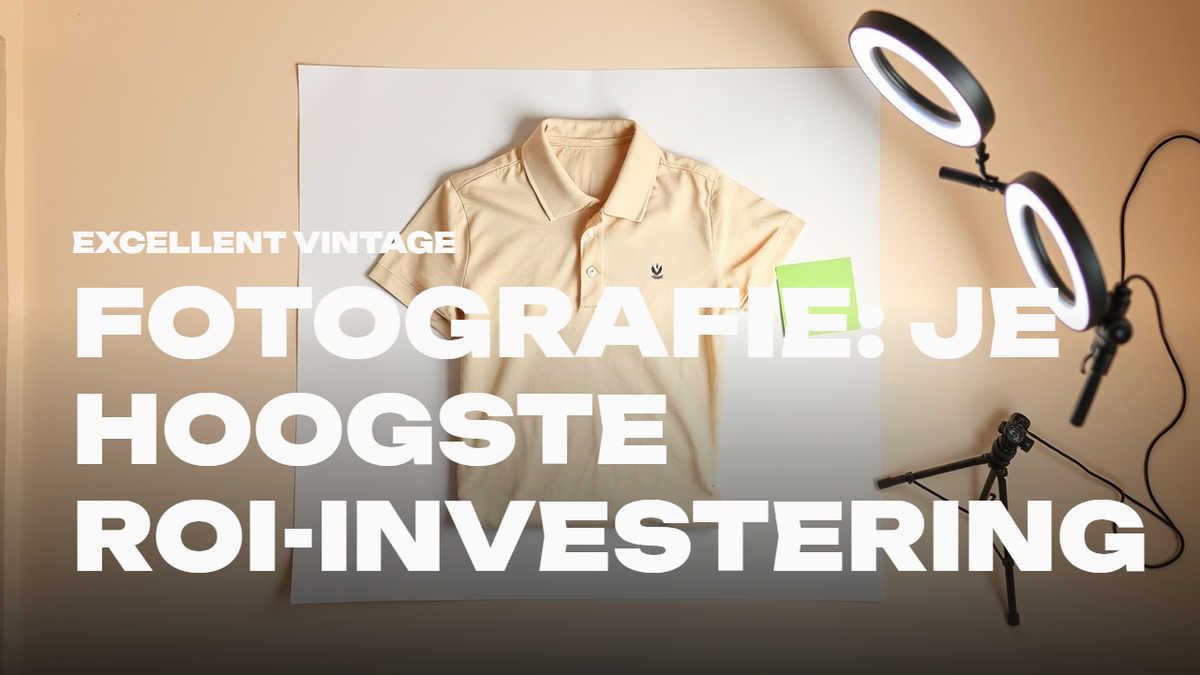
Photography: the highest-ROI investment
You don't need professional equipment. You do need:
- A light neutral background (white wall, light-coloured door, roll of white paper)
- Daylight or a daylight-temperature lamp (warm light shifts colours)
- A flat surface for overhead shots (sweatshirts, T-shirts, accessories)
- A clothing rack or hanger for hang shots (better for shirts, jackets, trousers)
On Vinted: three clear photos (front, detail, back) outperform six blurry ones. On Depop: consistency of aesthetic across your shop matters — try to maintain the same background and lighting across listings.
Patrick's observation after years at the warehouse: "The resellers who photograph well consistently outperform the ones who bought the same bale." It's the most underrated lever in this business.
Scaling From €1,000 to €3,000+ Per Month
Read the detailed roadmap: from €1,000 to €3,000 a month in vintage reselling →
Scaling isn't about spending more faster. It's about building a machine that turns over predictably.
The three levers
1. Sell-through speed. How fast does your inventory move? Every day an item sits unsold is margin you're not capturing. Consistent uploads, fast replies to enquiries, competitive pricing, and strong photos all affect this.
2. Capital rotation. Use your first bale's revenue as input for your next order. Resellers who reinvest at 70-80% sell-through — rather than waiting for every last piece to go — stay ahead of the market. Cash locked in slow-moving inventory is the most common growth blocker.
3. Volume upgrades. As your buying power grows, you move to higher volumes (lower cost per kg) or better quality tiers. Each step requires more capital and more operational capacity — but each step increases margin per piece.
When to go back to the warehouse
Patrick's rule of thumb: when you've moved about 80% of your first bale, it's time to plan your next visit. Not when everything is sold — by then you've already lost a week of income.
At your second visit, you know things you didn't know on the first: which pieces went fastest, which brands your buyers prefer, whether your Grade B sell-through was better or worse than expected. That information should drive your second order.
The Mistakes You Can Avoid
Read: 5 mistakes new vintage resellers make →
These are the patterns Patrick sees most consistently among resellers who don't stick with it:
Splitting the budget too thin. Ten small €100 purchases teach you less than one focused €1,000 bale. Spread too thin, you learn too little from any single decision.
Buying on taste, not on strategy. "I love this brand" isn't a sourcing rationale. The question is whether your buyers love it, whether it moves quickly on your platform, and whether the price differential works.
Treating Grade B as dead stock. Every Grade B piece has a buyer. Price it honestly, describe the flaw specifically, and sell it. Don't throw away 30% of your bale because it's not perfect.
Ignoring photography. The same piece, photographed well vs. photographed badly, will sell for meaningfully different prices. This is provable, not theoretical.
Waiting to reinvest. Don't wait until every last piece has sold before ordering again. You'll always be a step behind the market.
Buying Remotely: Not Just for In-Person Visits
Not everyone can drive to Bovenkarspel each time they want to order. That's fine.
Excellent Vintage operates remotely as well. Via WhatsApp, you can discuss available bales with Patrick, request descriptions or short video overviews, and receive a quote. The bale gets packed and shipped directly to you.
This model works best for returning customers who already know the warehouse. Your first visit is worth making in person — two hours on the floor teaches you more than ten remote conversations. After that, once you know the formats and the grading system, remote orders are straightforward.
Contact: WhatsApp Patrick → · +31 6 11 76 60 06 · reply within 1h, Mon–Fri.
What to Expect at the Warehouse
Excellent Vintage works by appointment only. Walk-ins aren't available — appointments let Patrick prepare the right bales for your visit rather than having you wade through everything at once.
A slot is two hours, exclusive to you (up to 4 people). Free parking on site. The bales are pre-sorted by brand and grade before you arrive — you choose which bales to take, not individual pieces. At 15 to 20 tonnes of monthly throughput, piece-by-piece handpicking isn't logistically possible.
From Amsterdam: 45 minutes by car, 60 minutes by NS train (direct to Bovenkarspel-Grootebroek, then a short walk or taxi). Patrick speaks Dutch, English, and French.
Seasonal Patterns Worth Knowing
Vintage reselling isn't flat year-round. Knowing the cycles helps you buy smarter.
Autumn-winter (September–February): Carhartt, North Face, Ralph Lauren knitwear, workwear categories. Peak demand, fastest sell-through on heavier pieces.
Spring-summer (April–August): Levi's shorts, Hawaiian shirts, Adidas sportswear, light RL polo shirts. The niche summer buyer is very active on Vinted.
Year-round stable: Core Ralph Lauren (polo shirts, Oxford shirts), Tommy Hilfiger, basic Levi's jeans, Patagonia fleece. These don't spike, but they don't crash either — good for a volume play that needs predictable cashflow.
For your first bale, buy into a stable year-round category unless you're very close to a seasonal peak. A beginner buying Carhartt jackets in February (late winter) will move them more slowly than a beginner buying them in October.
The VAT Question for European Resellers
If you're buying from Excellent Vintage as a business (sole trader or company) with a valid KvK number and an EU VAT number, you're eligible for reverse charge VAT on intra-EU B2B purchases. That means no VAT is added at the point of purchase — you handle it through your own VAT return.
For a reseller selling on Vinted (to consumers), you typically don't add VAT to your sales below certain turnover thresholds. The specifics depend on your country of registration and annual turnover. This guide isn't tax advice — consult an accountant or your national tax authority for your exact situation. The general principle is clear: B2B intra-EU purchases at Excellent Vintage are VAT-neutral for registered businesses.
All prices at Excellent Vintage are exclusive of VAT. Payment: SEPA transfer, debit/credit card (no surcharge), or cash on-site.
Frequently Asked Questions
How much does it cost to start vintage reselling?
A realistic entry budget is €1,000. That covers a first bale or bag from a reputable vintage wholesale supplier and gives you enough volume to learn from, sell systematically, and reinvest. Below €500, most Dutch wholesale suppliers are below minimum order; above €2,000 on a first order risks tying up too much capital in inventory you're still learning to sell.
What is the best platform to sell vintage clothing in 2026?
Vinted is the largest and most accessible starting platform in the Netherlands, Belgium, and Germany. Depop suits brand-focused resellers with higher-margin pieces. Whatnot works well for live selling of high-recognition workwear and sportswear brands. Most successful resellers start on one platform, master it, then expand.
What is the difference between a Grade A and Grade B vintage clothing bale?
Grade A items have no visible defects and sell at full market price. Grade B items have minor wear — small flaws in seams, light pilling, minor staining — and sell at a lower price if described honestly. A standard 45 kg bale averages 70% Grade A / 30% Grade B. A premium 25 kg bag runs 90% Grade A / 10% Grade B.
How many pieces are in a vintage clothing bale?
It depends on the category and whether the bale is sold by weight or by piece. A T-shirt bale by weight (45 kg at ~5 pieces/kg) contains roughly 225 pieces. A Ralph Lauren shirt bale sold by piece contains ~200 shirts (per-piece count, weight varies). Always confirm the selling model with your supplier before calculating margins.
Can I buy vintage wholesale without visiting the warehouse?
Yes. Excellent Vintage ships directly and sells remotely via WhatsApp consultation. For your first order, an in-person visit is strongly recommended — you'll understand the product far better after two hours in the warehouse than after any number of online conversations. After that, remote orders work well for returning customers.
How long does it take to recoup your first €1,000 investment?
That varies significantly depending on category, platform, upload frequency, and photography quality. The resellers Patrick sees succeeding fastest sell consistently (uploading several times per week), price honestly, and reinvest at 70-80% sell-through rather than waiting for everything to clear. A realistic range is four to eight weeks for a first bale — but "success" at that stage is about learning, not just the money.
Where to Go From Here
Vintage reselling with €1,000 is a real starting point — not a fantasy, not a get-rich shortcut. It requires a strategy, consistent execution, and willingness to learn from each bale.
Excellent Vintage has been working with resellers since 2012. Patrick personally handles every warehouse visit, answers WhatsApp messages himself, and has guided resellers from their first €1,000 bale to monthly orders in the Pro+ tier. The warehouse in Bovenkarspel — 2,500 m² — processes 15 to 20 tonnes a month. There's almost always inventory in the categories that move fastest.
See our full wholesale offer →
About Excellent Vintage — our story since 2012 →
Your 90-Day Roadmap: Weeks 1 Through 12
The abstract advice above doesn't tell you what to do on Monday morning. Here's what the first 90 days actually look like for a reseller who starts with €1,000 and a Heritage bale.
Weeks 1–2: Setup and first listings
Order and receive your first bale. If you're visiting the warehouse, book via WhatsApp at least a week in advance. Patrick will prepare the relevant categories for your arrival slot. If you're ordering remotely, a phone or video call is worth it for a first order — you'll understand the product far better.
Set up your storage. Before the bale arrives, sort out where it's going. A clothing rack, a set of hangers, and a flat surface for photography. You don't need a dedicated room, but you need a system from day one.
Do your first sort the day after the bale arrives. Three piles: ready to photograph, needs a refresh, Grade B to price carefully. Count the pieces, note the grade split (it should be roughly 70/30 A/B for a standard bale).
Create your seller account. If you're starting on Vinted, the account setup takes ten minutes. The priority in week 1 is getting your first fifteen to twenty listings live, not perfecting your shop profile.
Upload daily. Consistency beats burst. Fifteen to twenty listings this week, another fifteen next week. The Vinted algorithm rewards recent activity — items uploaded today appear higher in search than items uploaded three weeks ago.
Weeks 3–4: Learn from what's moving
By the end of week 2, you'll have data. Which pieces sold first? What category moved fastest? Which Grade B items sold, which didn't? Did buyers ask questions, and if so, about what?
This is the most important learning phase of your vintage reselling business. Don't rush past it. The answers tell you everything about your second order.
Lower prices on anything sitting past 10 days. On Vinted, a small price reduction triggers a notification to everyone who favourited the item. This is one of your best free marketing tools.
Reply to every message within the hour during this phase. Your response rate and review score are being built now. A single unanswered enquiry or an unresolved dispute early on sets you back disproportionately.
Weeks 5–8: First reinvestment
At 70–80% sell-through on your first bale (you'll hit this around week 5–6 if you've uploaded consistently), plan your second order.
Now you have real data:
- Which brand sub-category within your Heritage bale moved fastest?
- What was your Grade B sell-through rate? (If it was poor, investigate: were you describing flaws clearly? Were your prices sharp enough?)
- What platforms did you sell on, and how did each perform?
Your second order should double down on what worked and reduce exposure to what didn't. If Ralph Lauren polo shirts moved in three days and Oxford button-downs took two weeks, that's your answer.
Consider your first market stall or bundle listing for the slower-moving pieces in your first bale. Don't let them sit indefinitely — a stall or a bulk listing to another reseller at a reduced rate is better than frozen capital.
Weeks 9–12: Building the machine
By week 12, you should have completed two bale cycles and have a genuine sense of your unit economics: average days to sell, average margin per piece by grade and category, and your operational throughput (how many pieces you can photograph, list, and ship per week).
At this point, you're making real decisions:
- Scale up volume (same category, more pieces) — lowers your cost per piece if the wholesaler offers volume tiers, increases throughput
- Add a second platform — Depop for higher-margin individual pieces alongside Vinted's volume
- Add a second brand category — workwear alongside Heritage, or sport alongside workwear
The resellers Patrick sees graduating from starter to regular within three to four months have one thing in common: they treated the first two bales as a learning investment, not just a profit exercise. By week 12, they know exactly what they're buying and why.
The Warehouse Relationship: How It Works Over Time
One of the less-discussed advantages of vintage wholesale is the relationship you build with your supplier over time. It directly affects what you can access.
At Excellent Vintage, Patrick works with resellers at different levels — Starter (entry), Standard (regular), Pro, and Pro+. These aren't formal tiers so much as a reflection of order frequency and volume. Regular customers get earlier access to new containers. When a specific bale category is in short supply — Carhartt in peak autumn, for example — regulars hear first.
This isn't favouritism; it's logistics. Patrick processes 15 to 20 tonnes per month across 14 US containers and 6 European sources per year. He can't give everyone the same access at the same time. Resellers who show up consistently, who communicate clearly, and who reinvest reliably get rewarded with better timing and better availability.
What this means practically:
Be consistent. A reseller who visits every three to four weeks teaches the warehouse team what they need and when. That predictability helps everyone.
Communicate clearly. If you're interested in a specific brand or category next time, say so. Patrick notes it and can alert you when it's in. "Do you have Patagonia fleece coming in this month?" is a legitimate and useful question.
Pay promptly. This is obvious, but worth saying. A clean payment history is noticed.
Give feedback. If a bale contained more Grade C than expected, say so. It helps both parties calibrate expectations and improves the sourcing relationship over time.
Common Questions About Buying in Different EU Markets
Excellent Vintage ships across the EU. Resellers from Germany, Belgium, France, Denmark, and beyond are regulars. A few frequently asked questions from non-Dutch buyers:
Do I need to speak Dutch to visit the warehouse?
No. Patrick speaks English and French. Warehouse visits for international buyers work the same way as for Dutch buyers — book via WhatsApp, arrive at your slot, two hours exclusive to your group.
What about shipping to Germany or Denmark?
Remote orders are shipped directly. Shipping cost depends on the format (bale vs. bag) and destination — ask Patrick for a quote when you discuss your order. As a general principle: the heavier the format, the more the shipping cost per kg decreases as a proportion of total order value.
Can I visit with a business partner?
Yes, up to four people per appointment slot. Many resellers visit with a business partner or a trusted colleague. One person typically focuses on sorting; the other on loading.
What payment methods are accepted for international buyers?
SEPA transfer is the standard method for cross-border B2B orders. Card payment is available on-site. Cash is accepted in person.
One More Thing: The Mindset That Actually Scales
Patrick has watched resellers build their businesses from the warehouse floor since 2012. The ones who build something durable share a mindset that the others don't:
They think in cycles, not transactions. Every bale is a cycle: buy, sort, photograph, list, sell, reinvest. Getting faster at each stage of the cycle matters more than getting lucky on any individual piece.
They're honest about Grade B. Not embarrassed by it, not hiding it, not pretending every piece is perfect. They describe clearly, price fairly, and sell quickly. This builds their review profile and their buyer loyalty simultaneously.
They learn from what sells, not from what they like. A reseller who loves Patagonia fleece but discovers their buyers prefer Levi's denim learns the lesson fast: the market decides, not taste.
They treat the warehouse as a partner. Their relationship with Patrick improves over time because they communicate, they're reliable, and they show up with specific questions rather than vague requests.
They don't scale before they're ready. The temptation after a good first bale is to immediately triple the order size. Patrick's advice: double it, not triple. Give yourself room to fail at the new volume before committing to it fully.
Ready to buy?
Visit our warehouse · no deposit required · free cancellation.