How to Date a Pair of Levi's Jeans: The Complete Guide
A pair of jeans lands on the sorting table in Bovenkarspel. Before Patrick even reads the brand, his eye goes to one thing: the small red tab on the back pocket. If it says LEVI'S with a capital E,…
By Patrick Libanon — founder, Excellent Vintage · Bovenkarspel, since 2012
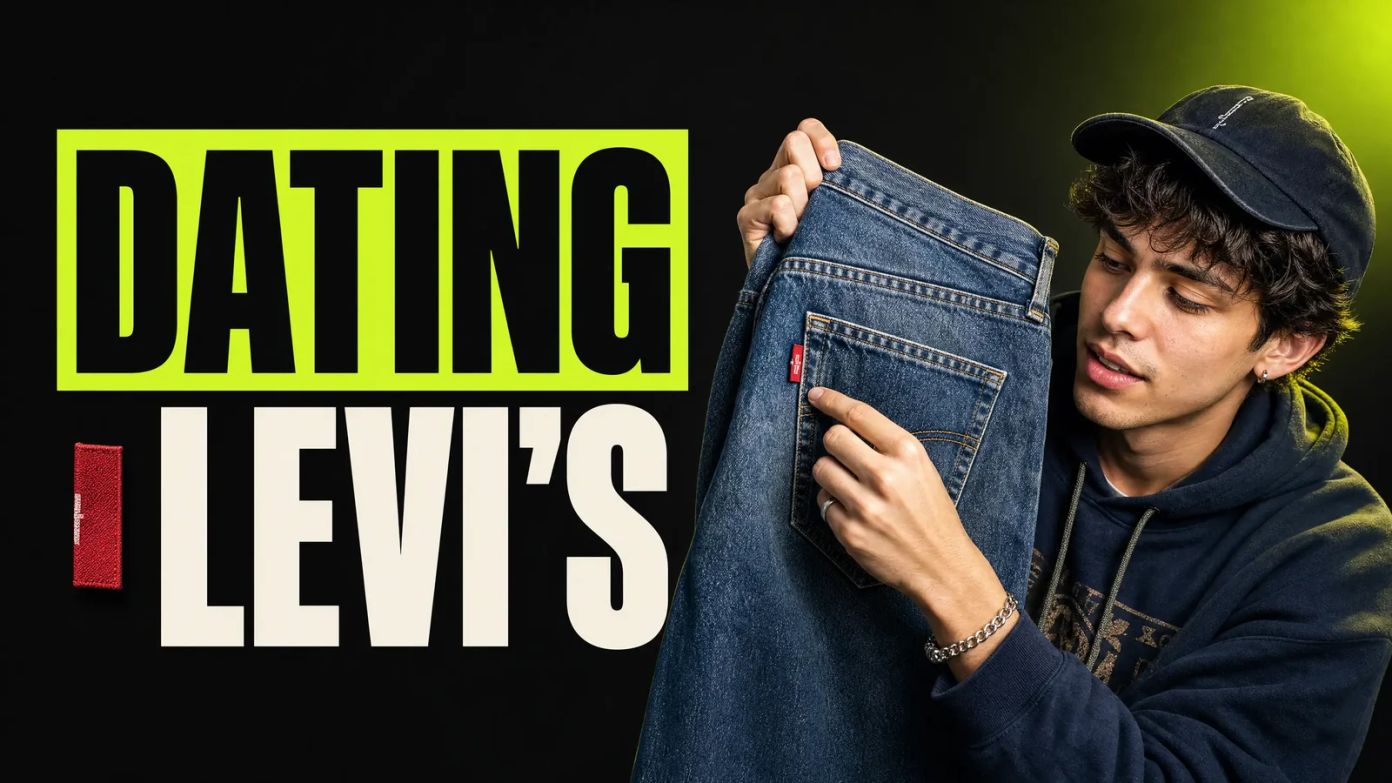
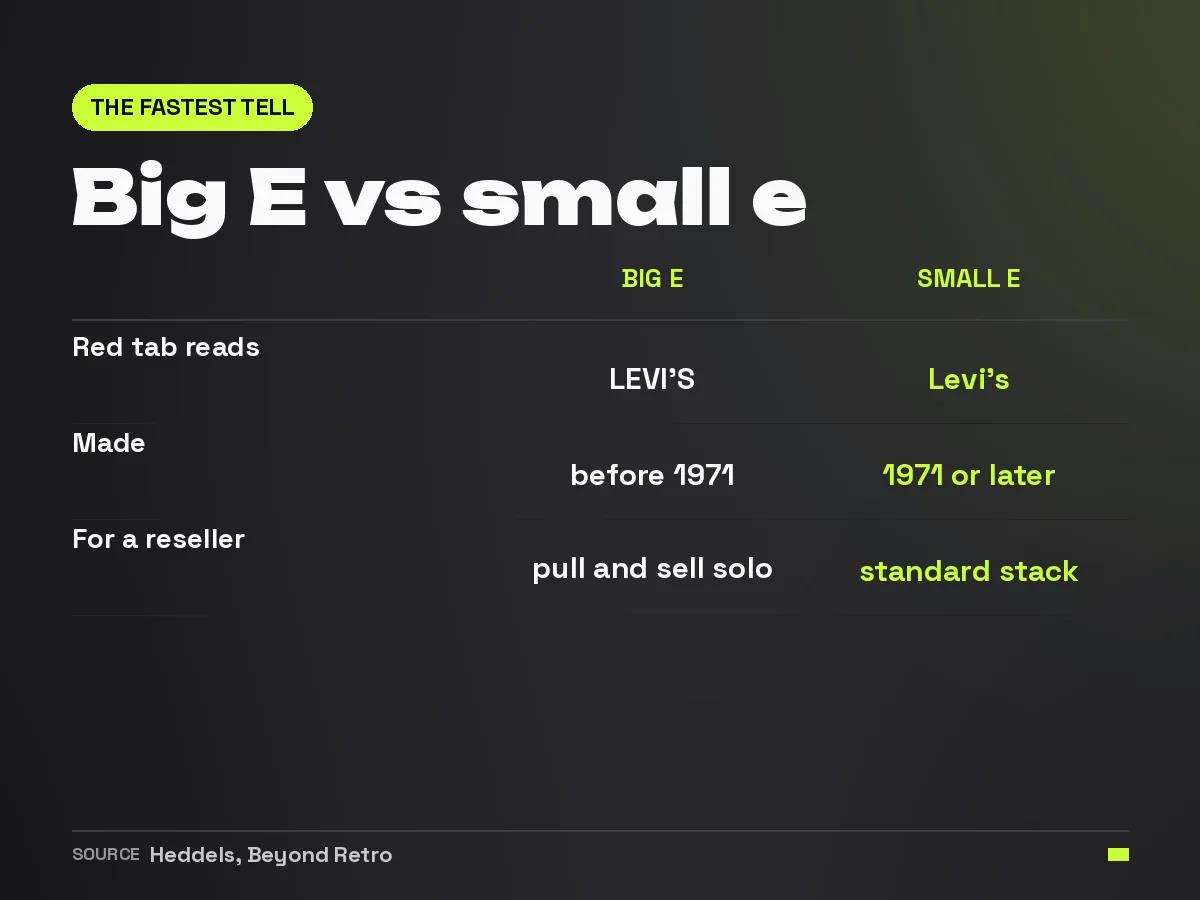
A pair of jeans lands on the sorting table in Bovenkarspel. Before Patrick even reads the brand, his eye goes to one thing: the small red tab on the back pocket. If it says LEVI'S with a capital E, the pair gets set aside. If it says Levi's with a lowercase e, it goes in the regular stack. That call takes him less than a second — and it is exactly the distinction this guide is built around.
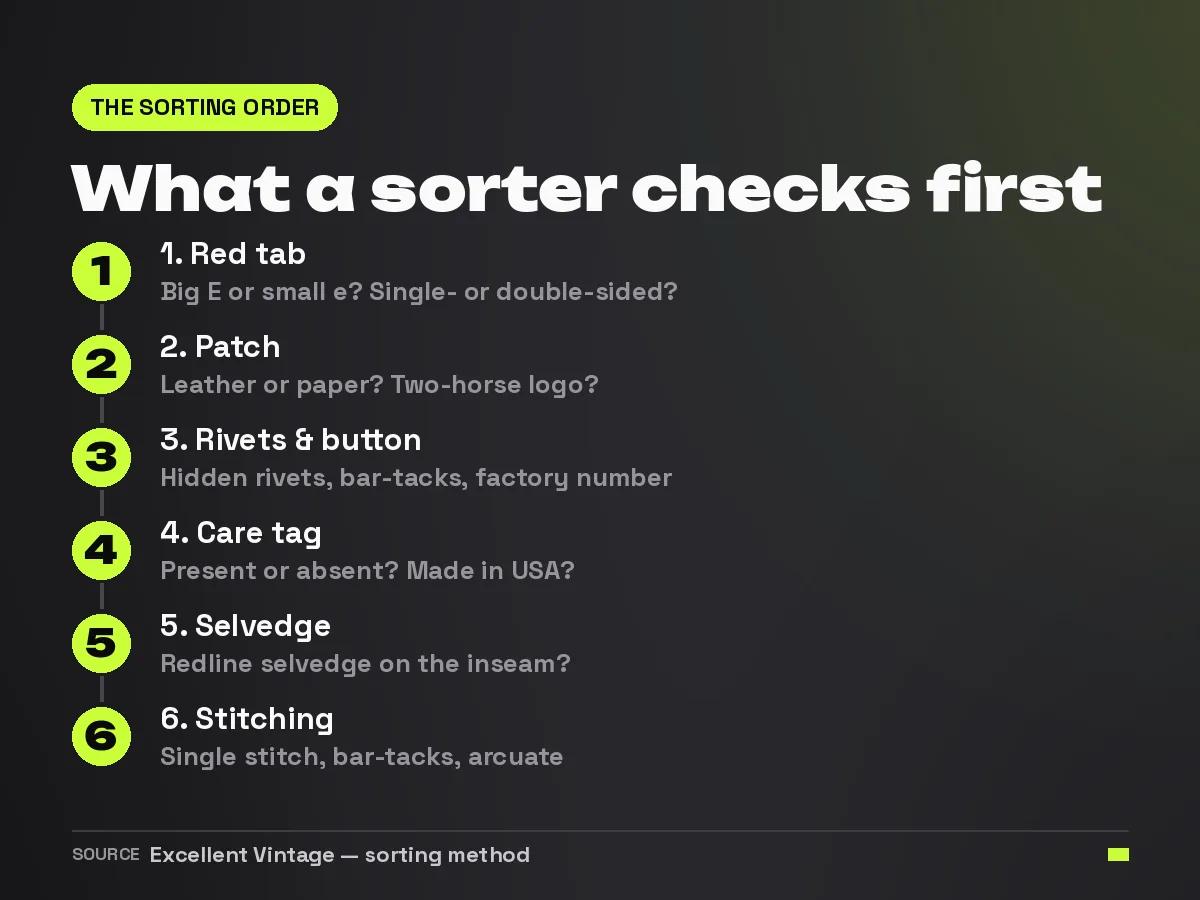
We have been moving 15 to 20 tonnes of clothing a month through this warehouse since 2012. A large share of it is denim, and Levi's is the brand that crosses the table most often. You learn quickly that dating a pair of Levi's is not one clever trick but a short sequence of signals you read in the right order. This piece hands you that order — not the way an auction house would authenticate a rare pair, but the way someone who runs hundreds of jeans through their hands every week actually works.
One rule before anything else: never date a pair from a single signal. Any one feature can mislead you, especially because Levi's itself produces reproductions under its Levi's Vintage Clothing (LVC) line that deliberately copy the Big E tab, the leather patch and the hidden rivets — while carrying a modern care label inside. Always stack several clues. That principle runs through everything below.
Why the red tab is the first thing you check
The small red tab sewn into the seam of the right back pocket is your fastest way in. Levi's introduced the Red Tab in 1936 to stand apart from competitors who were copying its back-pocket stitching. It has been there ever since, which is exactly why the way it is executed tells you which era you are looking at.
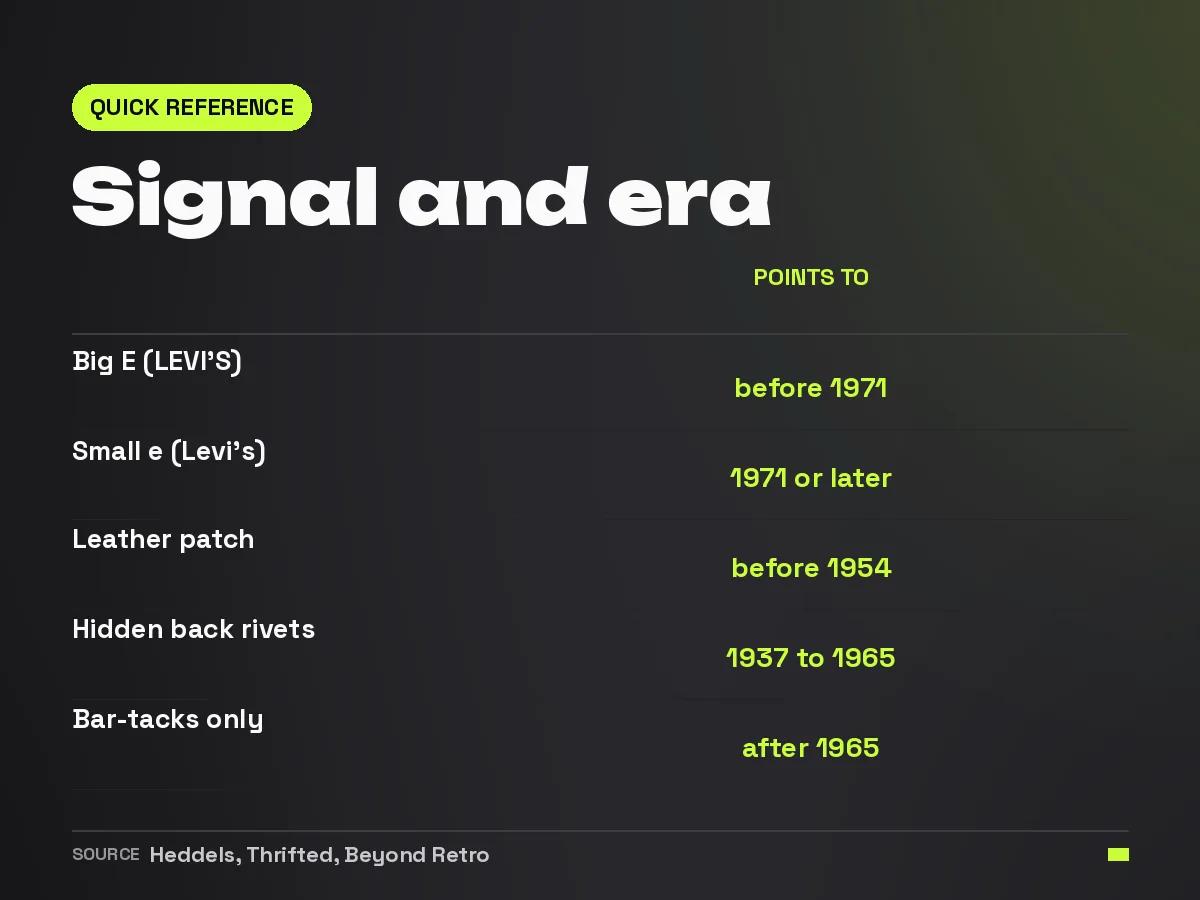
The best-known dividing line is Big E versus small e. Until 1971, the brand name was spelled entirely in capitals: LEVI'S. In 1971 the company switched to a lowercase e: Levi's. So a capital E means a pair made before 1971 — the kind collectors chase and the kind we pull aside. A small e on its own only tells you the pair is from 1971 or later; for anything more precise you need the other signals.
There is a second detail on that same tab. The earliest tabs were printed on one side only — "Levi's" appeared just on the outward-facing face. Around 1951 Levi's moved to a double-sided printed tab, adding the ® registration symbol. A tab with lettering on only one side therefore points to a pair made before the early 1950s. Put that together with a Big E and you are already in a very narrow, very old window.
Watch one trap here: roughly one tab in ten carries only the ® symbol and no name at all. Levi's has to keep producing these blank tabs to keep the trademark on the tab itself alive. A blank tab shows up across every decade and is not a dating signal — do not read it as a fake, and do not read it as a specific year. Date that pair from the care tag and the patch instead.
Not every tab is red: reading the colour
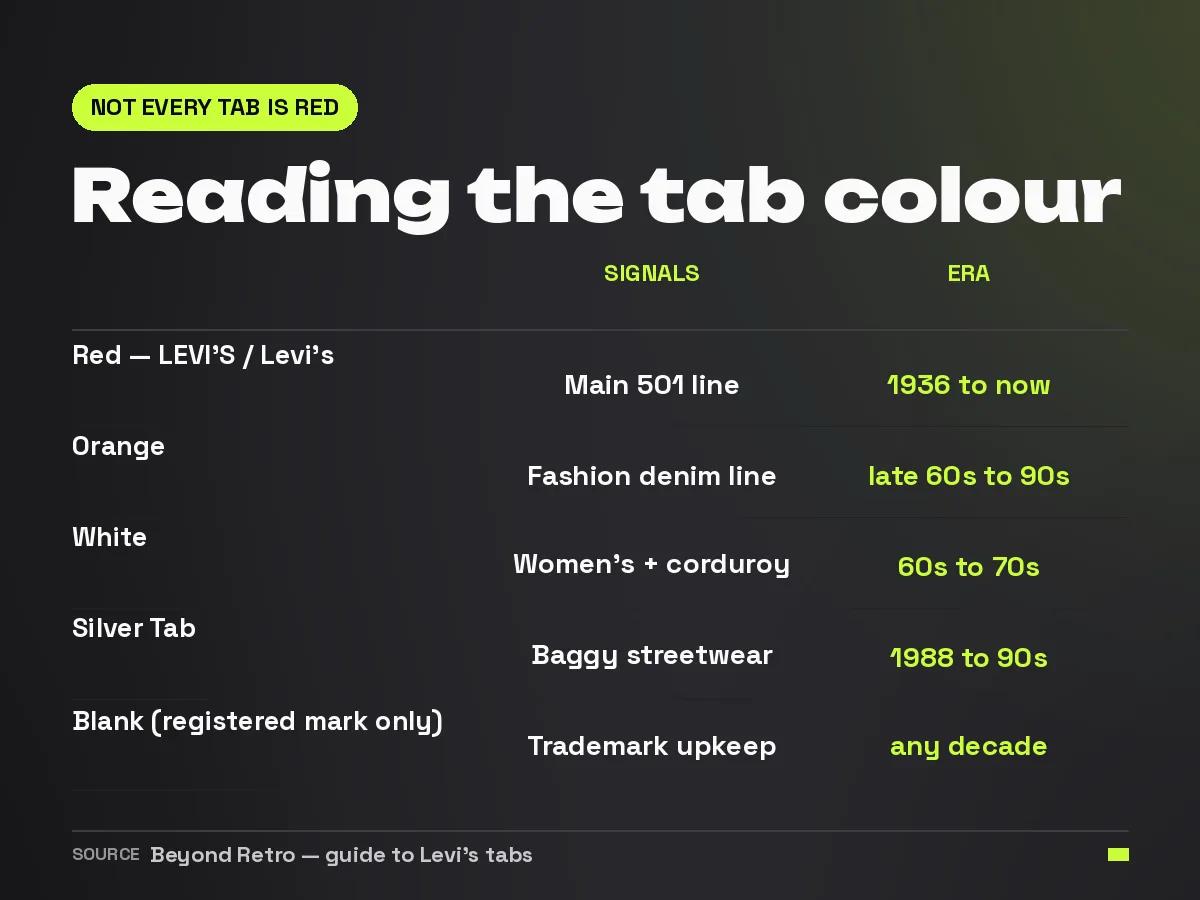
Here is where a lot of resellers slip up. The tab is not always red, and the colour is its own dating and line signal. A red tab (Big E or small e) is the main 501 line and has run from 1936 to today. An orange tab is not a faded red one — it marks Levi's fashion denim line (flares, slims, boot cuts) that ran from the late 1960s into the late 1990s, and it always carries a small e. A white tab belongs to the "Levi's For Gals" women's line and the corduroy pieces of the 1960s and 1970s. A black tab with gold lettering flags the Sta-Prest crease-resistant treatment of the 1960s. A Silver Tab is the baggy streetwear line that ran from 1988 into the late 1990s — useful to recognise now that 90s baggy is back in demand. And a pair with no tab at all is usually the entry-level Signature line sold through the likes of Walmart from the early 2000s, not vintage.
One modern caveat worth knowing at the bale: in recent years Levi's has used a Big E on some Eastern-European production, so a Big E on its own no longer guarantees a pre-1971 pair. This is the whole reason you cross-check the tab against the care label — a point we come back to below.
What the waistband patch tells you
Above the right back pocket sits the patch — the label with the two-horse logo of a pair of jeans being pulled apart between two horses. Its material is a strong signal. A genuine leather patch points to a pair made before 1954. After that, Levi's moved to a Jacron patch made of card or paper that looks like leather but is not, and that material carried through into the 1980s. So if you feel stiff, thick leather, you are holding something old; if you feel smooth card, you are in the post-mid-50s era at the earliest.
The wording on the patch narrows things further. The line "Every Garment Guaranteed" was dropped around 1963, so its presence points to an earlier pair. "501XX" printed in large black capitals belongs to the pre-1966/68 period; a small "501xx" with a gap between the 501 and the xx sits around 1986–1991; a continuous "501xx" with the xx in bold red runs 1991–1993, and the same in black runs through to 2002. Between 1968 and 1971 the patch often reads "CARE INSTRUCTIONS INSIDE GARMENT", a neat little window in its own right.
There is a construction tell too. On a pre-1969/70 pair the patch is sewn right up against the right belt loop with no gap; from the early 1970s it sits with a small space before the loop and a detachable section on the right. And on the very oldest pairs — a cloth patch reading "guaranteed", no belt loops and a cinch strap at the back — you are looking at the pre-1922 "buckle-back" era. That is museum material. If one turns up in a bale, set the pair aside and call someone.
Rivets, bar-tacks and the button
Turn the pair over and look at the back pockets. On the earliest models there were rivets in the corners. From 1937 those were hidden beneath the fabric ("hidden rivets") because the exposed ones scratched furniture and school benches. Around 1964–65 they disappeared altogether, replaced by a reinforced bar-tack stitch — the black bar-tack you see on the vast majority of pairs that come through here. So exposed back rivets point to before 1937, hidden rivets to roughly 1937–1965, and bar-tacks only to after that. For most bales it simply means: no visible rivets at the back, so post-war.
There is a wartime tell hiding near the crotch. On the S501XX made under WWII rationing (1942–1947), the crotch rivet was removed to save metal, then reinstated afterward. Combine a missing crotch rivet with a painted-on arcuate and you have a genuine wartime pair.
The top button helps too. Many 501s carry a stamped number or letter on the reverse of the top button that encodes the factory: "555", for instance, is generally identified as the Valencia Street plant in San Francisco, the last on US soil, which closed in 2002. Full code catalogues are not something we can point you to as a single verified list, so treat the button number as a confirmation of the rest — not a standalone build year.
Does the care tag reveal the age?
Yes, and it is one of the most reliable signals you have — precisely because it rests on law. In the United States, the Federal Trade Commission's Care Labeling Rule has been in force since 1971, requiring garments to carry a sewn-in care label with washing instructions and fibre content. So the rule of thumb is simple: no sewn-in care label at all points to a pair from before 1971. Before that, wash instructions were usually printed on the right pocket bag instead, and the 1968–71 patch even told you the "care instructions" were inside the garment.
Once the label arrives, the small print keeps dating the pair. An early-70s label carries the code "SF 207" at the top. A label that says the denim "shrinks approximately 8%" sits roughly 1971–1981; "shrinks approximately 10%" moves you to about 1981–1985. A red batwing logo on the care label points to after 1986, and the phrase "Care on Reverse" to 1987–1991. From 1991 to 2002 the wash instructions moved to the front of the label alongside a bold "501xx" on the patch. None of these are exact to the year, but stacked together they narrow a pair to a handful of seasons.
The care tag also tells you where the pair was made. Made in USA skews older; the bulk of Levi's production moved overseas over time, broadly around the early 2000s. We keep that as a trend rather than a hard year, because American production continued longer for some premium lines. And here the LVC trap comes back one more time: a reproduction from the modern Levi's Vintage Clothing line can carry a Big E tab and a leather patch, but the fresh, barcoded, recent-country-code care label gives it away. Old exterior plus a modern wash tag usually means a repro, not an original.
Reading the denim itself: selvedge, thread and stitching
Some of the best tells are in the fabric, not on a label. Look at the inside of the outseam. A self-finished edge with a red thread — the famous "redline selvedge" — from the Cone Mills denim became standard on the 501 in 1927 and ran until the early 1980s, so redline is a strong sign of a pre-1985 pair. When Levi's phased selvedge out, an orange overlock stitch replaced it around 1981–1984, then a white overlock from about 1984 to 1993. So a plain overlocked outseam in orange or white is itself a rough date stamp.
Thread colour is a quieter signal that experienced sorters lean on. A lemon-yellow thread on the arcuates, pocket bags, belt loops and hem chainstitch is characteristic of the 1940s–1960s; it drifted toward a copper-orange through the 1970s and disappeared by the end of that decade. The arcuate — the double-arc stitch on the back pockets — carries a small "diamond" where the two needles cross from 1947 onward; during WWII it was sometimes painted on rather than stitched, and often worn away entirely. A short single-needle V-stitch at the top of the fly points to before 1969, after which a chainstitch took over. And a small selvedge detail inside the coin (watch) pocket points to before roughly 1966.
Plenty of myths circulate about stitching, so be careful. What is well supported: on post-1971 pairs, single-stitched back pockets point to roughly 1971–1978 and double stitching to after 1978. The often-repeated claim that chain stitching "only appeared in 1987" is wrong — the chainstitched hem long predates it. The lot number, finally, gives you the style rather than the exact year: the 501 is the original button-fly straight, and other lot numbers denote other cuts.
Why a wholesaler teaches you brands faster than a single pair
The point of all this is not to turn every pair into a museum piece. For a reseller, speed is what counts: can you tell in five seconds whether this is a 1990s bulk pair or a Big E worth pulling and selling on its own? You only build that reflex through volume. Anyone who visits and runs bales of Levi's and other denim brands through their hands develops that eye far faster than someone examining one pair at a time at home.
The same goes for the wider sourcing question. If you want to understand how brand bales, grades and the by-the-kilo versus by-the-piece model fit together, read our complete guide to vintage wholesale in the Netherlands. And if you want to know how we sort a bale by quality — what grade A, B and C actually mean — our grading explainer walks through it step by step. Dating and grading go hand in hand: an old Big E in grade A is a very different story from the same pair with a hole in it.
Know what your brands fetch on Vinted and Depop For resellers we track live market data on what vintage clothing actually resells for on Vinted, Depop and closed eBay listings. Message Patrick and we will look at the brands you sell together. Talk through your brands with Patrick on WhatsApp
Frequently asked questions about dating Levi's
What year are my Levi's from? No single feature gives it away in one go. Run the signals in order — red tab (Big E or small e), patch (leather or card), rivets and button, care tag, selvedge — and let them point together to one era. Two confirming signals are more reliable than one striking detail.
Are Big E Levi's worth more than small e? Usually, yes. A Big E tab means production before 1971 and is sought after by collectors, while a small e simply indicates 1971 or later. But the condition of the pair (its grade) and the model weigh at least as heavily in the value, and a Big E on modern Eastern-European production is not the same thing at all — always confirm with the care label.
My Levi's have no care tag — how old does that make them? The absence of a sewn-in care label usually points to a pair made before 1971, because the US Care Labeling Rule of that year made the label mandatory. On older pairs the wash instructions were printed on the pocket bag instead. Cross-check against the tab and the patch, since labels can also have been cut out.
What does the number on the back of the top button mean? It encodes the factory — "555", for example, is generally identified as the Valencia Street plant that closed in 2002. It is a useful confirmation, but there is no single verified public catalogue of every code, so do not invent a build year from the number alone.
How do I tell an original vintage pair from a Levi's Vintage Clothing reproduction? An LVC repro copies old features (Big E, leather patch, hidden rivets) but carries a modern, barcoded care label. Always combine the look with the label: old exterior plus a fresh modern wash tag usually means a reproduction.
What does an orange tab on Levi's mean? An orange tab is not a faded red one. It marks Levi's fashion denim line — flares, slims and boot cuts — that ran from the late 1960s into the late 1990s, and it always carries a small e. A silver tab, by contrast, is the baggy streetwear line from 1988 onward.
Are hidden rivets and bar-tacks a dating signal? Yes. Hidden rivets on the back pockets broadly belong to 1937–1965; after that Levi's replaced them with bar-tack stitching. Exposed rivets at the back point to the pre-war period — which you rarely come across in a modern bale.
Excellent Vintage has been a vintage clothing wholesaler in Bovenkarspel since 2012. Patrick, with 32 years in the trade, welcomes every visitor personally and sorts tonnes of denim each week. Want to train your own eye for brands and eras at the bale? Book a warehouse visit or read more about us.
Ready to buy?
Visit our warehouse · no deposit required · free cancellation.