Vintage Wholesale Clothing in the Netherlands: The Complete Guide (2026)
A vintage wholesale clothing supplier in the Netherlands sells secondhand clothing in bulk to resellers and shops, by the bale or bag rather than by the piece. You buy by weight or by a fixed count,…
By Patrick Libanon — founder, Excellent Vintage · Bovenkarspel, since 2012
A vintage wholesale clothing supplier in the Netherlands sells secondhand clothing in bulk to resellers and shops, by the bale or bag rather than by the piece. You buy by weight or by a fixed count, pay as a business with VAT reverse-charged within the EU, and price depends on brand, grade and season.
That is the short answer. The trouble is that the short answer is exactly what trips up serious buyers. Most guides to "vintage wholesale" are written by people who have never unloaded a container. They talk about "treasure hunting in bales" and "free shipping over €150" as if that were the heart of the trade. It is not.
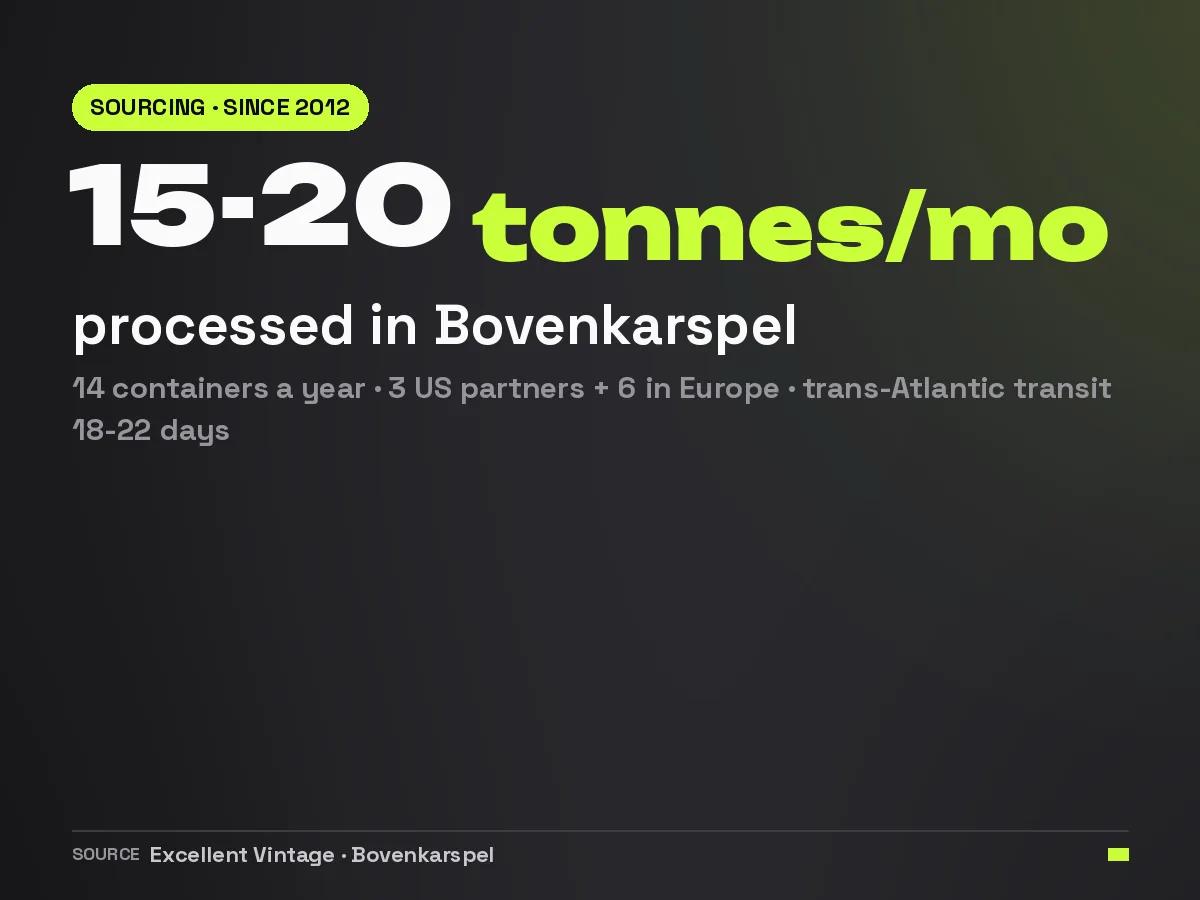
This guide is different. It comes from a 2,500 m² warehouse in Bovenkarspel, where Patrick has sorted and resold 15 to 20 tonnes of secondhand clothing every month since 2012, supplying resellers across Europe. No marketing story: how it actually works, where the margin sits, and why the most important decision you make is not "which bale" but "which wholesaler". We walk the whole chain, from the American port to your Vinted shop, and at each step we point you to a deeper article if you want to read on.
What a vintage clothing wholesaler actually is
A secondhand clothing wholesaler sits between two worlds. On one side is collection: containers of worn clothing gathered worldwide, sorted and pressed. On the other is the reseller, the person who finally sells the garment to an end customer on Vinted, Depop, Whatnot or in a physical shop. The wholesaler buys big, adds value by sorting and grading, and sells on in quantities a reseller can actually handle.
The difference from an ordinary clothing shop is fundamental. A shop sells single pieces to consumers. A wholesaler sells by the bale or bag to businesses, B2B. That means a minimum order, business payment, and in nearly all cases a registered company number. It also means you are not coming to "shop" the way you would in a thrift store. You are coming to stock up.
At a professional vintage wholesale clothing operation, everything turns on predictability at scale. Not "is this one jacket nice", but "is the composition of these 200 shirts right, and can I resell them at a margin". That is a different way of thinking, and it is exactly the shift on which beginner resellers most often stumble.
Why source vintage wholesale from the Netherlands
If you are a reseller in Germany, Denmark or elsewhere in the EU, sourcing from the Netherlands has a specific logic that goes beyond proximity. The country sits at a logistics crossroads, with major sea ports nearby and established trans-Atlantic supply lines. For a buyer inside the EU, that matters in a concrete way: there are no intra-EU customs duties, so a bale leaving Bovenkarspel for Berlin or Copenhagen crosses no tariff border.
There is also a depth-of-supply argument. A wholesaler that has been running monthly containers since 2012 has a stable inflow, not a one-off batch. For a reseller who needs to restock the same category every month, a stable source beats a cheaper but unrepeatable one every time. You build a brand on repetition, and repetition needs a supplier who can deliver the same thing again next month.
Finally there is the human factor, which is easy to underrate until you have been burned by a faceless seller. Here you deal with Patrick directly, in English, Dutch or French, with 32 years in the trade. No chatbot, no ticket system, a reply within an hour on weekdays. For a cross-border purchase where you cannot pop in casually, knowing exactly who you are talking to is worth a great deal.
The chain behind the bale: where your clothing comes from
Before a bale lands on your floor, it has travelled for weeks or months. Understanding that chain is not trivia. It explains why prices move, why stock differs from month to month, and why "always everything in stock" is a promise no honest wholesaler can keep.
It starts at the source. Excellent Vintage runs fourteen containers a year, each between eight and fourteen tonnes, on a monthly cadence. They come from three American partners (East, South and West) and six European partners (the Netherlands, Germany, the UK, France, Italy and Spain). The spread is deliberate: American clothing has a different character from European, and different climates yield different garments. A southern state sends more light clothing, a northern one more coats and heavy sweaters.
A trans-Atlantic container spends eighteen to twenty-two days at sea. After that it is another three to five weeks from port to warehouse, with customs clearance, transport and internal processing. Add it up and you see why stock breathes. What arrives this month was bought months ago, and the season in which it was collected shapes what is inside.
That monthly inflow of 15 to 20 tonnes is then sorted in Bovenkarspel. That is the real work of a wholesaler: not buying, but sorting. And sorting is precisely where the value is added.
The four formats: how big is your lot?
Secondhand clothing is not sold as one block. There are formats, and the format that fits you depends entirely on your sales channel and your budget. In practice we work with four.
The half-bag of 12.5 kg is the smallest serious entry point, ideal for testing a brand or category without going big straight away. The bag of 25 kg is the workhorse for most niche resellers. The bale of 45 kg is the volume format: one brand or category at scale. And the curon of 50 kg in carton is the largest unit, for those who want a lot of volume at once.
The weight tells you something about how many pieces you get, but that depends heavily on the category. Twenty-five kilos of t-shirts is a very different thing from twenty-five kilos of jeans. Exactly how much a bale costs, and how format, grade and category combine to set the price, we have worked out separately in how much a vintage clothing bale costs in the Netherlands. Here we keep it to the principle: choose your format by how much volume you can handle, not by what looks cheapest per kilo.
By weight or by piece: the difference that makes your margin
Here is the first real insider point, because almost no one explains it properly. Bales are sold in two ways, and anyone who confuses them calculates themselves rich or poor.
Part of the range is sold by weight: you buy around 45 kg and the piece count follows from the category. Another part is sold by the piece: you buy a fixed number of garments, and the weight is then not exactly 45 kg. Think a hundred Ralph Lauren shorts, a hundred Tommy sweaters, or two hundred Ralph Lauren shirts. That count is the honest figure, and you should not run kilo maths on it.
The classic slip: someone sees "200 Ralph Lauren shirts" and thinks "45 kg divided by the weight of a shirt, that does not add up". But a by-piece bale is not a weight bale. Two hundred means two hundred. Convert it to kilos and you land wrong, taking a decision on a number that does not exist. When in doubt about a specific product, one rule applies: ask, do not calculate.
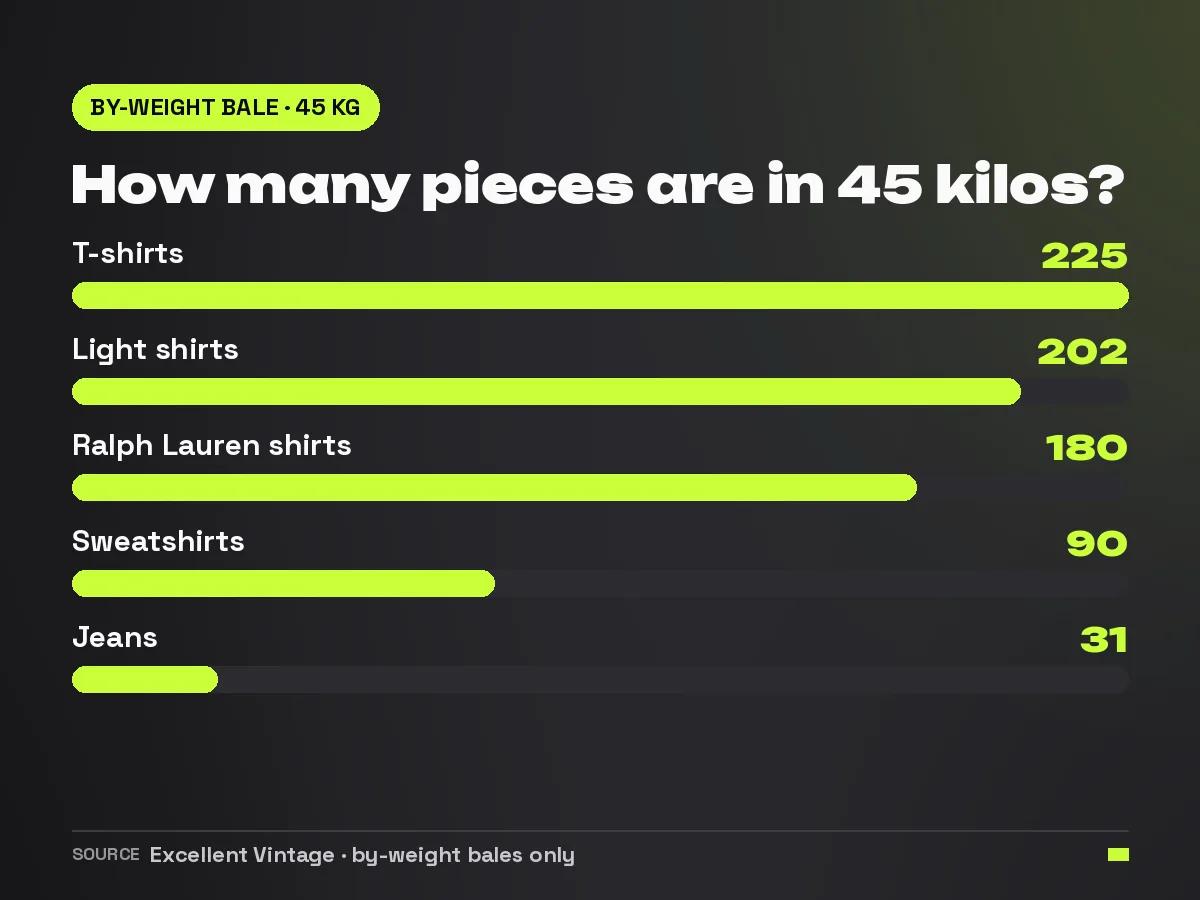
For a by-weight bale the conversion is useful, purely to picture the volume. The category changes everything: the same 45 kg yields a mountain of t-shirts or a handful of jeans.
Grade A, B and C: the language of quality
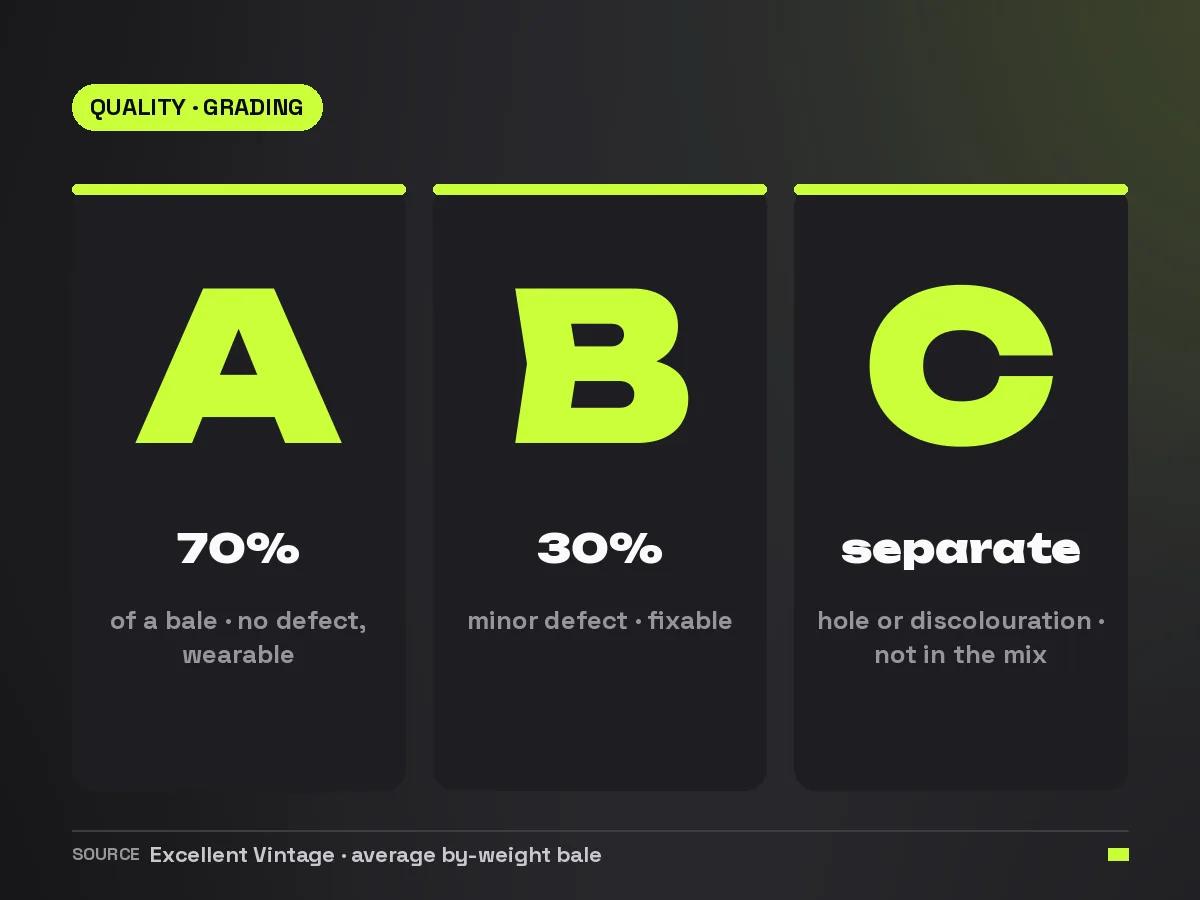
If sourcing is the skeleton of the wholesale trade, grading is its nervous system. A grade describes the condition of a garment. Grade A is a piece with no defect, wearable and immediately sellable. Grade B has a minor defect: light wear, a missing button, something a handy reseller fixes or states honestly in the listing. Grade C has a more serious problem, a hole or bleach discolouration, and is kept separate, not buried in the mix.
The crucial point honest wholesalers name and the rest stay quiet about: there is no universal standard for grades. What one supplier calls A, another files under B. That is why the composition a wholesaler dares to guarantee matters more than the label on the bale. At Excellent Vintage a by-weight bale averages 70 percent grade A and 30 percent grade B. A 25 kg "mix premium US" bag sits higher, around 90 percent A and 10 percent B. That transparency is not a detail, it is the whole difference between a gamble and a calculation.
We have set out the three grades and what they mean for your sales in a dedicated piece on what grade A, B and C actually mean. The short version for this guide: ask every wholesaler for the guaranteed A/B ratio, and distrust anyone who uses the label without daring to state the composition.
Raw mix versus pre-sorted: what you are really paying for
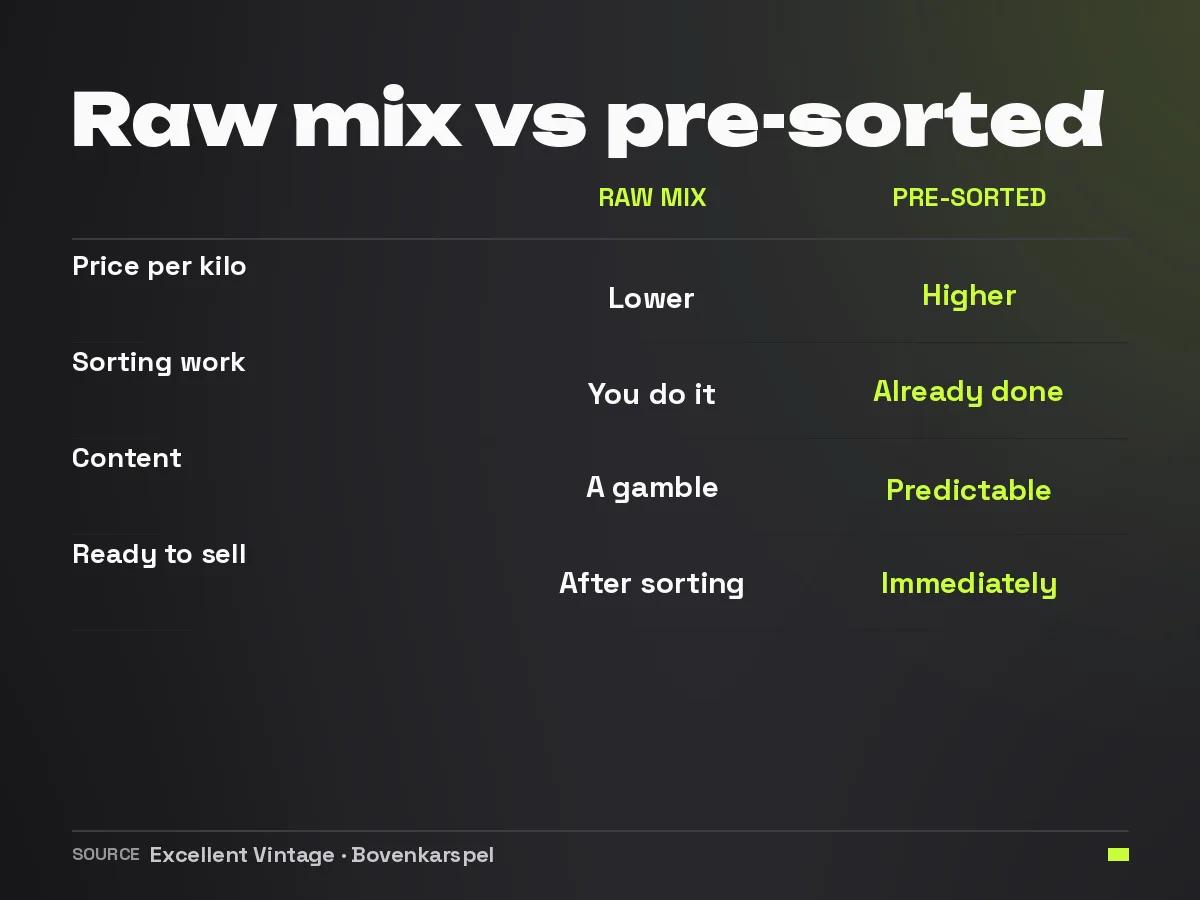
Beyond format and grade there is a third axis, and it is the one most often overlooked: how ordered is the content? At one end sits the raw mix, a lot in the state it arrived, not yet picked through. At the other sits pre-sorted clothing, selected before packing by brand, category and grade.
The difference is not a matter of taste, it is a sum about your time. A raw mix is cheaper per kilo, simply because you take over the sorting work. You open the bale, judge every piece, throw away what is not sellable, and keep what earns a margin. Pre-sorted costs more per kilo, but that work is already done, and you know in advance what you get. At Excellent Vintage the raw mix is not the default: we work pre-sorted, because a reseller who pours hours into sorting pours no hours into selling.
The confusion around "heavy bales" comes from here. People think "heavy bale" stands opposite "sorted", as if it were a choice between two products. It is not. A heavy bale is a large, heavy lot, and that lot can be raw or sorted. They are two separate axes, not opposites. Anyone who wants that distinction sharp should read our piece on the real difference between heavy bales and sorted clothing.
The sorting process: where the value is added
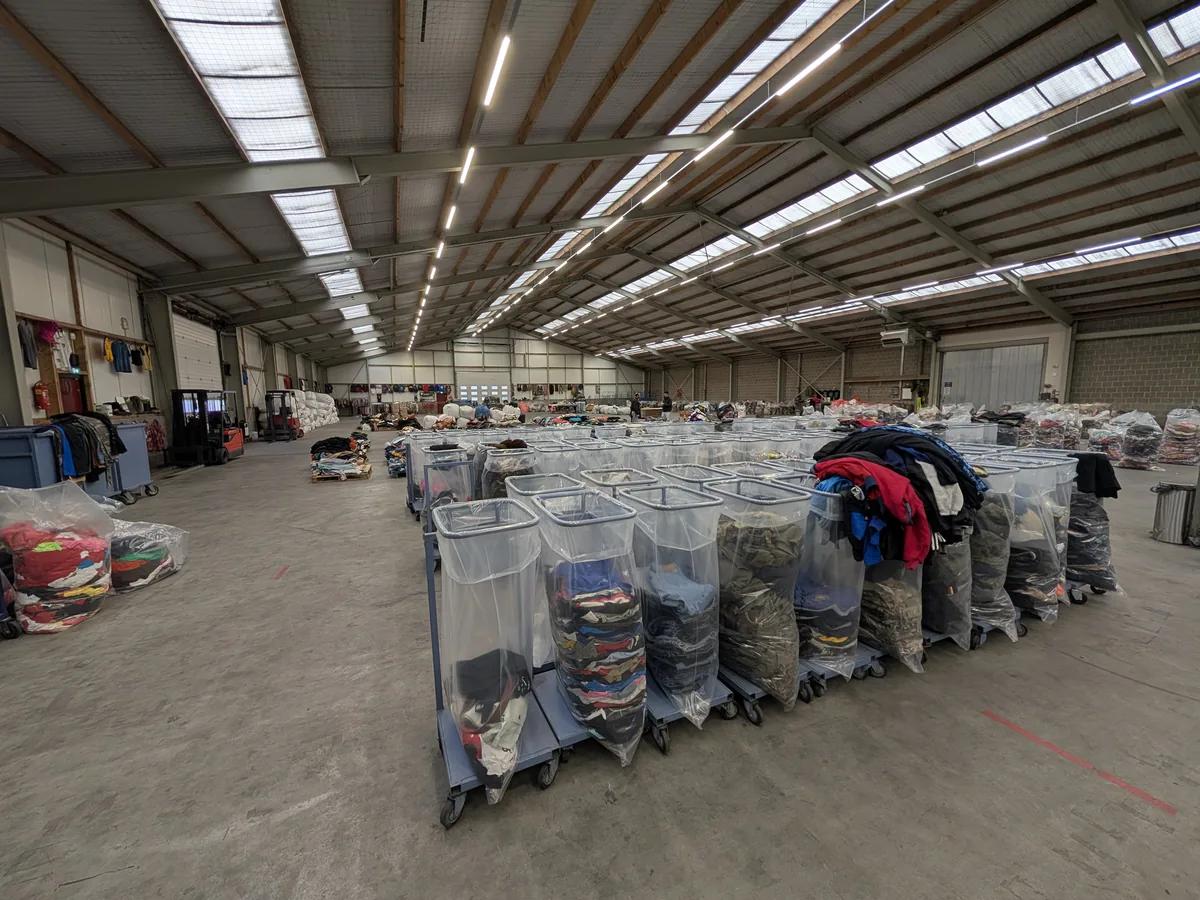
It is tempting to think a wholesaler mainly buys and resells. The real labour sits in between. When a container of eight to fourteen tonnes is unloaded, it is an unordered mass: every brand, category, grade and season jumbled together, just as it was gathered at the source. Turning that into a predictable product is human work, and it is exactly what separates a good wholesaler from a middleman who pushes bales on unseen.
Sorting happens in layers. First coarse, by category and brand: jeans with jeans, Carhartt with Carhartt. Then finer, by grade and by sellability per channel. An experienced sorter can tell in a fraction of a second whether a Ralph Lauren shirt is grade A or B, and whether a Nike piece comes from a wanted line or from the bulk. You do not build that eye in a month. Patrick has been doing it for 32 years, and those years are the difference between a bale that is called "Carhartt" and a bale that actually holds the Carhartt that moves on Whatnot.
That also explains why pre-sorted clothing costs more and is worth the premium. You are not paying for air, you are paying for hours of specialised labour that would otherwise have ended up on your floor. And it explains why no two bales are identical: the inflow differs per container, so the composition is an average over time, not a guarantee per piece. An honest wholesaler communicates that average transparently instead of promising a perfection that does not exist in secondhand clothing.
The handpick myth: why you do not pick pieces at scale
Open the search results for "vintage wholesale" and you see it everywhere: "handpicked", "selected piece by piece", "no minimum". It sounds appealing, and for a hobbyist selling twenty pieces a month a handpick box can work fine. But do not confuse it with wholesale at scale.
The reality is simple: at 15 to 20 tonnes a month you cannot handpick piece by piece. It is physically impossible, and any wholesaler claiming you select individual garments at real wholesale volumes is selling you a story or operating at a scale that is not volume. On the bale floor you choose which bales and bags fit you, not which individual shirts. That is not a limitation, it is the essence of the model. It is exactly why the price per piece is low enough to leave a margin.
There is an honest trade-off to make up front. If you want every piece in hand before you buy, you look for a handpick supplier and accept a higher price per piece and smaller volumes. If you want to scale seriously, you buy by the bale and accept that you trust composition rather than individual selection. A good wholesaler makes that trust real with transparent grading and a predictable A/B ratio, not with the illusion that you picked 200 pieces one by one.
Pricing: why an honest wholesaler has no fixed price list
The most asked question is also the hardest to answer honestly: what does it cost? The candid answer is that there is no fixed price per kilo or per category, and anyone who slaps one on is oversimplifying.
The reason is the stock itself. A wholesaler holds hundreds of categories, each priced on season and the balance between supply and demand. A bale of Carhartt in September is a different story from the same bale in March. Nike Tech moves differently from Burberry. Putting one number on that would mislead you, and a misled reseller comes once and never returns.
What we can be transparent about is how the price is formed. Brand, grade, format and season together set what a lot costs, and we have opened up that mechanism fully in how much a vintage clothing bale costs in the Netherlands. For a current price on your brand and category, the rule is: send it over and you get a real quote back instead of a marketing figure.
Curious what your brand costs right now? Send Patrick your brand and sales channel and get a current quote based on the season. Reply within 1 hour, Mon-Fri. WhatsApp Patrick →
VAT reverse charge: how the business side works
Buying from a wholesaler is a business transaction, and that brings one important tax mechanism that surprises many beginner resellers: the VAT reverse charge. If you buy as a business with a valid company registration and a valid EU VAT number, VAT is reverse-charged within the EU. You pay the supplier the amount excluding VAT and account for the tax yourself in your own return. All four markets we supply sit inside the EU, so there is no question of intra-EU customs duties.
That is the general principle, and it helps your cash flow: you do not have to pre-finance the VAT. But tax rules are precise, and your situation may differ. Anything beyond this basic principle, your specific return, a different legal form, a cross-border construction, belongs with your accountant, not in a blog. We do not invent tax advice. Payment is by SEPA transfer, debit or credit card without surcharge, or cash on site, all excluding VAT.
One last practical point: clothing is sold as it lies on the floor. There are no returns unless agreed in writing, and any complaint must reach us in writing within 48 hours of receipt. That is not fine-print trickery, it is the norm in a trade where you buy what you see. Which is exactly why it is so valuable to come by before you buy.
The warehouse visit: why you do not buy blind
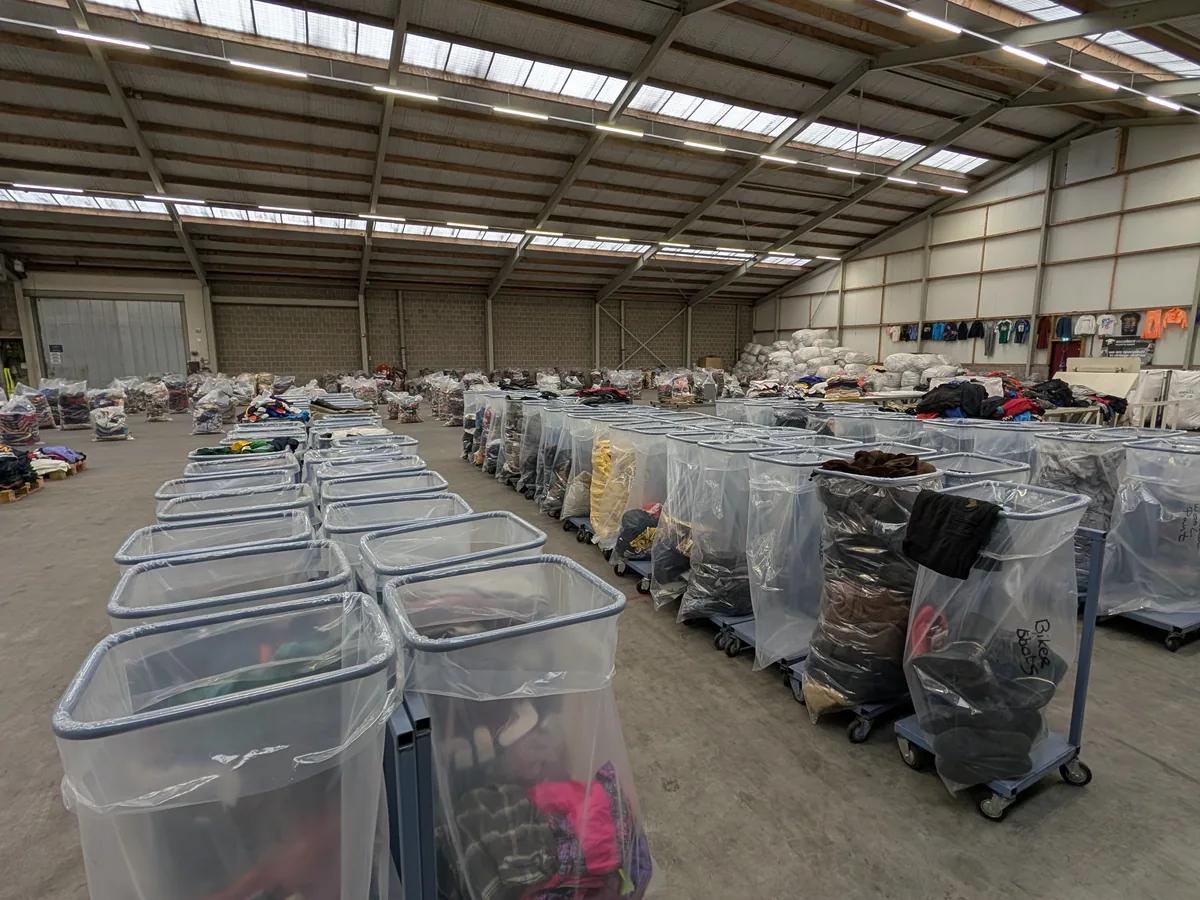
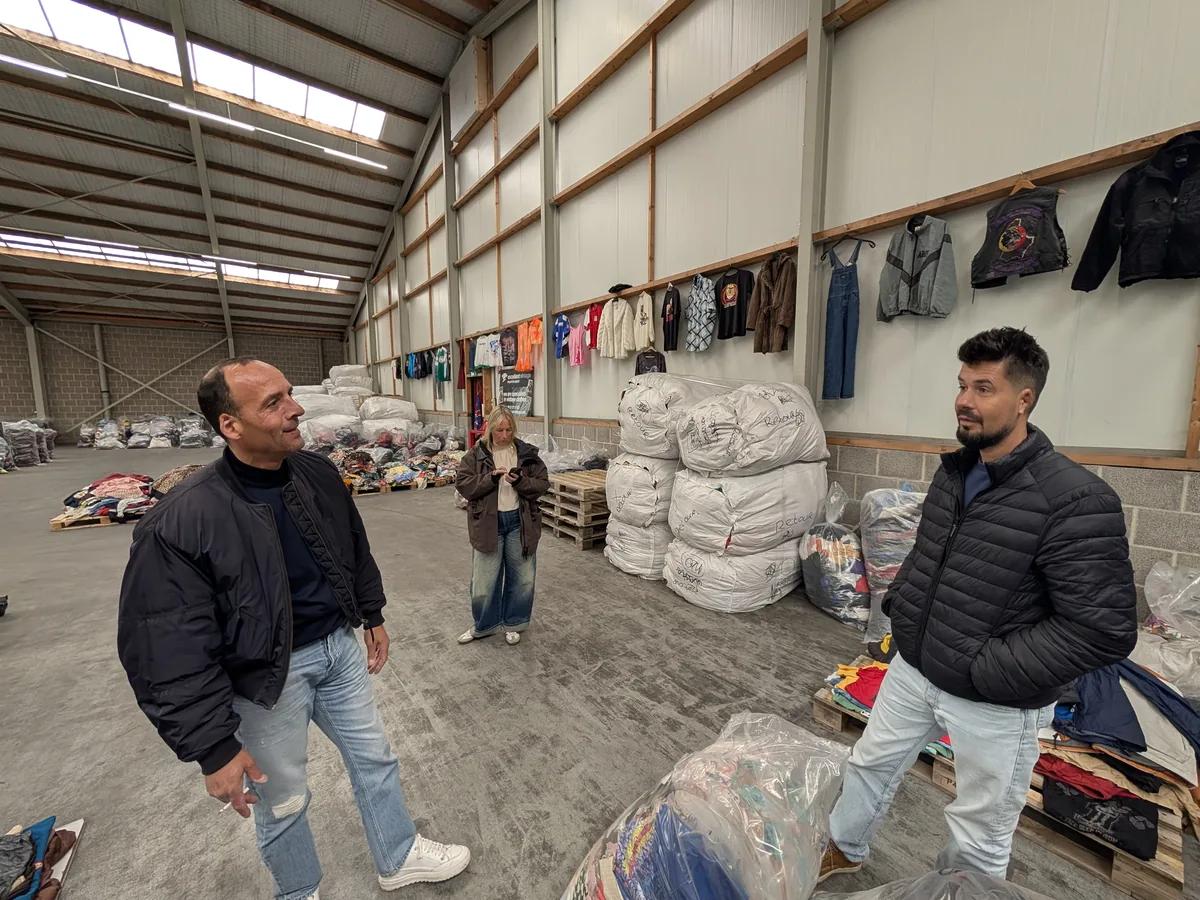
The difference between a wholesaler you trust and a gamble online comes down to one thing: you can come by. At Excellent Vintage it works by appointment, and that is a deliberate choice, not a barrier. An appointment means Patrick can prepare the stock around your brand and channel, and that you stand on the bale floor for two hours exclusively, not shoulder to shoulder with three other resellers picking through the same stacks.
Such a visit lasts two hours, with a maximum of four people, and parking is free. The bales stand sorted by brand and grade before you arrive, so you spend your time choosing which bales fit, not searching. Bovenkarspel is forty-five minutes by car from Amsterdam, and sixty minutes by direct NS train to Bovenkarspel-Grootebroek station. For foreign buyers, that makes a day trip from Amsterdam entirely realistic. For a day on which you take on hundreds or thousands of pieces of stock, that is a small investment.
The booking itself is set up without friction, precisely because a serious reseller has no patience for hassle. No deposit is required, you can cancel free of charge up to 24 hours before, and Patrick calls you the day before to align on the visit. The floor is open on weekdays from 9:00 to 17:00. What exactly to expect from such a day, from arrival to loading your car, we describe step by step in what to expect when you visit the warehouse.
Come and see the stock in Bovenkarspel Reserve two hours exclusively on the bale floor, sorted by brand and grade. No deposit, free cancellation up to 24 hours before. Book a warehouse visit →
Buying your first bale: from doubt to order
For anyone who has never bought wholesale, that first purchase feels large. Which brand? Which format? How much risk? The mistake almost everyone makes is either to start too small out of fear, or too big out of enthusiasm. The right first step depends on your channel and your budget, not on whatever happens to be on offer that week.
A Vinted starter testing a brand is better off with a smaller, higher-graded lot than with a large raw bale where half stays unsold. A Whatnot streamer who needs live volume benefits instead from a larger mono-brand bale. The logic is always the same: buy what fits how and where you sell. We have written out that first purchase in full, from brand choice to the moment of payment, in how to buy your first vintage clothing bale.
The single most useful piece of advice we give beginners: start with one brand you understand. Ten different brands in one bale feels like variety, but it makes your selling chaotic and you learn little from it. One brand, one channel, one learning curve. After that you scale with data instead of gut feeling.
What you can earn: the honest sum
In the end you are not buying clothing, you are buying margin. And here the honest guides part ways from the hype. "Earn €5,000 a month with vintage" is a headline, not a plan. Real margin depends on your buy price per piece, your sale price, your sell-through speed and the share that stays unsold.
The grade ratio works directly into this. With an average by-weight bale of 70 percent A and 30 percent B, your sellable stock is high, but never one hundred percent. Part of every bale costs you time or disappears. Budget for that up front and you will not be caught out. We have run the realistic margins per brand and channel in how much you can earn reselling vintage clothing, and anyone who wants to run the numbers themselves before a purchase will find them in our honest vintage bale profit calculator.
You scale not by buying more, but by buying better. The step from one-off purchases to a predictable monthly turnover we have described as a roadmap in how to grow from €1,000 to €3,000 a month. The thread running through it: know your numbers, repeat what works, and buy from a wholesaler who can supply you the same stock again.
Choosing a wholesaler: what really matters
We said it at the start: your most important decision is not which bale, but which wholesaler. A good supplier is a partner who delivers the same quality month after month; a bad one is a one-off gamble that pollutes your stock and damages your reputation with buyers. So what do you look for?
Look first at transparency about grading. Does the wholesaler dare to name a concrete A/B ratio and put it in writing? Or does it stay at vague labels? Look at the option to visit. A supplier that never lets you in has something to hide or works at a scale that cannot take the scrutiny. Look at who you deal with. At Excellent Vintage that is Patrick himself, with 32 years in the trade, no chatbot and no ticket system. He speaks Dutch, English and French, and replies within an hour on weekdays.
Look finally at repeatability. Can the wholesaler supply you the same category again next month? A reseller builds a brand on repetition, and repetition needs a supplier with a steady inflow, not someone who happened to have something this month. Our whole way of working, from containers to floor, is described on the about page: since 2012, from one warehouse, with a steady monthly supply.
A concrete tool we give resellers belongs in this list too: a resale price database based on live market data from Vinted, Depop and closed eBay listings, per brand, category and grade, updated weekly. With it you buy not on feeling but on figures, because you know in advance what a piece earns on average before you pay for the bale.
The brands that carry the market
One last piece of insider context. Not every brand sells equally fast, and a wholesaler who knows the market keeps a steady core. In practice ten brands run in four groups. The heritage layer, Ralph Lauren, Tommy Hilfiger, Burberry and Barbour, always sells and reaches a broad Vinted and Depop audience. The workwear and outdoor layer, Carhartt, Levi's and Patagonia, moves fastest and turns weekly on Whatnot livestreams and in shops.
Alongside that is the sport and techwear layer, Nike (Tech, ACG, Jordan), Adidas (Originals, Y2K) and The North Face (Nuptse), with the youngest audience and the highest demand on TikTok and Whatnot. And there is a mixed pro stack, with Burberry, Polo Sport, Barbour and The North Face, that fetches a higher price per piece on Depop. The textbook example for a livestream is the Ralph Lauren Polo Bear: one sweater that stops a whole stream. Anyone who tunes their buying to this rather than to taste buys stock that moves.
Who vintage wholesale is for (and who it is not)
Not everyone who loves vintage belongs at a wholesaler, and saying that honestly saves a lot of disappointment. A wholesaler is for people who resell: the Vinted seller moving from loose finds to stock, the Depop shop building a brand, the Whatnot streamer who needs volume every week, the physical thrift store or shop filling racks, and the market trader who buys by weight. For them it is the logical next step: lower buy price per piece, in exchange for volume and a minimum order.
Who is it not for? For the consumer looking for one jacket for themselves, a wholesaler is the wrong place, that is a thrift store or vintage shop. And for the hobbyist selling a handful of pieces a month, the minimum order can be too large to process at once. That is no shame, it is a question of timing. Many resellers start small on marketplaces, learn their channel, and only move to wholesale once they notice that hunting for loose stock is holding their growth back.
The line, then, is not how much you love vintage, but whether you sell it. If you are unsure whether you are ready, that is exactly the conversation to have with a wholesaler rather than blindly ordering a bale. A good supplier will tell you honestly when a smaller format or a different starting point is wiser, because a reseller who starts too big and stalls does not come back.
Common mistakes and how to avoid them
Finally, the pitfalls. Most failed starts in vintage reselling come not from bad luck with a bale, but from a handful of predictable mistakes: buying too broad, ignoring the grade ratio, mixing up kilos and pieces, and buying from the cheapest rather than the most transparent wholesaler. We have lined up the main ones in the five mistakes new vintage resellers make.
The thread through all of them is haste. Resellers who succeed treat their first months as learning, not scoring. They buy small enough to survive mistakes, pick one brand and one channel, and build a relationship with a supplier they can call. Wholesale is not a lottery, it is a trade. And like every trade, it begins with the right people at the table.
Frequently asked questions
What is the difference between a vintage wholesaler and an ordinary secondhand shop?
A wholesaler sells in bulk, by the bale or bag, to business buyers with a company registration, while a shop sells single pieces to consumers. At a wholesaler you choose which bales fit you, not which individual garments, because picking piece by piece is impossible at scale.
Do I need a registered company to buy from a vintage wholesaler in the Netherlands?
For a business purchase with VAT reverse charge you need a valid company registration and an EU VAT number. VAT is then reverse-charged within the EU, so you pay the amount excluding VAT and account for the tax in your own return. For your exact situation, consult your accountant.
Can I see the clothing before I buy?
Yes. At Excellent Vintage you can spend two hours by appointment exclusively on the bale floor in Bovenkarspel, with stock pre-sorted by brand and grade. No deposit is required and you can cancel free of charge up to 24 hours before.
What do grade A, B and C mean?
Grade A is a garment with no defect, grade B has a minor defect, and grade C a more serious one such as a hole or discolouration. There is no universal standard, so always ask for the guaranteed A/B ratio. An average by-weight bale at Excellent Vintage is around 70 percent A and 30 percent B.
How much clothing is in a bale?
That depends on the category. A 45 kg by-weight bale holds roughly 225 t-shirts, 90 sweatshirts or 31 pairs of jeans. Some products are sold by a fixed piece count rather than by weight, such as 200 Ralph Lauren shirts; do not convert those lots to kilos.
Ready to source seriously?
Understanding a vintage wholesaler is one thing, experiencing how it works is another. The fastest way to decide whether this fits you is to come by, see the bales and discuss your brand with Patrick.
Book your warehouse visit Two hours exclusively on the bale floor in Bovenkarspel, pre-sorted by brand and grade. No deposit, free cancellation up to 24 hours before, and Patrick calls you the day before. Book a warehouse visit →
Prefer to talk it through first? Message Patrick your brand and sales channel and he will think along on the right format and grade. Reply within 1 hour, Mon-Fri. WhatsApp Patrick →
Ready to buy?
Visit our warehouse · no deposit required · free cancellation.