Adidas Vintage Wholesale in the Netherlands: Buying It by the Bale
For a reseller in Hamburg, Copenhagen or Rotterdam, Adidas is one of the easiest brands to sell and one of the hardest to source in bulk. Easy, because a track top with the three-leaf mark on the…
By Patrick Libanon — founder, Excellent Vintage · Bovenkarspel, since 2012
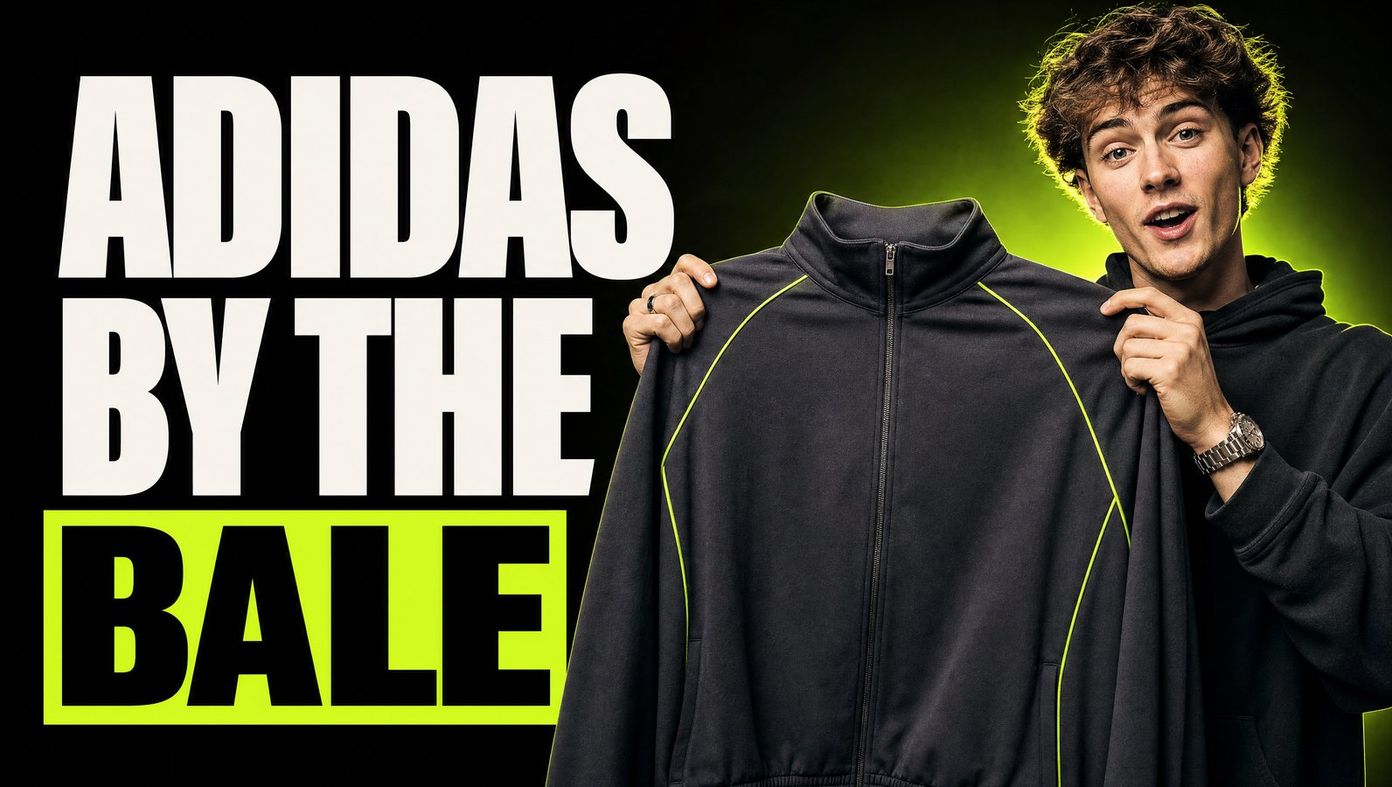
For a reseller in Hamburg, Copenhagen or Rotterdam, Adidas is one of the easiest brands to sell and one of the hardest to source in bulk. Easy, because a track top with the three-leaf mark on the chest needs no explanation in a listing photo or a live stream. Hard, because the name covers two very different products, and most bulk offers online never tell you which one you are getting.
That is the gap this guide closes. Below: what the trefoil actually signals, how a bale gets built on our floor in Bovenkarspel, what changes when you buy this from inside the EU rather than importing it yourself, and how a visit works if you are coming from abroad.
Excellent Vintage has been running since 2012 out of a 2,500 m² warehouse in Bovenkarspel, about 45 minutes by car north-east of Amsterdam. Patrick, who runs the trade and welcomes every buyer personally, has 32 years in this industry and works in Dutch, English and French. Adidas is one of our ten permanent brands, sitting in the sport and techwear cluster next to Nike and The North Face.
The trefoil is the line worth knowing
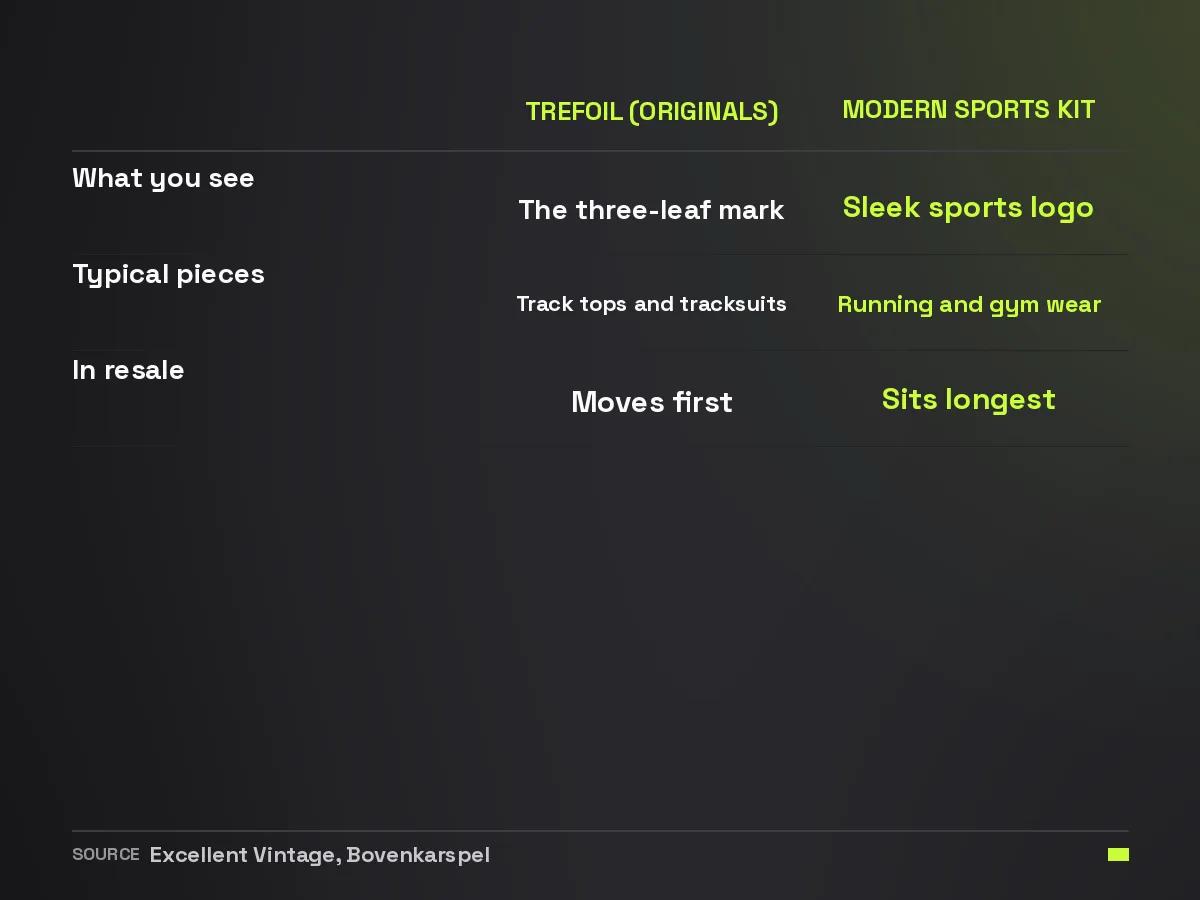
The three-leaf mark arrived in 1971, ahead of the 1972 Munich Olympics, and served as the company's main logo for years before the more modern sports mark replaced it in the late nineties. Since 2001, when Originals was set up as its own line, the trefoil has stood specifically for the lifestyle and heritage side of the brand — track tops, tracksuits, retro sweatshirts.
The other half of Adidas is the modern sports side: functional running shirts, technical gym wear, recent team kit. Nothing wrong with any of it, but it is not vintage, and it is not what buyers react to. What we see on the floor, and what resellers report back to us, points the same way every time — the trefoil pieces move first and the modern sports kit sits longest. That is the stock an inexperienced buyer ends up holding: technically fine, no visual hook.
Which is why the useful opening question about an Adidas bale concerns the mix inside it, long before anyone gets to the piece count.
What "by the kilo" actually means here
Some bales we sell by weight — around 45 kg, priced per kilo. Others we sell by the piece, with a fixed stated count. On a weight bale you convert kilos into pieces; on a by-piece bale you convert nothing, because the stated count is the number.
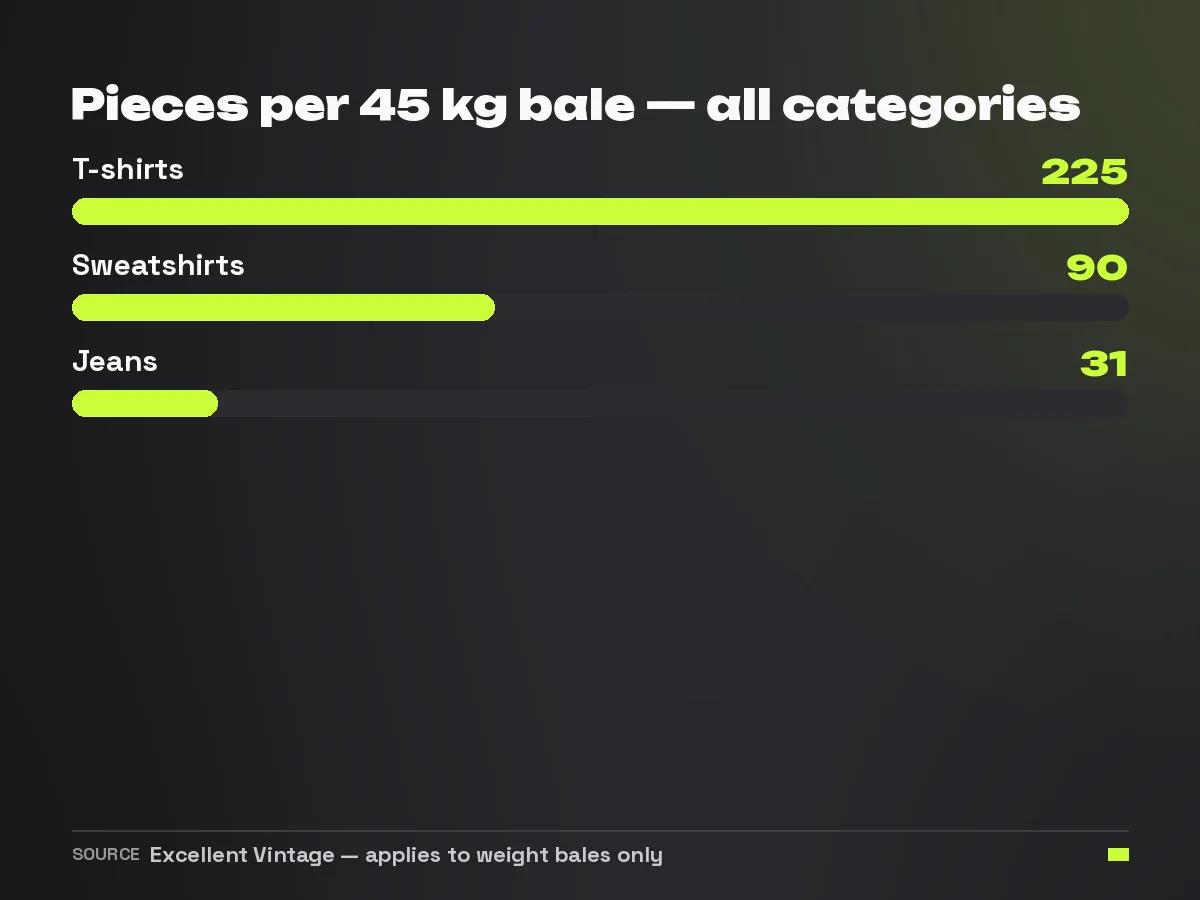
On a weight bale the count comes down entirely to the category. A t-shirt runs at roughly five pieces per kilo, so about 225 shirts in a 45 kg bale. A sweatshirt sits closer to two per kilo, so nearer 90. A lined track jacket is heavier than a sweatshirt and therefore comes in below that — the exact figure is something you get when you enquire, not something to read off a table. For scale across everything we handle, denim is the heaviest category at around seven pieces per ten kilos.
Mixing up those two models distorts a margin calculation before the bale is even open. Someone who budgeted around two hundred pieces and receives a bale of track jackets counts far fewer items out of the box and assumes something went wrong, when the bale simply holds a heavier garment. Which model and which category apply to a specific bale is something Patrick tells you at the enquiry stage — that is the point of asking before you commit.
Ask what is actually in the bale Tell Patrick which platform you sell on and he will tell you which Adidas bales are on the floor, whether they go by weight or by piece, and what the mix looks like. Book an appointment
Grades, and why they bite harder on a jacket
Fifteen to twenty tonnes of raw intake pass through our hands every month, and separating it is the real work of a wholesaler. Pieces are split by brand, by category and by grade, and only then does something become a bale worth the name.
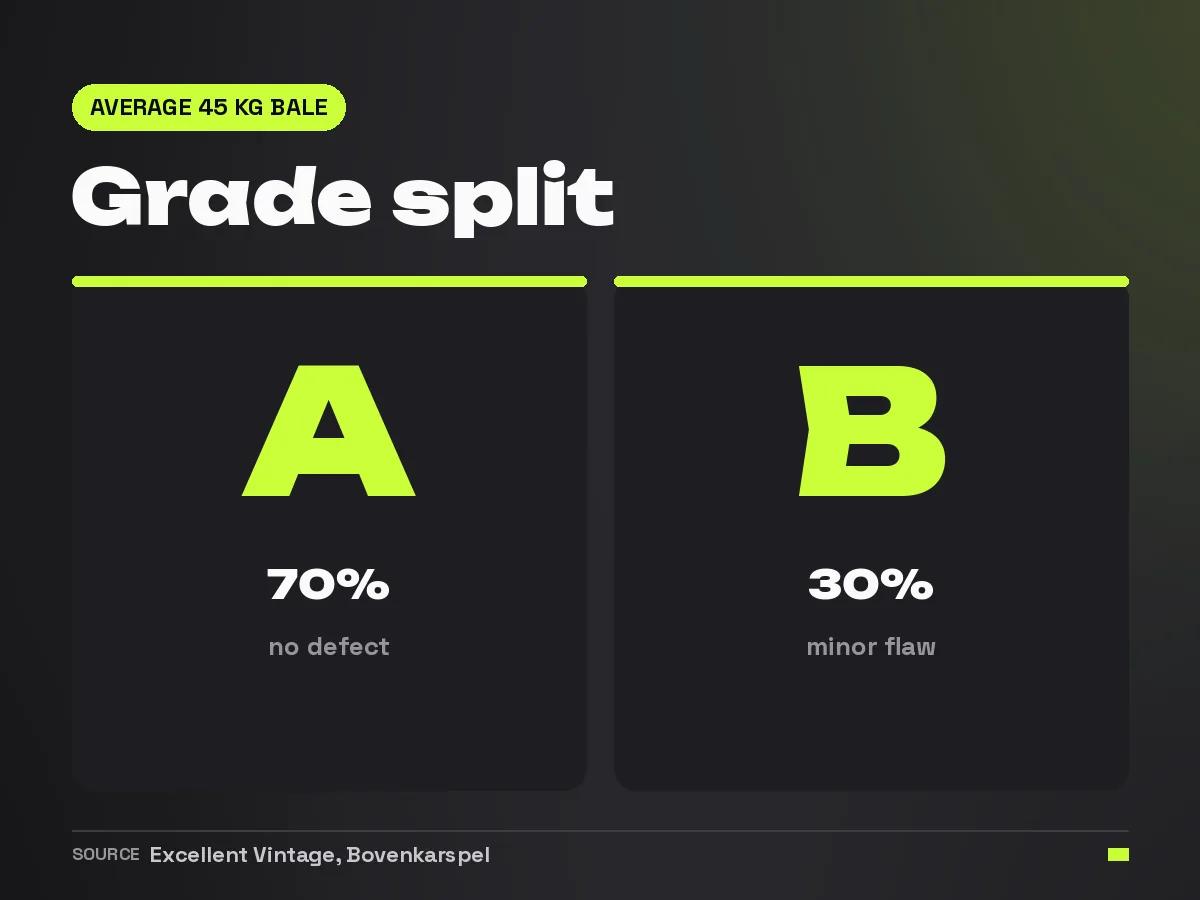
You know the quality ratio before you buy: a 45 kg bale averages 70% grade A against 30% grade B. The scale behind those letters is straightforward — A is a garment with no defect, B carries a minor flaw. Anything with real damage, a hole or bleach discolouration, is graded C and goes down its own channel, sold separately. The full scale, and why 70/30 is an honest starting point, is set out in the guide to grade A, B and C explained.
On this brand that ratio matters more than it does on a t-shirt label. A track jacket with a small zip fault is harder to move than a tee with a comparable flaw — that is what resellers report back to us, and it tracks: people look longer at the photos of a pricier item. If you want to run on cleaner stock, there is also a 25 kg "mix premium US" bag sitting around 90% grade A — a niche format rather than a brand bale, so ask what is in it at the time. And if you are still weighing raw against pre-sorted, heavy bales versus sorted clothing sets the two side by side.
Buying a German brand from a Dutch warehouse
Seven of our ten permanent brands are American. Adidas is one of the exceptions: the company was registered on 18 August 1949 by Adi Dassler in Herzogenaurach, Bavaria, and is still based there. The only other non-American names in our permanent line-up are British — Burberry and Barbour.
Our intake runs on fourteen containers a year, each between 8 and 14 tonnes, through three American partners and six European ones across the Netherlands, Germany, the UK, France, Italy and Spain. On a typically American brand the flow leans hard on the Atlantic route: eighteen to twenty-two days at sea, then three to five weeks from port to warehouse. What we see on the sorting table is that Adidas arrives through the European partners as readily as the American ones — a brand that was ordinary daily clothing across this continent for decades sits in the European flow too.
For a buyer in Germany or Denmark the practical part is simpler than the sourcing story. You are buying from a Dutch supplier, so it is an intra-EU transaction: short transport, no import formalities on your side, and for B2B buyers with a valid company registration and EU VAT number the VAT is reverse-charged. That is a different proposition from importing bales yourself from across the ocean, where the container, the crossing and the customs work are all on you.
Sourcing from Germany or Denmark? Message Patrick before you plan anything. He speaks English, answers himself rather than through a support desk, and will tell you straight whether a trip is worth making this month. Message Patrick
Who buys it, and where
The sport and techwear cluster carries the youngest audience of our ten brands, and a young audience behaves differently from the heritage crowd. A brand name in the listing title counts for less here than the shape in the photo, and a good share of the buying happens live, at speed.
In practice that favours sellers moving volume through live selling or short-form video, where a stack of track tops can clear inside a single stream. A curated Depop boutique works the other way: a smaller, sharper selection where one tracksuit or one distinctive eighties silhouette carries the whole photo set. And on Vinted the broad middle does the work — sweatshirts, tees, ordinary track jackets in common sizes.
If you already run on sports brands, the neighbouring half of the cluster is worth a look: sourcing vintage Nike wholesale covers how that one behaves.
What you are actually judging on the floor
Because the sorting is finished before you arrive, a visit is spent assessing whole bales — each one already separated by brand and grade. On Adidas specifically, three things are worth your attention: how heavily the bale leans into track jackets, since that drives your piece count; how much trefoil is visible at the surface; and whether the sizes suit the audience you sell to.
You get two hours to work through that, with the floor to yourself, which is enough to do it properly on a single trip from Hamburg, Copenhagen or anywhere else in the region. Nothing is committed until you say so. And if the travel does not fit this month, Patrick does the same round on a WhatsApp video call, holding bales up to the camera and shipping once you agree. Heavy bales, fast shipping.
If your questions run wider than this one brand — formats, how the sorting actually works — our complete guide to vintage wholesale clothing in the Netherlands is the longer answer, and current stock sits on our page about our wholesale offer.
Frequently asked questions about sourcing vintage Adidas
Is vintage Adidas worth reselling?
Yes, provided you buy the right half of the brand. The trefoil side — track tops, tracksuits, retro sweatshirts — reads instantly in a photo or a live stream and appeals to a young audience that decides quickly. Modern functional sportswear from the same company is the stock we see sitting longest.
How many pieces are in an Adidas bale?
On a weight bale it depends entirely on the category: roughly 225 t-shirts in 45 kg, or nearer 90 if the bale is sweatshirts. Heavier pieces such as lined track jackets come in below that. On a by-piece bale the stated count is the real number and no conversion applies, so ask which model your bale uses.
Can I buy from Germany or Denmark without customs hassle?
You would be buying from a Dutch supplier inside the EU, so there are no intra-EU customs duties, and for B2B buyers with a valid company registration and EU VAT number the VAT is reverse-charged. Past that general principle it depends on your own company, so run it by your accountant; we will supply whatever paperwork he needs.
What if I cannot travel to the warehouse?
A WhatsApp video call covers it. Patrick walks the bales with you on camera, tells you what is in each one, quotes, and ships. Plenty of buyers in Germany and Denmark start that way and only make the trip once they know the stock is worth the drive.
What does the trefoil logo mean?
It appeared in 1971, just ahead of the 1972 Munich Olympics, and was the company's main logo until the late nineties. Since 2001 it has marked the Originals line — the lifestyle and heritage side of the brand. For a reseller it is the fastest visual signal that you are looking at the interesting half of Adidas.
Before you book anything
Adidas comes down to one skill: recognising which half of the brand is in front of you. The trefoil side is what your audience responds to; the modern sports line is what stays on the rail. Separating the two is exactly what a wholesaler's sorting is for, and the reason you can know what is in a bale before it reaches you.
If a sourcing trip from Germany or Denmark is on your mind, the cheapest first step is a message asking what is on the floor this week. How we have worked since 2012 is on the page about Excellent Vintage.
See the Adidas bales before you commit Two hours on the bale floor, exclusively yours, with Patrick alongside to show what is in each bale. No deposit required, and free cancellation up to 24 hours beforehand. Visit our warehouse
Ready to buy?
Visit our warehouse · no deposit required · free cancellation.