Vintage Carhartt Wholesale in the Netherlands: How to Actually Buy It in Bulk
If you resell vintage, you already know how hard Carhartt is to keep in stock. It is one of the rare brands that is instantly recognisable, genuinely durable, and never really out of fashion — which…
By Patrick Libanon — founder, Excellent Vintage · Bovenkarspel, since 2012
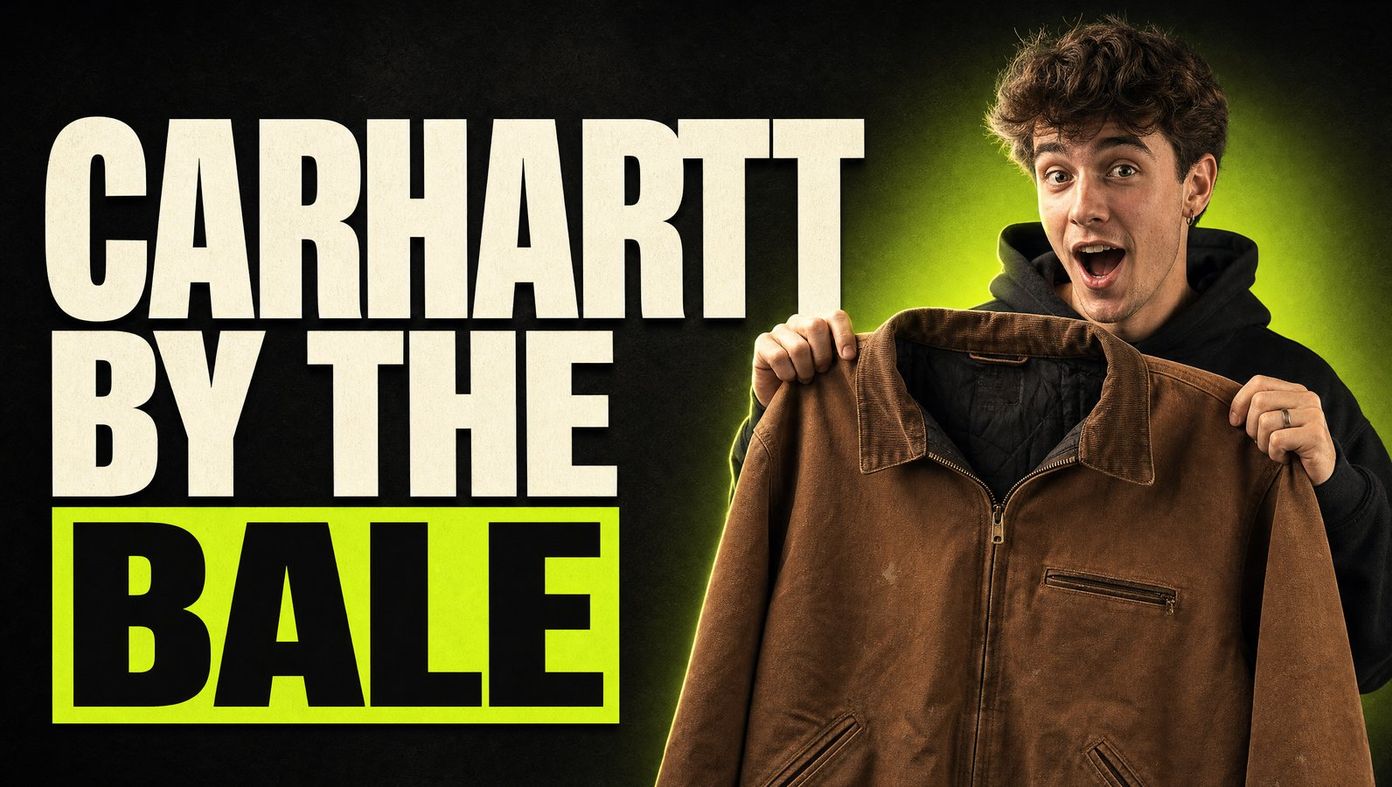
If you resell vintage, you already know how hard Carhartt is to keep in stock. It is one of the rare brands that is instantly recognisable, genuinely durable, and never really out of fashion — which is exactly why single pieces on marketplaces dry up fast and creep toward retail prices. Once you are serious about moving volume, chasing individual jackets stops making sense. The question most resellers land on is simple: can you just buy vintage Carhartt by the bale from a wholesale supplier?
Yes, you can. The more useful answer — what a branded Carhartt bale actually holds, how it is graded and sorted, whether you buy by the kilo or by the piece, and why this workwear resells as fast as it does — is what this guide is about. Written from the warehouse floor in the Netherlands, not from a product page.
For resellers in Germany and Denmark, the Netherlands is a short, duty-free hop across the EU border, and Bovenkarspel — just north of Amsterdam — is where we run Excellent Vintage from a 2,500 m² warehouse. We have been at it since 2012. Patrick, who runs the operation and personally welcomes every visitor, has spent 32 years in this trade. Carhartt is a fixture in our stock: one of the ten brands we always carry, and inside that list it belongs to the category that moves fastest.

Why is vintage Carhartt worth reselling?
To see why a Carhartt bale is a safe buy, you have to know where the brand comes from. Carhartt is not a streetwear hype that disappears next season. Hamilton Carhartt started in Detroit in 1889 making workwear for railroad labourers — work trousers and jackets built to survive a full shift of hard use. That DNA is still there. The double-knee work trouser with its reinforced fabric over the knee, the Detroit jacket with its corduroy collar and blanket lining, the chore coat: these are pieces engineered not to fall apart.
One distinction trips resellers up constantly, so pin it down early. The classic American workwear brand Carhartt is not the same thing as Carhartt WIP (Work In Progress), the separate European streetwear line that emerged in the nineties. Both have buyers, but they are different audiences and different price segments. A vintage workwear bale is mostly the first kind: real, worn-in American work clothing.
For you as a reseller, that durability turns straight into margin. Because the products were built to last, a large share comes in as grade A — no holes, no bleach stains, ready to list. And the wear that is there often reads as character rather than a defect; a faded Detroit jacket sometimes sells better than a crisp one. On top of that sits broad, steady demand. Carhartt moves on Vinted, on Depop, and it is a gift on a Whatnot livestream because viewers recognise the brand on sight. You are not betting on a trend — you are buying into a constant.
In our own stock, Carhartt sits in the workwear and outdoor cluster alongside Levi's and Patagonia. That grouping is not arbitrary. It is the cluster that rotates fastest for us: this is the clothing that flows out weekly through Whatnot lives and physical shops. Where heritage brands enjoy a broad, steady sell-through, workwear is the segment that actually keeps your stock moving.
What kind of Carhartt turns up in a vintage bale?
This is the part product pages stay vague about, so it helps to know Carhartt's range. Over the decades the label has made workwear across a lot of categories, and a vintage workwear bale reflects that spread rather than one single style. Carhartt is best known for its jackets — the Detroit jacket, the Active hooded jacket, the chore coat — and jackets like these tend to be the fastest pieces to sell. The catalogue also runs to double-knee and carpenter work trousers, bib overalls and dungarees, heavyweight sweatshirts and hoodies, flannel and chambray work shirts, plain pocket t-shirts, work shorts and denim jeans. Which of these turn up, and in what proportion, varies from bale to bale — that is simply the nature of vintage, and it is exactly what you confirm with Patrick when you enquire rather than assume from a list online.
That breadth matters for how you list. Because Carhartt spans so many categories, a workwear bale can feed several parts of your shop at once — jackets and hoodies for the higher tickets, shirts and t-shirts as steady mid-range volume, shorts and trousers to round things out. You are not tied to one product type; you are working with a branded cross-section of a workwear label, which is part of what makes a bale efficient to photograph and sell.
Carhartt and Dickies: the workwear duo
Browse any vintage wholesale supplier and you will see Carhartt and Dickies listed side by side — the two names are almost a shorthand for American workwear. Dickies, best known for its 874 work trouser, draws a very similar reseller audience. Our own workwear cluster is built on Carhartt, Levi's and Patagonia, with Carhartt as the anchor. The point worth taking away is simple: vintage workwear as a segment — Carhartt at the front of it — is one of the most dependable things you can put in your stock.
Sourcing vintage Carhartt by the bale? Tell Patrick which audience you serve and which platform you sell on, and he will match the workwear bales that fit. No deposit, free cancellation up to 24h. Book a warehouse visit
How does a wholesaler put a Carhartt bale together?
This is where the real work happens. A bale does not appear on its own. Everything reaches us through fourteen containers a year, each carrying 8 to 14 tonnes, on a monthly rhythm. We source from three American partners on the East, South and West coasts and from six European partners. Out of that raw flow, we process 15 to 20 tonnes of vintage clothing every month.
What happens next is sorting — and sorting is precisely the value a good wholesale supplier adds. A raw, unsorted mix is a gamble: you do not know what is inside. With us, all stock is pre-sorted by brand and by grade long before you get anywhere near the floor. A Carhartt bale, then, is not a random grab from a pile. It is a curated, single-branded unit of workwear with a predictable quality split.
Grading: what grade A and grade B mean for workwear
That split is transparent on our side. A 45 kg bale averages 70% grade A and 30% grade B. Grade A is a piece with no defect; grade B has a minor flaw; and the serious damage — a hole, a bleach mark — falls into grade C and is kept separate, never quietly buried among your grade A pieces. If you want higher quality for a specific niche, there is also a 25 kg "mix premium US" bag that runs around 90% grade A. For workwear the standard bale usually works best: Carhartt is a category where a grade B piece with a bit of honest wear still resells fine, because a little patina is part of the appeal.
So when the containers land, what Patrick does is triage — separating the stock by brand and grade, so that a Carhartt bale genuinely is Carhartt and the quality holds up. That upfront handwork is why you no longer have to dig through a bin when you arrive.

Do you buy Carhartt by the kilo or by the piece?
This is one of the most common questions, and the answer depends on the product. Some bales we sell by weight — around 45 kg — and there you can get a feel for volume with simple maths. A 45 kg bale of sweatshirts holds roughly 90 pieces, because a sweater weighs about half a kilo; lighter shirts and t-shirts naturally give you more. Other bales we sell by piece, with a fixed count — and then 45 kg is not the starting point, the piece count is. For workwear, which is heavier than a plain t-shirt, weight quickly means fewer pieces per bale but more value per piece.
The rule to remember: never blindly convert kilos into pieces when a bale is sold by the piece. Just ask. Which model applies to a specific Carhartt bale is exactly the kind of thing Patrick should tell you when you enquire — the sort of detail you confirm with a call rather than guess. The same goes for pricing: we do not put a price on the products online, because we hold hundreds of categories and the price of any one moves with season and supply. Every pricing question is answered on a quick call or over WhatsApp.
Which Carhartt labels can you read off the bale?
Once you are sourcing vintage Carhartt in bulk, you will eventually want to place a piece in its era — that decision feeds directly into how you price and list it. Over the decades Carhartt has used different neck labels, and the shape, the wording, and the "Union Made" line on those labels are the cues that let people who know the brand date a piece. For seasoned resellers this is one of the most enjoyable sides of Carhartt: you learn to recognise the generations.
We are deliberately not spelling this out to the last detail here, because a half-remembered dating rule is more dangerous than none — you misprice a piece and it sits, or you claim an era that does not hold up. A proper standalone guide to Carhartt labels and dating is something we are building, and it deserves to be done thoroughly rather than crammed into a footnote. What matters here: the labels are visible on the pieces in the bale, they tell a story, and it is a skill you build over time. Come to us and Patrick will simply point them out at the collar.
Prefer to talk it through on WhatsApp first? Not sure which format or grade fits your Carhartt plan? Message Patrick. He answers himself, usually within an hour on weekdays. Message Patrick
Why do you choose bales instead of loose pieces?
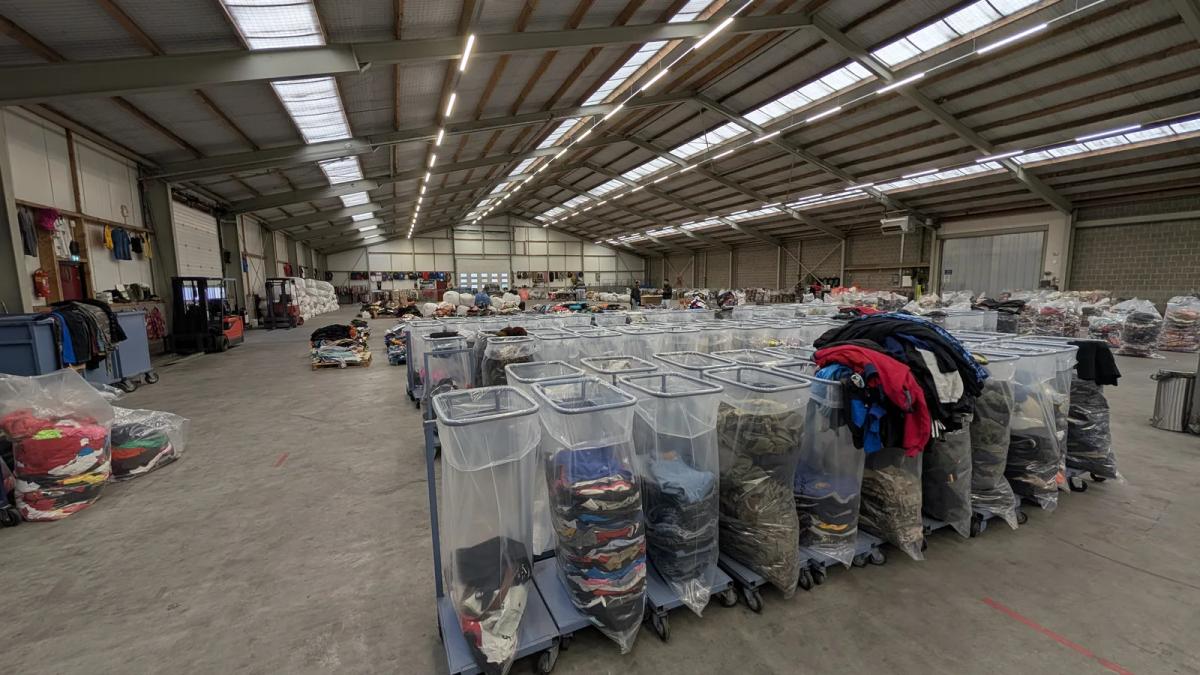
On a visit you choose which bales suit you — not the individual pieces. That is a deliberate way of working, not a limitation. At a throughput of 15 to 20 tonnes a month, letting every visitor pick piece by piece is simply impossible; the floor would seize up and nobody would get served. More importantly, the sorting is already done. Patrick has separated by brand and grade in advance, so what you choose is a curated, predictable branded unit of Carhartt.
What does that look like in practice? You come by appointment, you have the floor exclusively for two hours, and you choose bale by bale. You see what is in stock, you feel the quality, and you decide which bales fit your audience and platform. For a Whatnot streamer running on pace, that is a different call than for someone building a curated Depop boutique. The floor is the same; your strategy decides which bales go home.
Shipping vintage Carhartt to Germany and Denmark
You do not have to come to Bovenkarspel in person. If you cannot make the trip, sourcing also works over a WhatsApp video call: Patrick walks the bales with you, puts together a quote, and arranges shipping. Because Germany, Denmark, Belgium and the Netherlands all sit inside the EU, there are no customs duties on an intra-EU shipment, which keeps cross-border buying simple. On the tax side, a B2B buyer with a valid trade-register and EU VAT number is invoiced under VAT reverse charge (btw verlegd), so the VAT shifts to you rather than being charged on the invoice. Heavy bales, fast shipping — that is the promise, without us pinning an exact number of hours on it.
Where does Carhartt fit in your sourcing strategy?
Do not think of a Carhartt bale as a one-off purchase but as a building block. If you run volume — lots of pieces, moved quickly on Vinted or Whatnot — a single-branded bale at scale is your friend: a predictable 70/30 grade split, one brand to photograph and list, few surprises. If you serve a niche audience specifically hunting workwear, a higher-graded bag can make more sense.
The good thing about workwear as a category is that it keeps your stock in motion. Where some brands are seasonal, Carhartt sees demand almost year-round, with a peak in autumn when everyone wants a solid jacket again. For a reseller who does not want to sit on dead stock, that is exactly the kind of brand you want to be able to fall back on.
If you want the full mechanics behind formats, grades and the sorting process at your own pace, we laid it all out in our complete guide to vintage wholesale clothing in the Netherlands. To go deeper on quality specifically, the piece on what grade A, B and C actually mean explains why a 70/30 bale is an honest bale. And if you are still weighing a raw mix against pre-sorted stock, the difference between heavy bales and sorted clothing sets them side by side.
Frequently asked questions about buying vintage Carhartt wholesale
Is vintage Carhartt worth reselling?
Yes, and it is one of the safer brands to source. Carhartt is built tough, which means a large share arrives ready to list in grade A, and it has broad, steady demand on Vinted, Depop and Whatnot. You are not betting on a short hype but on a brand with constant sell-through — for us it belongs to the cluster that rotates fastest.
What products are in a Carhartt bale?
A spread of the label's real workwear: jackets like the Detroit jacket and chore coat, double-knee work trousers, bib overalls and dungarees, sweatshirts and hoodies, flannel work shirts, t-shirts, work shorts and the odd pair of jeans. One branded bale can feed several categories on your shop at once.
Do you buy Carhartt by the kilo or by the piece?
It varies by bale. Some workwear bales we sell by weight (around 45 kg), others by the piece with a fixed count. Never convert kilos into pieces yourself when a bale is sold per piece — ask which model applies when you enquire, and you will know exactly what you get.
Which platforms does vintage Carhartt sell best on?
Carhartt performs across the board. It is steady on Vinted and Depop, and it is a strong pick for a Whatnot livestream because viewers recognise the brand instantly. That broad, multi-platform demand is a big part of why it belongs to the cluster that rotates fastest for us — you are rarely stuck holding it.
What is VAT reverse charge and does it apply to me?
VAT reverse charge (btw verlegd) means that on a B2B sale within the EU the VAT shifts to the buyer, provided you have a valid trade-register and EU VAT number. All four of our markets sit inside the EU, so there are no customs duties intra-EU. For your specific situation, check with your accountant or ask us — we do not invent tax rules.
Ready to source Carhartt?
Carhartt is one of those rare brands where the clothing does the work for you: durable enough to arrive in grade A often, recognisable enough to sell quickly, and wanted enough to keep your stock moving. What a wholesale supplier adds is the sorting up front — the separation by brand and grade that lets you buy a predictable, branded bale instead of a gamble.
Want to see which workwear bales are in stock now and which suit your platform? Book a visit to Bovenkarspel or message Patrick. He welcomes you in person, the floor is yours for two hours, and you choose the bales that fit your plan. For more on what we offer, see our page on our wholesale range, and to learn who we are, read about Excellent Vintage.
See the Carhartt bales in Bovenkarspel Book two hours on the bale floor, exclusively yours. No deposit, free cancellation up to 24h, and Patrick calls you the day before to prepare your visit. Book a warehouse visit
Ready to buy?
Visit our warehouse · no deposit required · free cancellation.