Buying Champion at a vintage wholesaler: the label is the substrate, the print is the variable
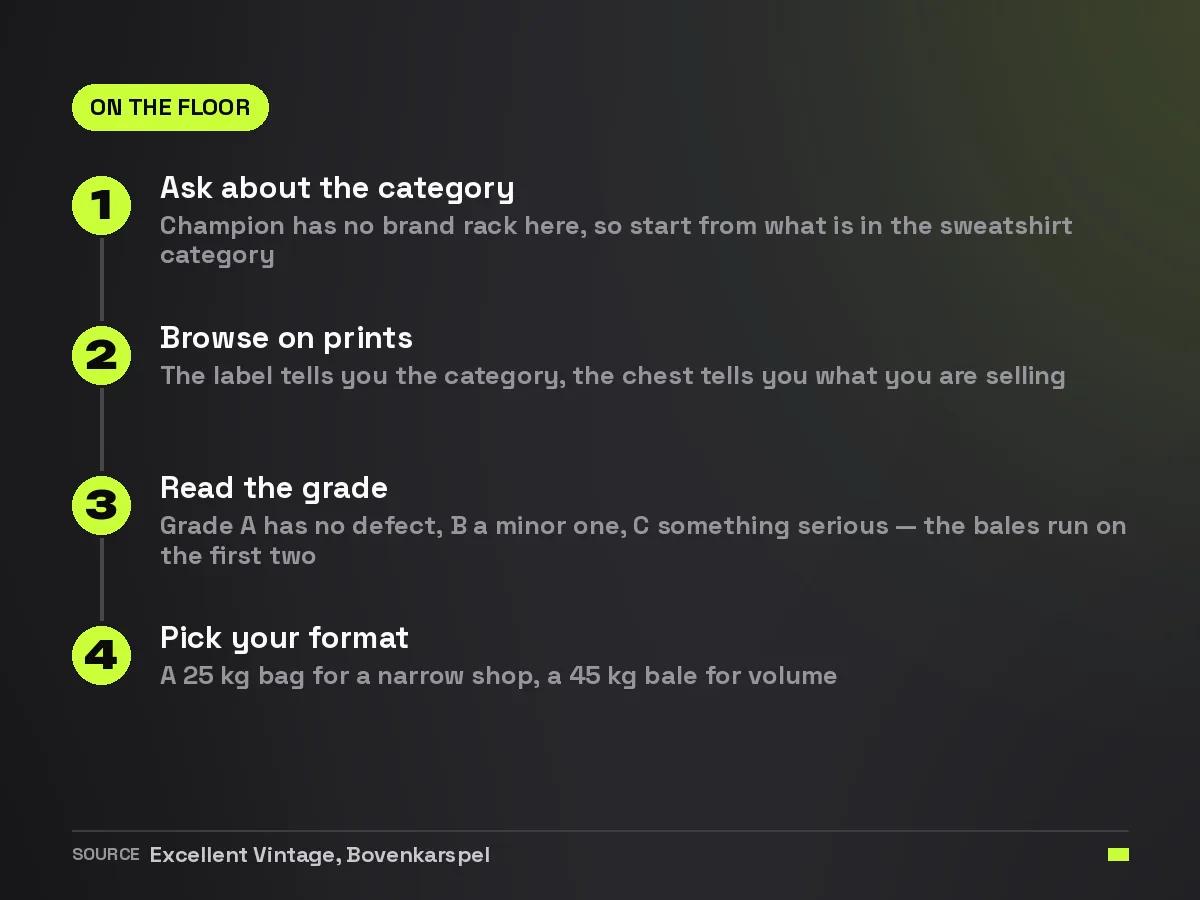
Walk our floor looking for a Champion rack and you will not find one. You will find Champion, but it will be inside a sweatshirt lot, sitting next to whatever else came in on the same container.
By Patrick Libanon — founder, Excellent Vintage · Bovenkarspel, since 2012
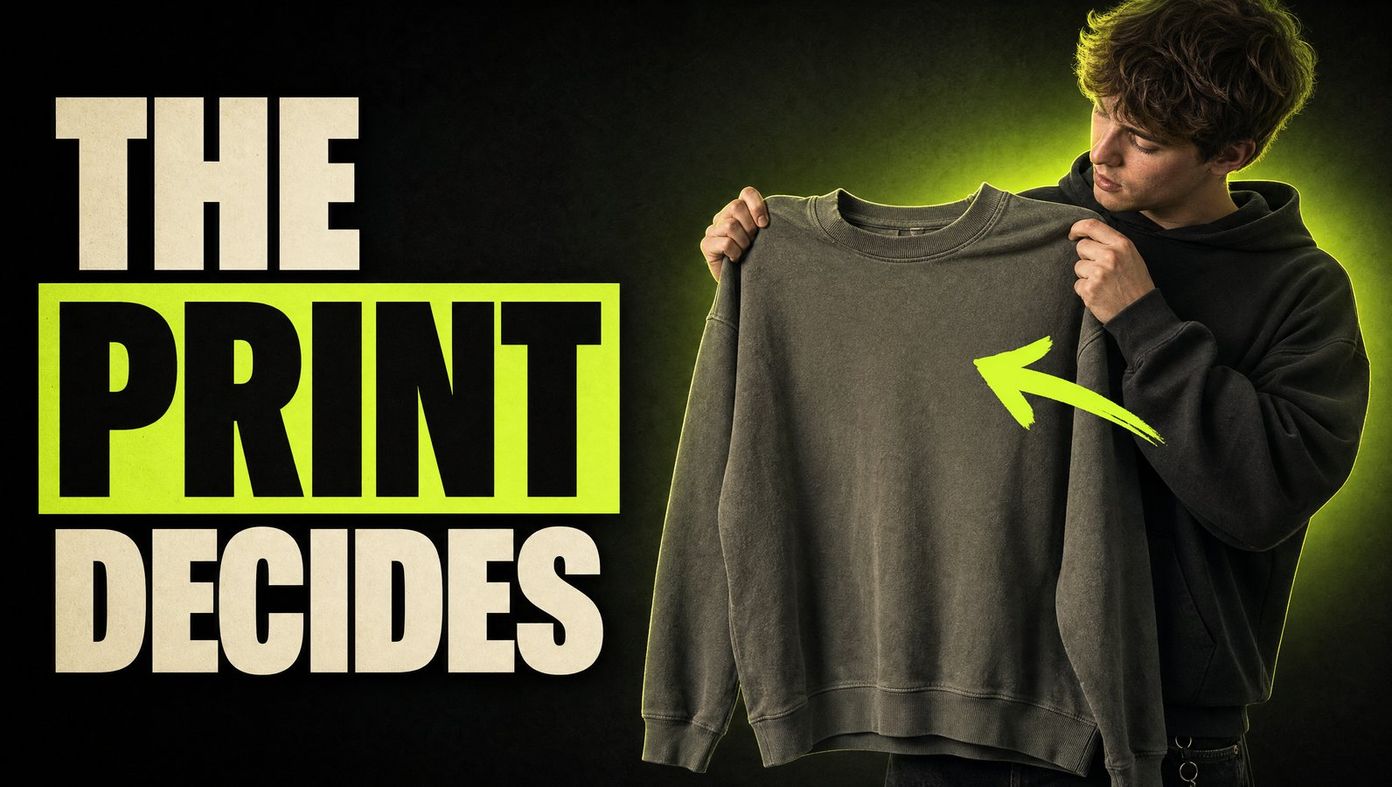
Walk our floor looking for a Champion rack and you will not find one. You will find Champion, but it will be inside a sweatshirt lot, sitting next to whatever else came in on the same container.
At Excellent Vintage in Bovenkarspel, Champion does not sit on the floor as a branded bale. It travels inside the sweatshirt category, which runs at roughly two pieces per kilo: around fifty pieces in a 25 kg bag, ninety in a 45 kg bale. What varies from piece to piece is not the label. It is the print on the chest.
That distinction sounds academic until you are standing in front of the lot. Then it decides what you buy.
Ten brands live here permanently, and Champion is not one of them
Our wholesale page lists the brands we hold in stock at all times. There are ten of them, and Champion does not appear. That comes down to how the supply arrives.
Excellent Vintage has been in Bovenkarspel since 2012, in a 2,500 m² warehouse that processes fifteen to twenty tonnes of clothing a month. That volume arrives through fourteen containers a year, sourced from three American and six European partners. Patrick, who has thirty-two years in this trade, decides what gets set aside as a brand lot and what goes out on the floor as a category. A brand earns a permanent rack when it lands in enough volume month after month to justify one. Champion arrives — just not with that regularity.
The practical consequence for a buyer is straightforward. You do not order a Champion bale. You buy into the category that contains it, you ask ahead of your visit what is currently on the floor, and you decide once you have seen it. For the wider picture of how a container turns into a rack of bales, start with our guide to sourcing from a Dutch vintage wholesaler.
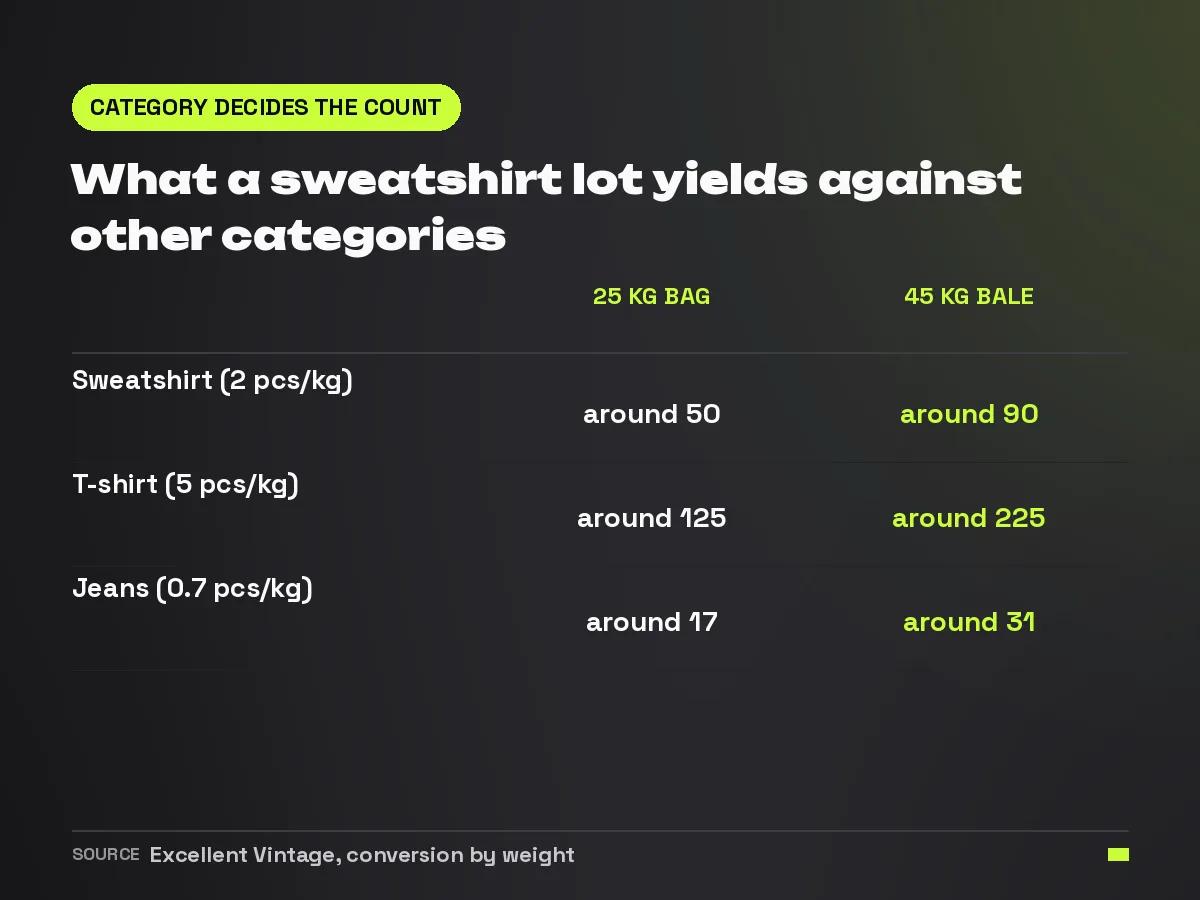
In pure numbers a sweatshirt lot lands between two extremes. You do not get the pile a t-shirt lot gives you, and you are nowhere near the low count of denim. Fifty to ninety pieces is a size you can photograph across a few evenings. Whether it moves depends entirely on whether you can sell the prints. Which is where the whole thing turns.
A century spent making clothes with somebody else's name on the chest
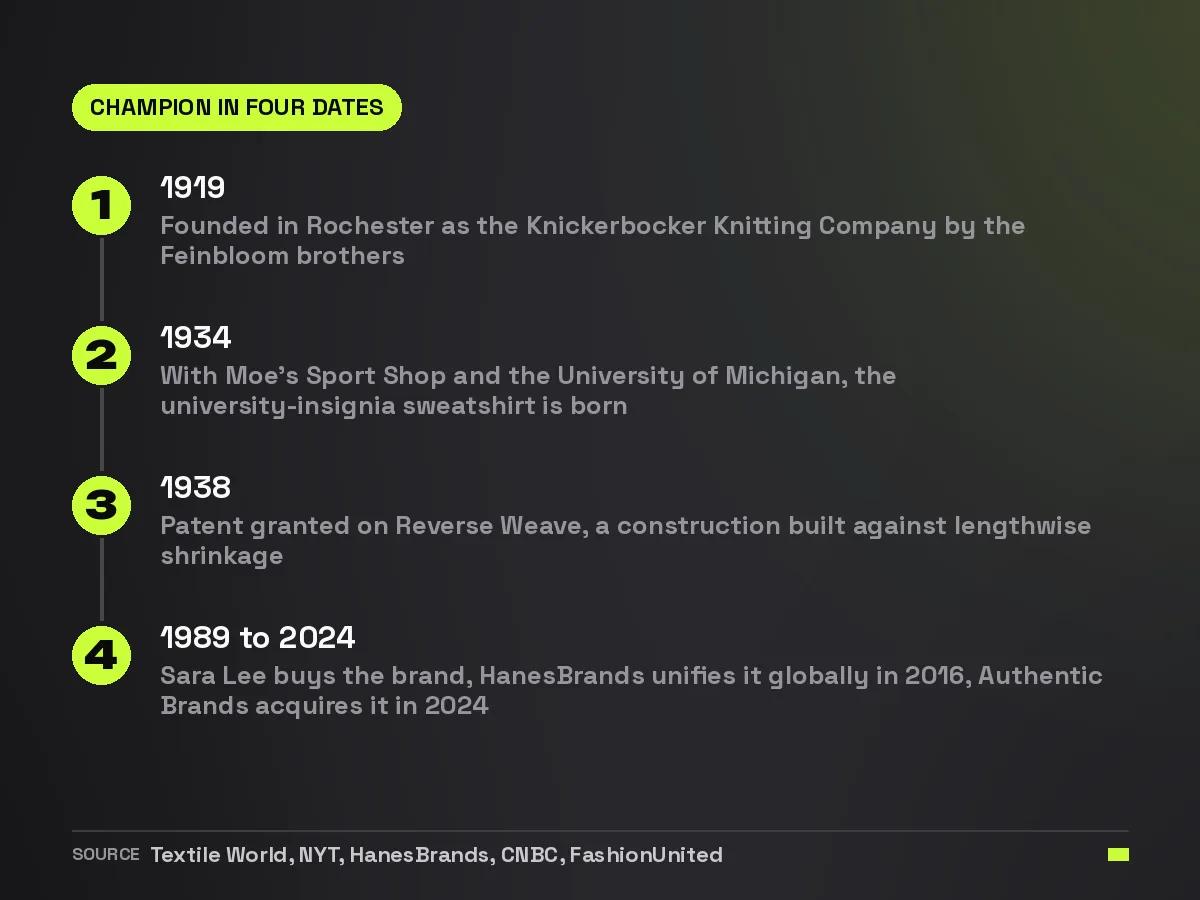
The company starts in 1919 in Rochester, New York, as the Knickerbocker Knitting Company, run by the brothers Abraham and William Feinbloom. An early agreement with the Michigan Wolverines puts them in team kit; by the 1930s the name has changed to Champion Knitting Mills. West Point picks up the clothing for training and physical education.
Then, in 1934, comes the moment you can still hold in your hands on a warehouse floor. Working with Moe's Sport Shop and the University of Michigan, Champion puts sweatshirts on sale carrying the university's insignia, and the collegiate sweatshirt exists as a product from that point on.
Everything after that is a variation on the same business. Champion supplies sportswear to a long list of major American universities. It dresses every NBA team from 1990 to 1997 and a portion of them until 2002, with Reebok taking the NBA contract in 2001. Across the NFL, franchises from the Bills and the Bengals to the Jets and the Saints wear it between the late eighties and the middle of the nineties. Notre Dame football stays with the brand for more than fifty years, ending in 2001 when adidas signs the university. The 1992 United States Olympic basketball team plays in it.
Add up that century and you can see where the garments in front of you came from. A large share of the vintage Champion that reaches us through American partners carries someone else's name across the chest: a university, a team, a club, a summer camp. Champion sat on the supplier side of that story rather than the brand side.
What can be pre-sorted, and what never will be
A wholesaler sorts on brand, category and grade. Those are the attributes that survive contact with fifteen to twenty tonnes a month. The print does not. We do not build a bale of sweatshirts carrying Midwestern universities, because at that volume the sorting does not scale.
With a brand like Carhartt that is a non-issue, because the label carries the value on its own. A Carhartt jacket is a Carhartt jacket. Champion works differently: the label tells you which category you are in, and the chest tells you what you are selling. Two sweatshirts from one lot, in the same condition, can behave completely differently in your shop because one carries a university buyers recognise and the other carries a high school nobody outside its own region has ever heard of.
That is exactly the kind of difference a photograph hides and a floor reveals. You get a two-hour slot, you choose bales rather than individual pieces, and you go through them. Two hours on the floor mostly buys you a feel for which prints move with your particular audience. How the rest of a visit is organised sits in our piece on walking a bale floor for the first time.
Ask what is in the sweatshirt category first Because Champion is not held permanently, the honest order of operations is to ask before you book. Send Patrick a message with the category you run and the platform you sell on, and you will hear what is on the floor that week. You get him directly, in English, Dutch or French. Message Patrick
Reverse Weave, 1938, and why the category is still wearable
In 1938 Champion patented what has been called Reverse Weave ever since. The idea is purely mechanical: the fabric is turned through ninety degrees, so the direction in which cotton pulls back after washing no longer runs along the length of the garment. The patent describes cutting from a tube, with shoulder and sleeve in one continuous piece and a neck opening that needs no seam.
That is a garment engineered to survive laundry. And there is a direct line from that to what ends up in a bale three or four decades later. Clothing designed not to distort comes out the far end of thirty years of wardrobes, gyms and washing machines wearable more often than clothing that was not. That is part of the reason the category still exists.
Champion also claims to have invented the hooded sweatshirt, in the 1930s, for athletes who needed to stay warm between sessions. That is a claim made by the brand's owner rather than an independently established fact, so treat it that way if you repeat it in your own listings.
One thing we do not do is grade on fabric or construction. Our letters describe defects and nothing else: a piece with no defect is graded A, a minor defect makes it B, and something serious such as a hole or bleach damage puts it in C. A heavy sweatshirt and a thin t-shirt can therefore share a grade and behave nothing alike once they are listed. What those letters mean in practice sits in our piece on grading and grade A, B and C.
Choosing a format for a category you sell on prints
There are four formats: a half bag at 12.5 kg, a bag at 25 kg, a bale at 45 kg and a curon at 50 kg. A second line runs across all of them. Some lots are sold by weight and others by the piece. A hundred Tommy sweaters is a count rather than a kilo calculation, and that count is the honest figure.
When value varies piece by piece, which is exactly the case with printed sweatshirts, the spread inside your lot matters more than its weight. Across a 45 kg bale the split averages seventy-thirty between the two working grades. A 25 kg bag of mix premium US tightens that to ninety-ten: higher in quality, narrower in composition, and therefore a narrower bet. Where raw and pre-sorted lots part company is covered in buying raw against buying sorted.
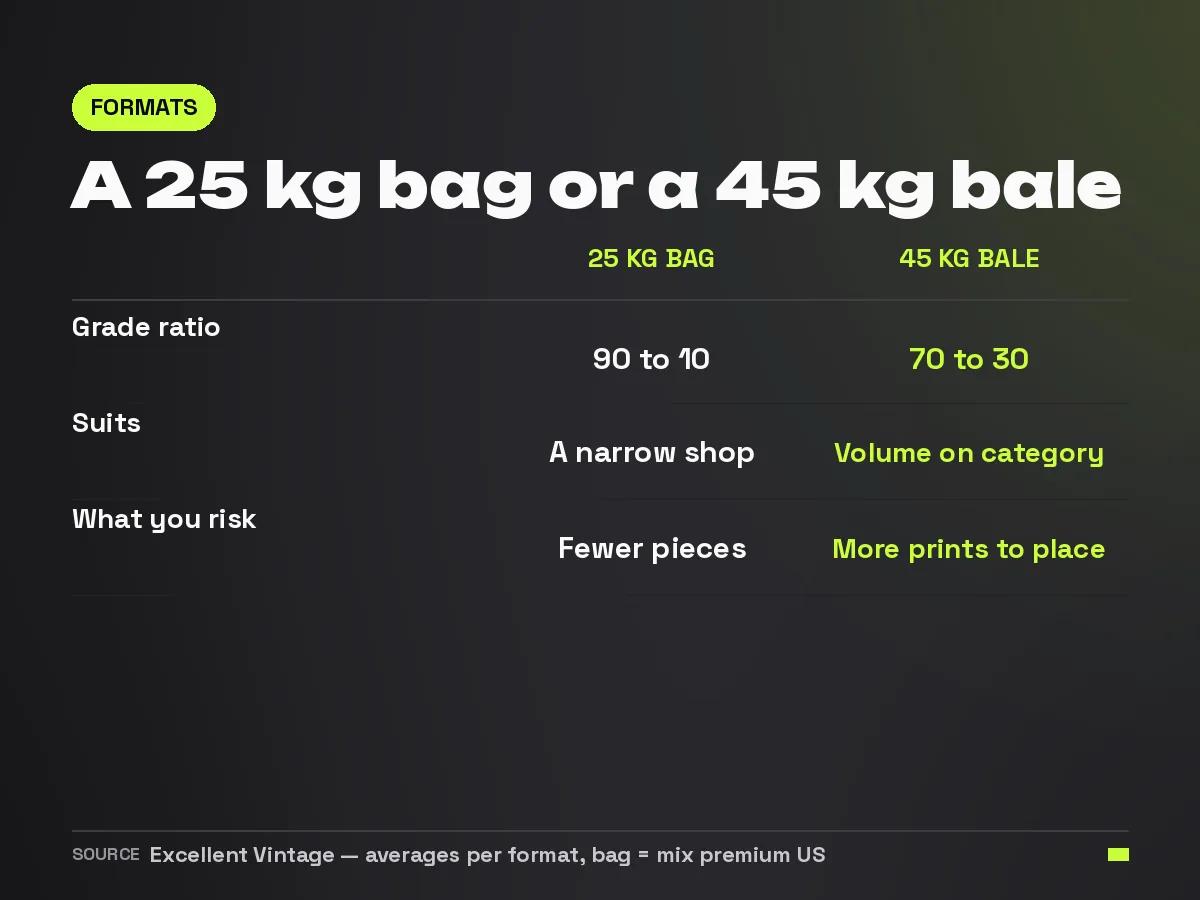
The rule that falls out of this is not complicated. If you sell on volume to an audience that searches by category, the bale makes sense. If you run a narrower shop where every piece gets its own photograph and its own caption, the bag hands you fewer pieces but a higher share that can go straight to listing.
The name has covered several different companies, and none of it dates a garment
Sara Lee bought Champion in 1989. In 2016 HanesBrands acquired Champion Europe, the Italian company that held the trademark across Europe, the Middle East and Africa and ran around a hundred and thirty stores in Italy and Greece; combined with buying out the Japanese licensee, that brought the brand under one roof worldwide. In June 2024 HanesBrands announced the sale to Authentic Brands Group, a 1.2 billion dollar transaction that closed at the end of September that year.
For a reseller the usable conclusion here is mostly a negative one. Until 2016 that word on the neck label sat over two companies at once, on either side of the Atlantic. We have not found a reliable, publicly published dating chart for Champion labels that we would be willing to stand behind. So we do not work with one: what we cannot support, we keep out of a listing.
What you do have is the garment. Its condition, its print, the weight of the fabric in your hand. That is how we look at it when a container is unloaded, and it is why we would rather have you on the floor than on the phone. More about how we work sits on our about page.
Book two hours on the bale floor You reserve a two-hour block in Bovenkarspel, yours alone, for up to four people, with free parking. Nothing is paid up front and cancellation is free up to twenty-four hours before your slot. Patrick calls you the day ahead to hear which category you run, so the right corner of the floor is ready when you walk in. Book a warehouse visit
Coming from Germany or Denmark
If you are travelling in from outside the Netherlands, two things are worth settling before you set off.
The first is paperwork. If you buy as a registered business elsewhere in the EU with a valid VAT number, the supply is intra-community and the VAT is reverse-charged to you. A Dutch company buying here is making a domestic purchase and pays Dutch VAT in the normal way. Every market we serve sits inside the single market, which keeps customs duties out of the equation. Anything beyond that general principle belongs with your own accountant rather than with us.
The second is the trip itself. Visits run on appointment only, weekdays between nine and five, in two-hour blocks. That is the only way Patrick can set out the right bales by brand and grade in advance and keep the floor to you. If travelling is not realistic yet, we point the camera at the prints rather than the labels: a WhatsApp video call stands in for the first look, and a quote with shipping can follow from there. If this would be your first wholesale purchase of any kind, start with how to buy your first vintage clothing bale.
Frequently asked questions about buying Champion wholesale
Do you sell Champion bales?
Not as a standing brand rack. Champion is not on our list of ten permanently stocked brands, so you buy it inside the sweatshirt category. What sits in that category shifts with the containers, so ask before you book a slot.
Why does the chest carry a name other than Champion?
Because Champion spent a century as a supplier rather than a name on display. It made kit and sweatshirts for universities, teams, clubs and summer camps, and the customer's name went on the chest. The neck label tells you who made the garment; the print tells you who it was made for.
What should I check on vintage Champion?
The print and the condition. Read the chest first, because that is what a buyer searches for, then check the seams, the cuffs and any bleach or holes against our A, B and C letters. We have found no reliable public dating chart for Champion labels, so judge the garment itself rather than the tag.
Can I visit without an appointment?
No. Visits run in two-hour blocks, yours alone, for up to four people, weekdays between nine and five. There is no deposit and you can cancel free of charge up to twenty-four hours before your slot.
What you are actually buying with this brand
With Champion you are buying a selection rather than a brand rack. The label puts you in the sweatshirt category, and from there the chest decides what a piece is worth to your particular audience. That judgement is yours to make, and it goes better with the bales in front of you than from a photograph. So ask first what is on the floor, then book your two hours for a week when the supply works in your favour.
Start from the category, not the brand The sweatshirt category follows the same rule as the rest of the floor: you buy what you have seen. Book a two-hour block in Bovenkarspel, tell us which platform you sell on, and decide with the bales in front of you instead of from a photograph. Book your visit
Ready to buy?
Visit our warehouse · no deposit required · free cancellation.