How to Start Vinted Reselling With Vintage Bales: A Step-by-Step Guide
Don't buy a full bale first. Sell a few dozen pieces from your own wardrobe or a small curated box, see which brands move, and only then buy a sorted clothing bale of the brand that already sells in…
By Patrick Libanon — founder, Excellent Vintage · Bovenkarspel, since 2012
Don't buy a full bale first. Sell a few dozen pieces from your own wardrobe or a small curated box, see which brands move, and only then buy a sorted clothing bale of the brand that already sells in your shop. That turns your first bale into a calculated step, not a gamble.
Most "start reselling on Vinted" guides open with "create an account and photograph your clothes." I'll skip that, because it's the easy part. The question new resellers actually get stuck on is the next one: when and how do you move from buying single pieces to buying real wholesale bales? That step is the difference between a nice side income and a reseller who turns stock month after month. This is the sequence I'd follow, with the sourcing knowledge of a wholesaler that has been sorting bales since 2012.
Step 1: Are you ready for a bale? Be honest
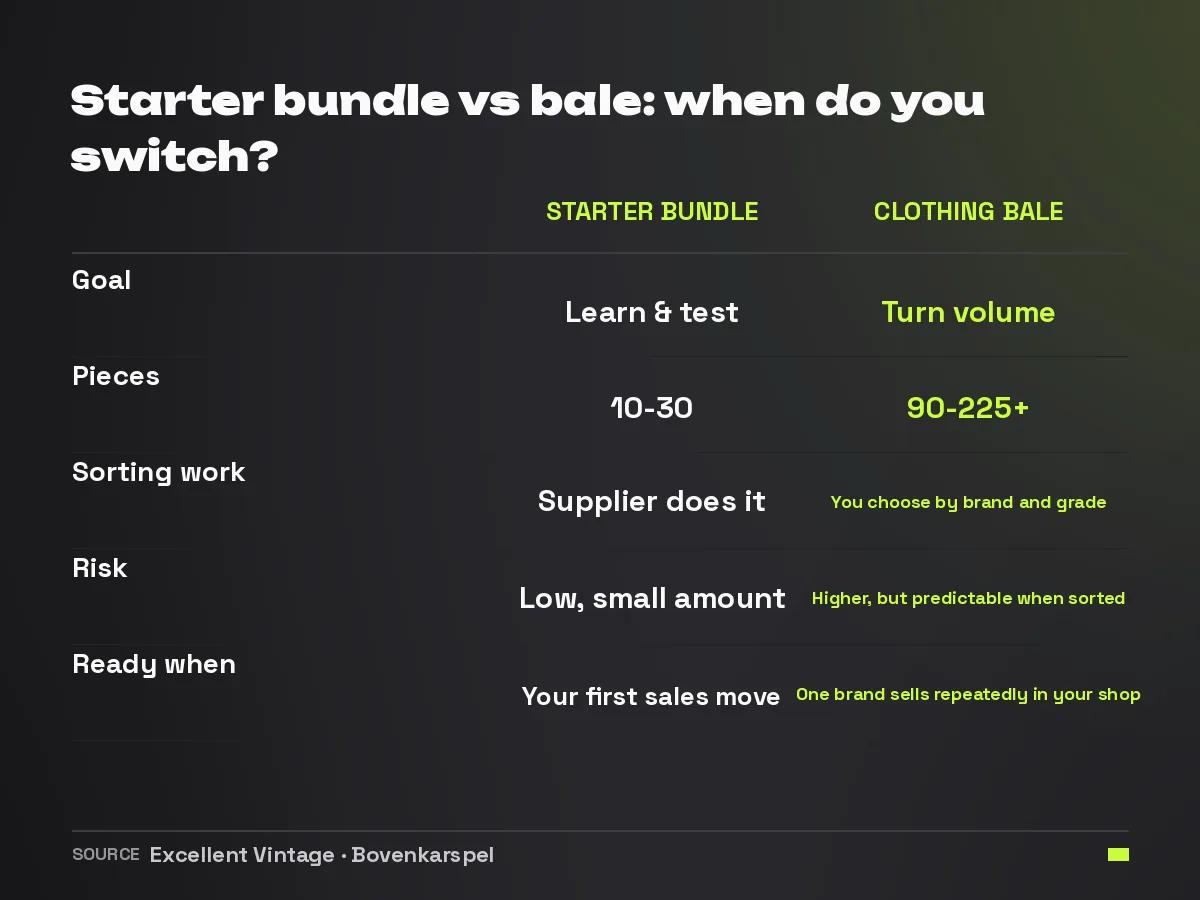
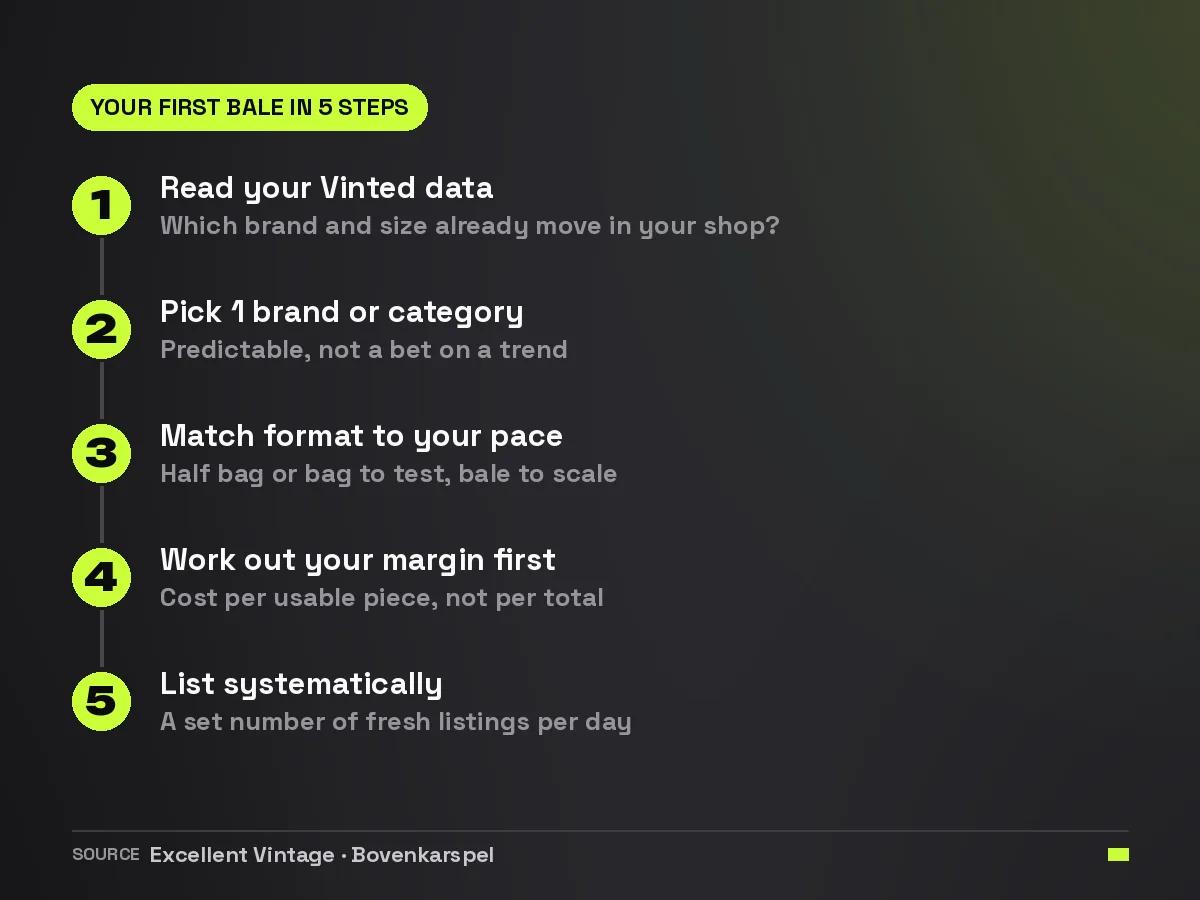
Buying a bale before you know what sells is the most expensive lesson in reselling. So start in reverse. Sell ten to thirty pieces first: from your own wardrobe, a thrift run, or a small starter bundle from a supplier. The goal in this phase isn't profit, it's data. You learn how Vinted search behaviour works, which sizes and brands move quickly, and how much time a single listing really costs you.
On a reseller forum I saw it put well: you don't have to start with a full bale, there are suppliers offering ten to twenty piece bundles and starter packs to test with. That's exactly the right order. A curated box or starter bundle is step one, because someone else does the sorting and you only have to learn to sell. A bale is step two, once you know which brand sells repeatedly in your shop and you're ready to take on the sorting yourself in exchange for a far lower price per piece.
The signal that you're ready is concrete: the same brand sells more than once, your listings don't sit unsold, and you notice you keep reordering the same category. That's the moment a bale works out cheaper than buying boxes. Not before.
Step 2: Pick your brand from your own Vinted data, not a trend
This is where the calculated reseller splits from the gambler. Open your own sold items on Vinted and read what actually moved, not what a TikTok told you is "hot." Which brand sold fastest? In what category and size? At what price? That is your purchase order, written by your own buyers.
Only then do you look at what a wholesaler keeps in stock structurally. Excellent Vintage runs ten brands in constant rotation across four clusters: heritage that always resells (Ralph Lauren, Tommy Hilfiger, Burberry, Barbour), workwear and outdoor that turns fastest (Carhartt, Levi's, Patagonia), sport and techwear for the youngest audience (Nike, Adidas, The North Face), and a mixed pro stack for the boutique margin. A Ralph Lauren Polo Bear sweater is the textbook example of a piece that pulls a sale on its own.
The mistake I see new resellers make most often is buying a bale of a brand they think is cool instead of a brand their buyers already bought. Your first bale has to be predictable. Predictability comes from your own sales data plus a supplier that sorts by brand and grade, so you bet on a sorted lot rather than on a word.
Talk through your brand before you buy a bale Send Patrick the brand that's moving in your Vinted shop, and the right stock is ready when you visit. Reply within 1 hour, Mon–Fri. WhatsApp Patrick →
Step 3: Choose the right format, because volume sets your workday
Once your brand is fixed, you choose the format. And that's a bigger decision than beginners think, because the format decides how many hours you'll spend photographing and listing. A by-weight bale of around 45 kg holds completely different quantities depending on the category. The same 45 kilos gives you roughly 225 t-shirts or roughly 31 pairs of jeans. Same weight, an entirely different workday.
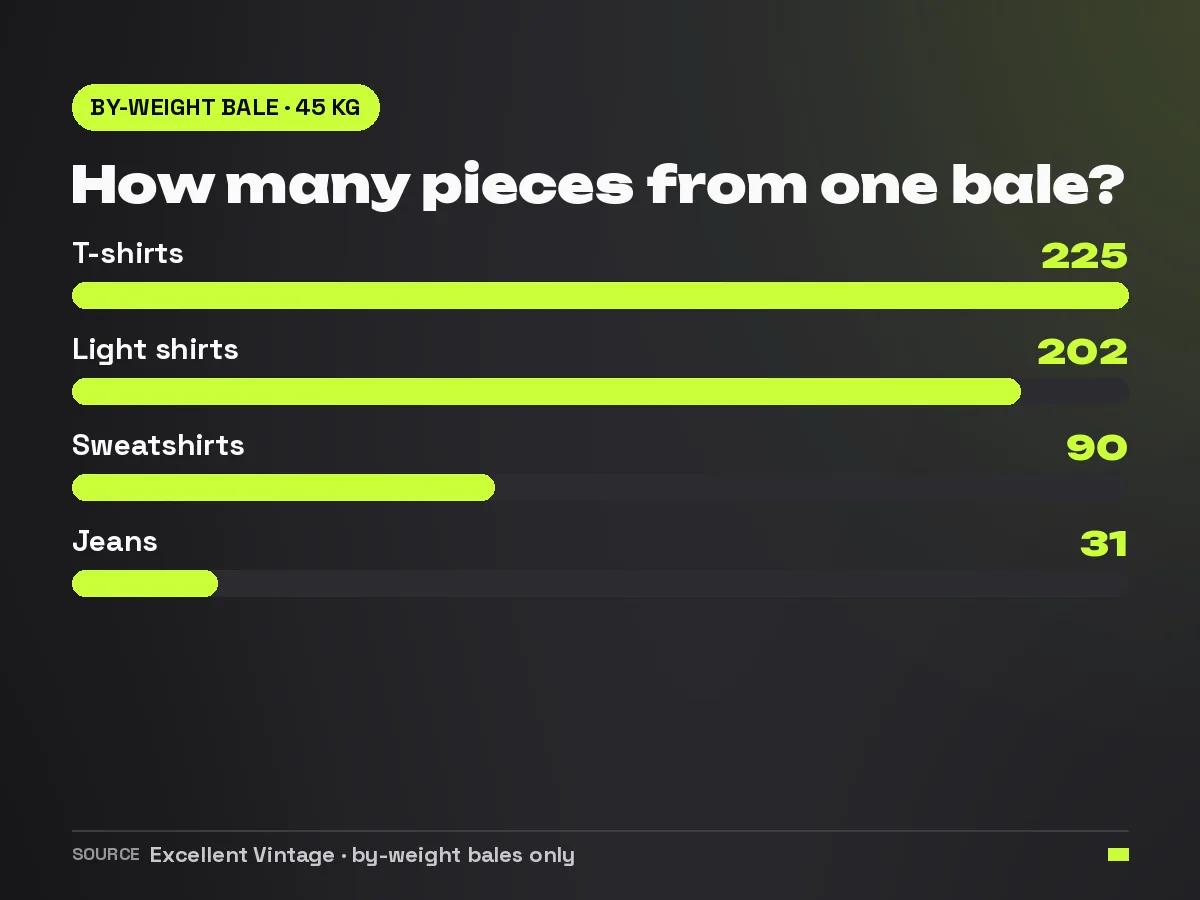
There's one catch that costs starters money: not every bale is sold by weight. Some are sold by the piece, as a fixed count. Think 200 Ralph Lauren shirts or 100 Tommy sweaters, where the weight is not exactly 45 kg and the stated number is simply the honest figure. For a by-piece bale you must never apply the kilo-to-pieces maths, you get exactly what it says. So ask of every bale: is this by weight or by piece? That alone prevents the classic "I thought there'd be more in it" disappointment.
For a beginning Vinted reseller, a manageable format is smarter than the biggest one. A half bag of 12.5 kg or a bag of 25 kg lets you test a brand without your living room being full for a month. Scaling up to a full 45 kg bale or a 50 kg curon can always come later, once your listing pace can handle it.
Step 4: Understand the grade, it's what your listing photo shows
Grade is the most underrated factor for your first bale. It directly decides how many of your pieces can go straight to the photo, ready to wear, and how many you need to wash or repair first. The scale is simple: grade A is a piece with no defect, grade B has a minor defect, and grade C has a more serious problem such as a hole or a stain.
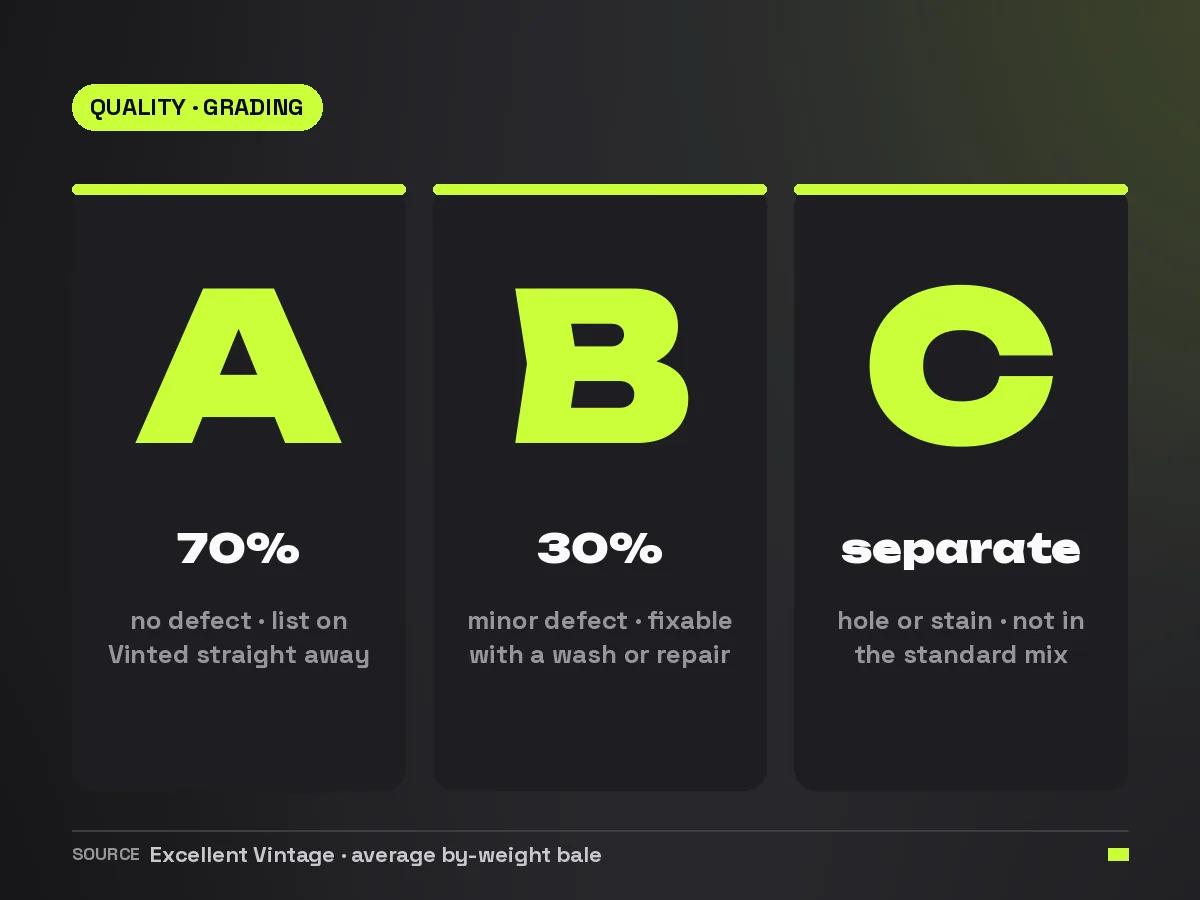
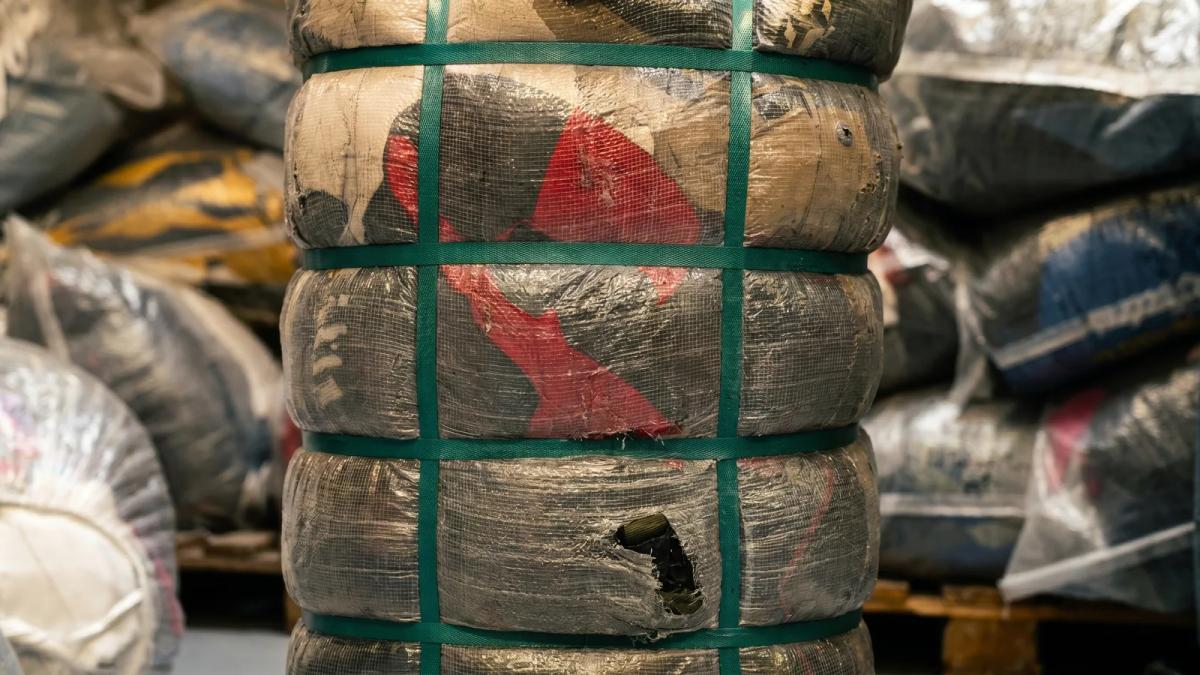
The number to remember: a sorted 45 kg bale at Excellent Vintage averages 70% grade A and 30% grade B. A smaller 25 kg bag of "mix premium US" sits higher, around 90% A and 10% B. Those ratios come out of the sorting process in the factory, not out of a slogan. Grade C, the genuine defects, is not part of these standard mixes.
What does that mean for your Vinted planning? With a 70/30 bale you can roughly photograph and list two thirds straight away, while a third is "work": washing, a small repair, or bundling. Know that in advance and the first B pieces won't panic you. Don't know it and you'll think you got a bad bale, when 70/30 is actually an honest, normal composition. If you want to fully understand this before you buy, read how vintage grading works so you know which questions to ask on the floor.
Step 5: Work out your margin before, not after
The reseller who makes a profit calculates before the purchase, not after the sale. The method is simpler than it sounds: divide the total cost of your bale by the number of usable pieces, and you have your cost per piece. Put that next to the price your kind of item actually sells for on Vinted (look at completed sales, not asking prices) and you know whether the bale pays off before you even open it.
Important: "usable pieces," not "all pieces." Calculate with your A-grade plus the B pieces you'll realistically fix up, and account for Vinted fees and your own hours. A bale that looks like hundreds of pieces on paper delivers a lower number of directly sellable items in practice, and that's exactly where optimistic beginners go wrong. I work the real sum out in how much you can earn reselling vintage clothing and in the vintage bale profit calculator, so you reckon with numbers instead of hope.
I deliberately don't quote bale prices here, because they depend entirely on category and season, with more than 400 categories that each move with the season and with supply and demand. You always request a current price for the specific brand and format you want.
Book a visit to the bale floor Want to compare format, grade and brand yourself before you choose? Book 2 hours in Bovenkarspel. No deposit, free cancellation up to 24 hours before, and Patrick calls you the day before. Book a warehouse visit →
Step 6: List systematically, not in bursts
A bale changes your selling rhythm. With single pieces you list now and then; with a bale you have dozens to hundreds of items that all need to go to the photo. The resellers who scale treat this as a process rather than a burst of enthusiasm. In practice that means a fixed photo spot with daylight, batches instead of item-by-item, and a set number of new listings per day instead of everything in one weekend and then silence.
Why a steady pace? Because Vinted gives new listings visibility. A handful of fresh items every day keeps your shop near the top of search results, rather than one spike that then sinks. A bale of 90 sweatshirts is therefore not a weekend job, it's six weeks of daily content if you spread it well. Build that rhythm into your plan up front, or your stock sits still and your money stays locked up.
Step 7: Handle grade B and C smartly instead of binning them
The pieces with a minor defect aren't a loss, they're margin most beginners throw away. A B piece with a missing button or a washable stain is an ordinary A piece after ten minutes of work. Whatever genuinely won't sell as a single item, you bundle: selling three lesser t-shirts of one brand as a single lot works fine on Vinted and clears your stock.
This is exactly where the hobbyist and the reseller who calculates part ways. The hobbyist sells the cream and bins the rest. The reseller also pulls a return out of the bottom of the bale. With an honest 70/30 composition, that bottom 30% isn't a problem, it's a second income stream that only asks for a little handwork.
Sourcing across the border: why a Dutch wholesaler works for a German or Danish reseller
If you resell on Vinted from Germany or Denmark, buying your bales from the Netherlands is often the cleaner route, and the paperwork is simpler than people fear. All four markets sit inside the EU, so there are no customs duties on an intra-EU purchase. As a registered business with a valid VAT number you buy under the reverse charge mechanism (btw verlegd): you don't pay Dutch VAT on the purchase and you account for it yourself in your own country.
That removes the usual cross-border friction and leaves you with the part that matters: a sorted bale of a brand you've validated. The minimum order at Excellent Vintage is €500 excluding VAT, roughly one mid-format bale or two lighter ones. Beyond this general principle, check your specific situation with your own accountant; tax rules aren't something I'll invent for you. What I can say is that a reseller in Cologne or Copenhagen sources from Bovenkarspel for the same reason a Dutch one does: predictable grading and a human who picks up the phone.
Why your first bale at Excellent Vintage is a safe step
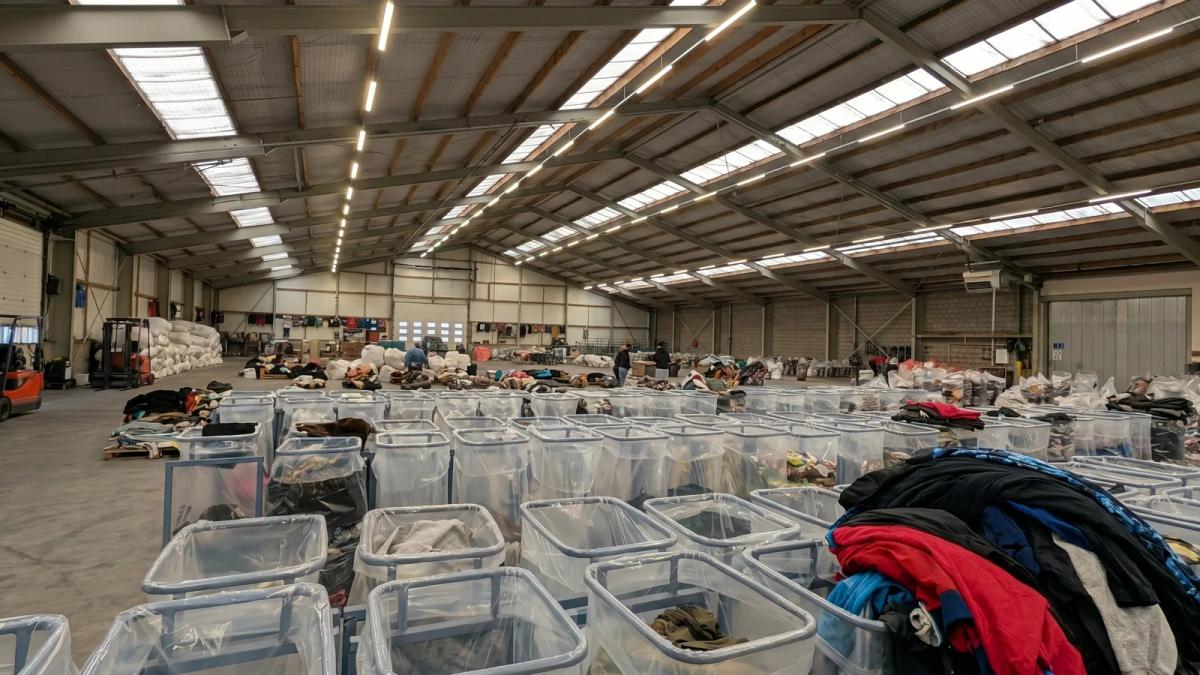
The reason I'll say "start with a sorted bale of your proven brand" is that sorting here isn't a side activity. The team processes 15 to 20 tonnes of secondhand clothing a month and brings in 14 containers a year through three partners in the US and six in Europe. Patrick, with 32 years of industry experience, prepares the bales in the 2,500 m² warehouse in Bovenkarspel and welcomes every visitor personally. The company has worked with that same transparency since 2012: no hidden filler, no surprises at the bottom of the bale.
For a starting reseller, that means your first bale is predictable. You choose by brand, format and grade, and you get a sorted lot instead of a raw gamble. If you want to understand how a wholesaler works at all before you buy, our complete guide to buying vintage wholesale for Vinted is the overview this step-by-step sits under. And you can see the whole wholesale offer at a glance.
Frequently asked questions about Vinted reselling with bales
Should I buy a whole bale right away as a beginner?
No, and I'd actively advise against it. Start with ten to thirty single pieces or a small starter bundle to learn which brands sell in your shop. Only buy a bale once the same brand moves repeatedly. Then a bale is cheaper per piece; before that it's a gamble with a large amount.
How many pieces are in a clothing bale?
For a by-weight bale of 45 kg it depends on the category: roughly 225 t-shirts, 90 sweatshirts or 31 pairs of jeans. Note that some bales are sold by the piece (for example 200 Ralph Lauren shirts). The kilo maths doesn't apply to those, you get the stated count. So always ask whether a bale is by weight or by piece.
Which brands sell best on Vinted?
Look at your own sold items first, that's your best data. The structural performers are heritage (Ralph Lauren, Tommy Hilfiger, Burberry, Barbour), workwear and outdoor (Carhartt, Levi's, Patagonia) and sport and techwear (Nike, Adidas, The North Face). You choose your first bale on the brand your buyers already bought, not on a trend.
What do I do with the pieces that have a minor defect (grade B)?
Don't bin them. A minor defect like a missing button or a washable stain takes ten minutes to fix, and then it's an ordinary sellable piece. Whatever truly won't sell on its own, you bundle as a lot. In an average 70/30 bale, that 30% B is a second income stream, not a loss.
Can I source bales from the Netherlands if I sell on Vinted in Germany or Denmark?
Yes. All four markets are inside the EU, so there are no intra-EU customs duties, and as a registered business you buy under VAT reverse charge. Shipping is fast across NL, BE and DE, or you can collect on site in Bovenkarspel by appointment. Check the VAT detail for your country with your accountant.
What does a bale cost to start with?
Prices depend on brand, format, grade and season, with more than 400 categories that move per season, so there's no fixed figure. The minimum order is €500 excluding VAT. For a current price for your brand and format, request a quote via WhatsApp or a visit.
Conclusion: make your first bale a calculated step
Starting Vinted reselling with bales isn't a leap in the dark, it's a sequence. Sell first to learn, then choose your brand from your own data, then match format and grade to your workday, and work out your margin before instead of after. Reverse those steps and start with a big, random bale, and you'll learn the same lesson, just more expensively.
The wholesaler isn't the enemy of the curated box, it's the logical second phase. Once you know what sells, you want that brand cheaper and in volume, and that's when a sorted bale is the move. Want to judge that yourself before you buy? Come to Bovenkarspel, compare the formats and grades with your own eyes and ask Patrick your questions, or read first who we are since 2012.
Set up your first bale purchase the right way 2 hours exclusively on the bale floor in Bovenkarspel, sorted by brand and grade. No deposit, free cancellation up to 24 hours before. Book a warehouse visit →
Further reading
- Buying Vintage Wholesale for Vinted: The Complete Reselling Guide — the overview this step-by-step sits under
- How to buy your first vintage clothing bale — the purchasing steps in detail
- Vintage clothing grading: Grade A, B and C explained — so you can judge a bale's composition
- How much can you earn reselling vintage clothing? — the realistic margins behind a bale
Ready to buy?
Visit our warehouse · no deposit required · free cancellation.