Buying Vintage Wholesale for Vinted: The Complete Reselling Guide (2026)
To source vintage clothing for Vinted, you buy in bulk: sorted bales or bags from a wholesaler, by brand and grade, then resell the pieces one by one. Starting out, a curated box fits. For margin at…
By Patrick Libanon — founder, Excellent Vintage · Bovenkarspel, since 2012
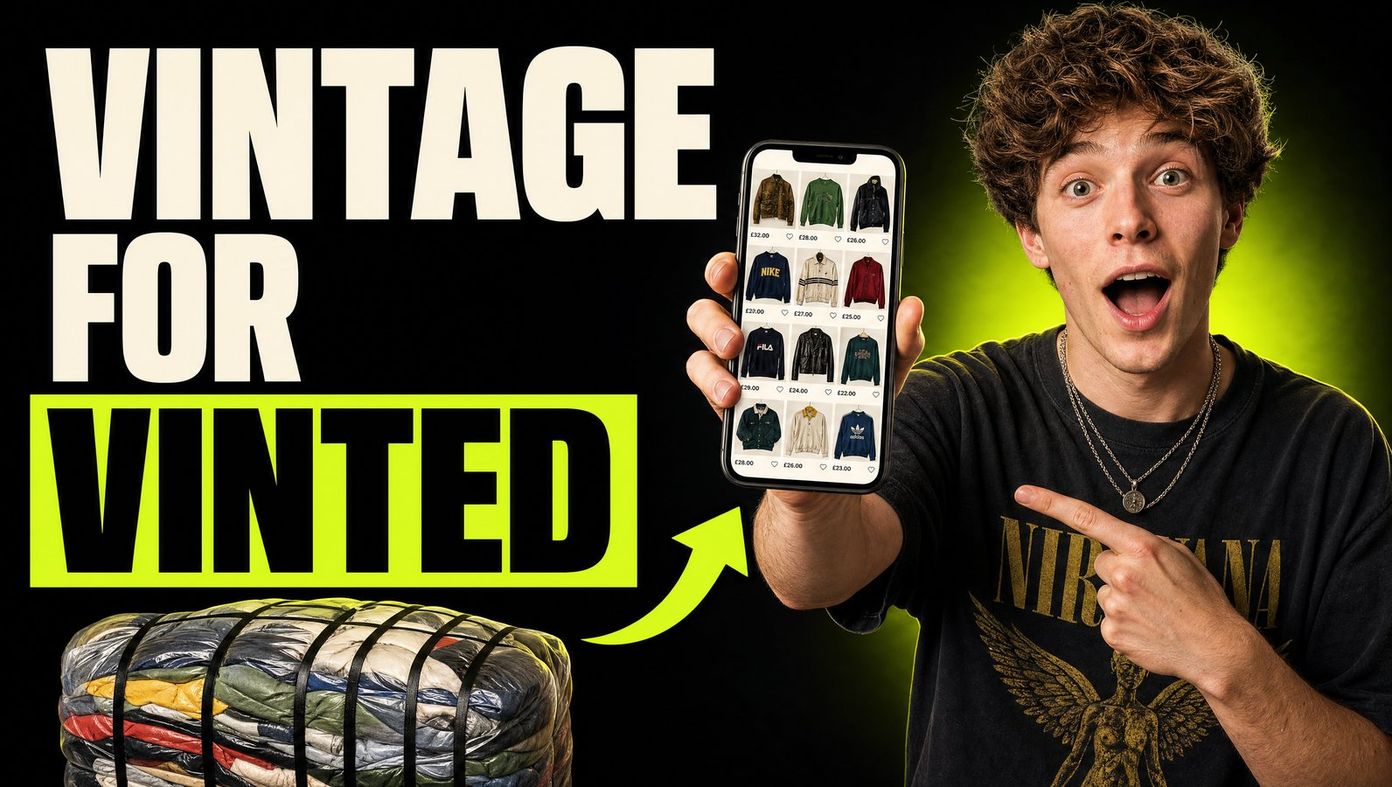
To source vintage clothing for Vinted, you buy in bulk: sorted bales or bags from a wholesaler, by brand and grade, then resell the pieces one by one. Starting out, a curated box fits. For margin at volume, you move to bales. The price depends on brand, grade and season.
That is the short answer. The trouble is that almost every guide on this topic stops there, and that is exactly where you start losing money. "Buy a box, list it on Vinted, profit." It does not work like that. The people who sell you that story are usually selling you a box.
This guide is different, because it comes from the other side of the deal. Excellent Vintage has been a vintage wholesaler in Bovenkarspel, the Netherlands, since 2012: a 2,500 m² warehouse where Patrick sorts and resells 15 to 20 tonnes of secondhand clothing every month to resellers across Europe. We are the source a Vinted seller's stock comes from, often two links up the chain. That gives a view a "tips to sell faster" blog does not have. We see which resellers last and which quit after three bales, and we know why.
We will walk through the whole sourcing side of your Vinted business: where you stand right now (box or bale), how buying really works, which brands sell on Vinted and which format to buy for them, what is honestly inside a bale, and how to choose your first lot without gambling. At each step we point you to a deeper article, so this is the map and the other articles are the zoom-in. A quick note for readers in Germany and Denmark: buying from a Dutch wholesaler is intra-EU, so there are no customs duties between member states, which is part of why cross-border sourcing from the Netherlands works.
Box or bale? Work out where you stand first
The most important decision happens before you buy anything, and it is not "which brand". It is: do I buy a curated box or a bale? Those two serve different stages of a Vinted business, and most mistakes come from choosing the wrong format for your stage.
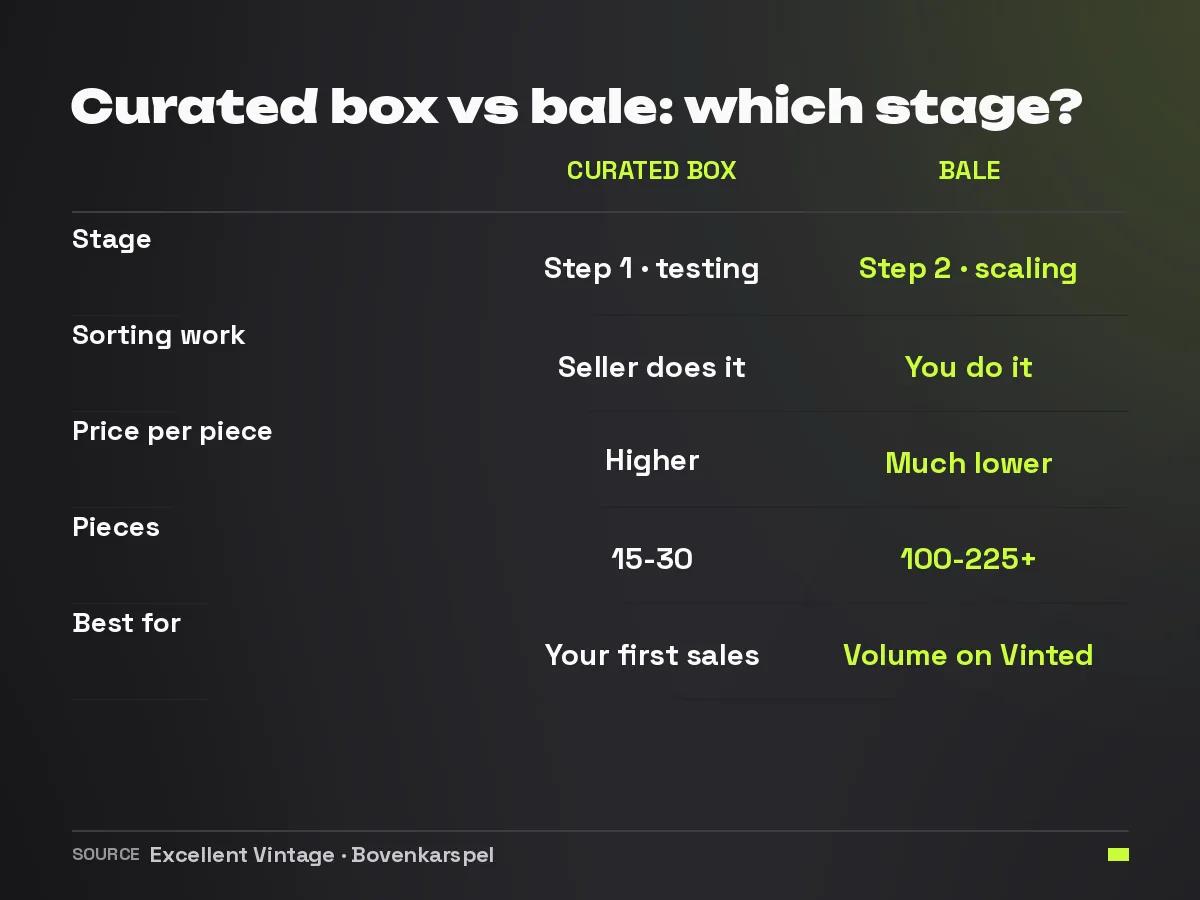
A curated box is what most "Vinted wholesale" webshops sell. A parcel of fifteen to thirty pieces, ordered online, hand-picked for you, delivered to your door. Free shipping over a threshold, returns allowed, low entry. For your first ten sales, that is fine. You test whether you enjoy photographing, measuring, shipping and chatting with buyers, without hundreds of pieces stacked in your hallway. Nothing wrong with it as a starting point.
The problem with boxes is the maths at scale. Someone hand-picked that parcel for you, and that labour sits in the price per piece. While you sell ten pieces a month, you barely feel it. Grow toward a hundred sales a month and you pay that labour a hundred times, and your margin evaporates. Curated boxes are designed to get you started, not to let you grow.
A bale is the opposite. You buy one brand or one category at scale, not hand-picked but by weight or by a fixed count, pre-sorted by brand and grade. The price per piece drops sharply because the sorting work sits mostly with you, not with the seller. A bale is not a luxury upgrade; it is the step that makes your margin healthy again once you run real volume.
The honest rule of thumb: a box is step one, a bale is step two. Once you sell consistently and notice you keep re-ordering to keep your shop stocked, you are paying too much per piece. That is the signal to switch. We worked out the full financial side of that in our guide on how much you can earn reselling vintage clothing; read it if you want to see where the tipping point sits.
How does buying from a wholesaler actually work?
Before you pick a format, it helps to understand what you are buying. A vintage wholesaler sits between collection and the reseller: containers of worn clothing come in, get sorted and pressed, and go out in manageable quantities to people like you. The value a wholesaler adds is not in the buying; it is in the sorting. That is exactly the step you do not want to do yourself for thousands of random pieces.
When you buy, you will meet two models, and the difference matters for your maths. A by-weight bale is roughly 45 kg and is priced per kilo; the piece count depends on the category. A by-piece bale has a fixed number of pieces and does not weigh exactly 45 kg: think 200 Ralph Lauren shirts or 100 Tommy sweaters. With a by-piece bale, the stated count is the honest figure; you should not apply kilo maths to it. So never convert a by-piece bale as if it were weight, and vice versa.
This is deliberately not a full explanation of the whole chain, because we already wrote that. If you want to understand the entire sourcing side, from the US port to the sorting process and the VAT reverse-charge rule, read our complete guide to vintage wholesale clothing in the Netherlands. Here we stay on your side of the counter: what this means for your Vinted shop.
Which brands sell on Vinted, and which format do you buy for them?
This is where the profitable reseller splits from the hobbyist. Not every brand sells at the same speed, and your buying must follow demand on Vinted, not your own taste. The good news: the brands that perform hardest on Vinted are exactly the brands a serious wholesaler keeps in stock.
Sportswear is the engine of the platform. Nike is by far the most searched brand on Vinted, with vintage sweaters, hoodies and Tech fleece moving fast. Adidas sits just behind, especially the Originals and Y2K pieces. But the real workhorse is simpler: a branded t-shirt. A good vintage t-shirt is Vinted's bestseller, because it is cheap to buy, light to ship and quick to sell. Anyone chasing volume builds their shop on a base of branded t-shirts and lays the pricier pieces on top.
Above that sits the heritage layer: Ralph Lauren, Tommy Hilfiger, Lacoste polos, Burberry, Barbour. They sell a little slower but at a higher price per piece, and they have a broad audience that buys year-round. The Ralph Lauren Polo Bear is the textbook example of a piece that catches attention in any feed or stream. Then workwear and outdoor: Carhartt, Levi's, Patagonia, The North Face. That category has exploded in recent years on the back of the gorpcore trend and moves the fastest of all, especially toward a younger audience.
The point is that you buy a different format per brand. Want volume on t-shirts and sweaters? A bale makes sense: one brand at scale, averaging around 70% grade A and 30% grade B. Specialising in a niche, say Hawaiian shirts or one specific brand? A pre-sorted 25 kg bag, "mix premium US", running around 90% grade A, fits better. The full brand mix we keep as standard, ten brands in four clusters, is described in our wholesale offer; use it as a shopping list against demand on your channel.
The ten brands we run, and what they do on Vinted
It helps to think of your buying in clusters rather than single brands, because each cluster plays a different role in your shop. We keep ten brands in stock as standard, split into four groups, and each cluster has its own job for a Vinted reseller.
The heritage cluster, Ralph Lauren, Tommy Hilfiger, Burberry and Barbour, is your reliable base. These brands sell year-round to a broad audience, not at lightning speed but at a tidy price per piece and with little risk of sitting unsold. This is the layer that gives your shop steady revenue while you wait for a peak on other pieces. The workwear and outdoor cluster, Carhartt, Levi's and Patagonia, is the motor: this category currently moves fastest thanks to gorpcore, and speaks to a younger, spending audience. A Carhartt jacket or a solid pair of Levi's rarely lingers.
The sport and techwear cluster, Nike, Adidas and The North Face, targets the youngest audience and runs on recognition and hype. Nike Tech, Adidas Originals and the TNF Nuptse are the pieces you want in bulk for Vinted volume and for Whatnot streams. And then there is the mixed pro stack, where brands like Polo Sport and Barbour serve the pricier, boutique side of Depop, with a higher price per piece for those who sell on style rather than volume.
The craft is to build your shop as a combination, not a single brand. A base of heritage for steady revenue, an engine of workwear for speed, and a few hype pieces from the sport cluster as "stream stoppers" or eye-catchers. The Ralph Lauren Polo Bear is the classic example: one sweater that holds attention in a livestream or at the top of a Vinted shop. Which brands are in right now, and in which grade, is best heard directly, because it shifts with the containers; the full overview is on our wholesale page.
What is really inside a bale? The honest maths
This is where box sellers get vague and where you, as a reseller, need to be sharp. A bale is not a lottery you fish "treasures" out of; it is a predictable lot with a known composition, provided your wholesaler is honest about the grading.
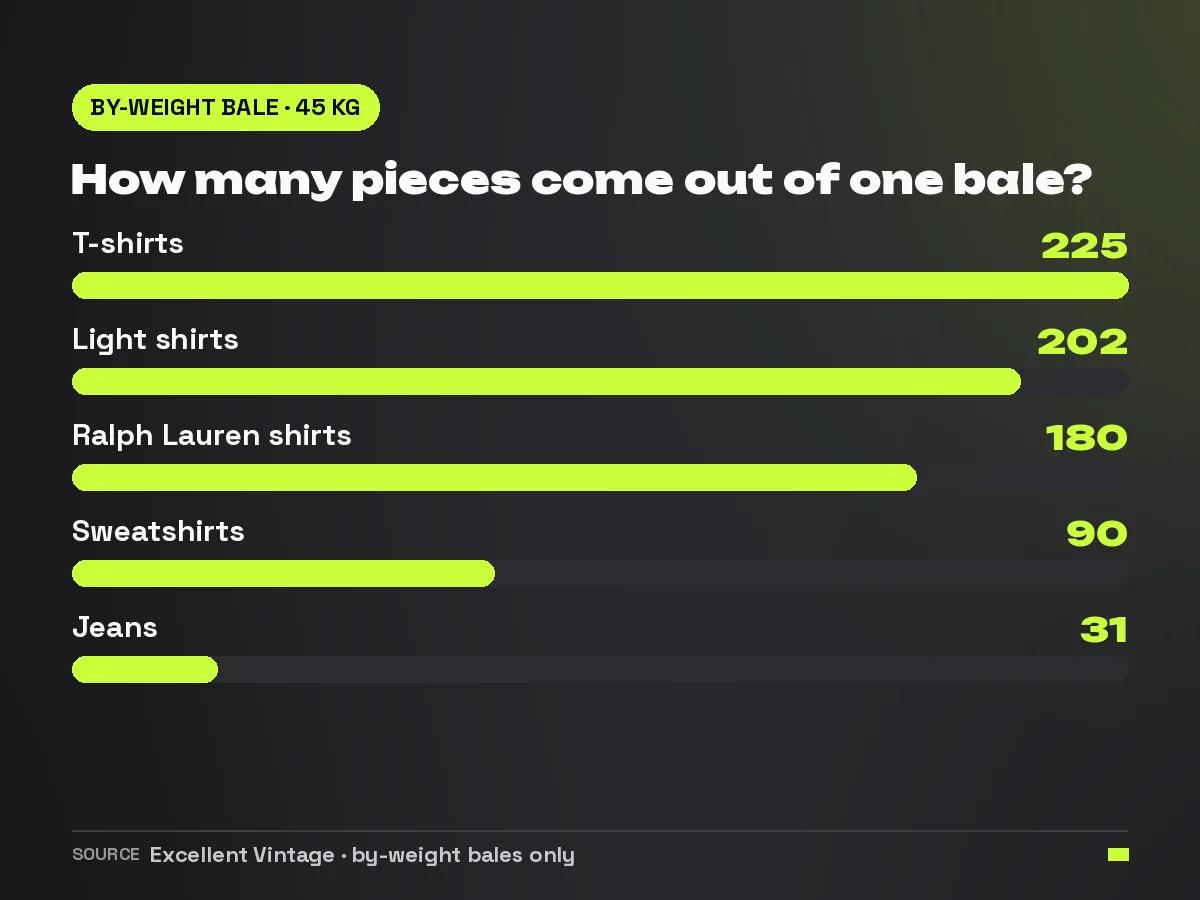
First the volume, because this is what most beginners misjudge. A 45 kg bale is not a fixed number of pieces: the category decides everything. Five t-shirts go in a kilo, so a bale yields about 225. Sweatshirts are heavier, around two per kilo, so the same 45 kg gives you about 90. Jeans are heavier still and yield around 31. Same bale, same weight, a completely different number of listings on your Vinted shop. Buy a bale of jeans expecting t-shirt numbers and you will be disappointed. We laid out the full conversion table and what a bale costs by format in how much a vintage clothing bale costs.
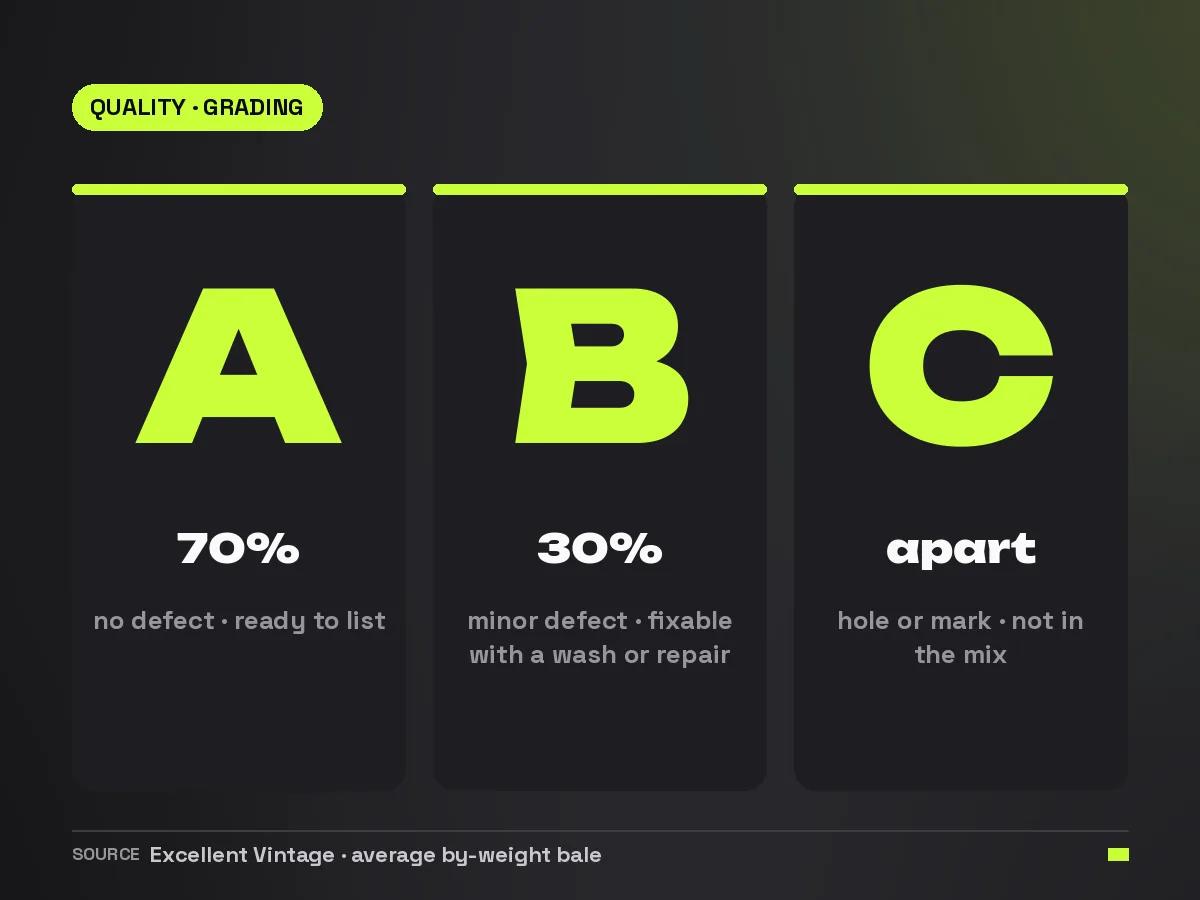
Then quality. Grade A means no defect, ready to wear. Grade B is a minor defect you often fix with a wash or a small repair. Grade C is something bigger, a hole or a bleach mark, and does not belong in a clean mix. An average bale runs around 70% A and 30% B; a premium bag higher. Important for your expectations: even in an honest, well-sorted bale, a small share is not immediately sellable. That is not a scam; it is the nature of secondhand. A wholesaler who promises you 100% perfect pieces is either lying or has quietly slipped grade C into the mix. Plan for that sorting work; it is your margin work.
The full explanation of what A, B and C mean in practice, with examples, is in our grading guide on grade A, B and C. And if you want the difference between a raw unsorted mix and a pre-sorted bale, the difference between "sort it all yourself" and "ready for the photo", read heavy bales vs sorted clothing.
How much stock do you need for a full Vinted shop?
A question rarely asked but central to your buying: how many pieces do you actually need to keep a Vinted shop running? The answer explains immediately why the move to bales eventually becomes unavoidable.
A shop that sells seriously needs a constant flow of fresh listings; buyers come back for new items, and the algorithm rewards activity. Plan to add dozens of new pieces a week to keep momentum. One curated box of twenty pieces is then gone within a week. One by-weight bale of t-shirts, by contrast, yields about 225 listings, enough to plan weeks or months ahead, depending on your sell-through. The same weight in heavier pieces like jeans gives you around 31, so your category choice sets not only your margin but how far ahead you can work.
This is exactly why volume and buying format are linked. Re-order from a box shop every week and you pay the sorting work each time, and you also risk a popular box being sold out the moment you need it. Buy one bale and you have a buffer and a lower price per piece, in return for the sorting and storage work that comes with it. Work out how many listings you sell per month, multiply by the lead you want, and you know which format fits. The bale profit calculator helps you run that, including the work you put in.
Vinted, Depop or Whatnot: buy for the right channel
Many resellers sell on more than one platform, and that changes what you buy. Vinted, Depop and Whatnot are not three flavours of the same thing; they are three different games, and your bale has to suit the game.
Vinted runs on static listings and a broad, price-aware audience. Here the accessible brand that moves fast wins: Nike tees, sweaters, polos, recognisable logos. Volume and turnover are king. You want a bale that yields many listings at a tidy average price, not a handful of expensive pieces that sit for months. This is the channel where a t-shirt bale or a mixed brand bale works best.
Depop has a younger, more trend- and style-driven audience willing to pay more for the right piece. Here curation pays: a sharper niche, a clear aesthetic, better photos. A pre-sorted premium bag often fits better than a raw volume bale, because you can take more margin per piece from an audience that buys on style rather than price.
Whatnot is a different animal, and this is where many guides go wrong. Whatnot is live selling: auctions and livestreams, not static listings. The mechanic is volume and energy in real time. Here it is about large numbers of recognisable pieces you can run through a stream, plus a few "stream stoppers" like a Polo Bear or a Nuptse jacket that hold viewers. Advice that fits Vinted, build bundles, one listing per piece, wait patiently, makes no sense during a live. Buying for Whatnot, you buy for tempo. How you grow from single sales into a running system, with or without live, is in our roadmap from €1,000 to €3,000 a month.
The thing you choose is not the bale, it is the wholesaler
Remember one thing from this whole guide: your biggest risk is not which bale you buy, but who you buy from. A mediocre bale from an honest wholesaler costs you an extra afternoon of sorting. A pretty product photo from an unreliable seller costs you your buying budget. Yet most resellers spend zero time assessing the source and all their time second-guessing a brand.
Here is how to assess a wholesaler without the jargon. First, ask about the grade of a specific lot. An honest outfit says "this bale runs around 70/30, this premium bag around 90/10, and we keep grade C separate". An unreliable one promises you "all grade A" or, worse, uses invented terms like "credential" and "original" that mean nothing and exist only to push the price up. We talk about mix versus pre-sorted, and about A, B and C, because those are the real axes.
Then ask whether you can see the stock. A wholesaler with a real warehouse lets you come and look; a reseller with no stock sends you a rejected photo. Ask who answers your phone. With us, that is Patrick, with 32 years in the trade, who welcomes every visit personally and answers your message himself, in Dutch, English or French. No ticket system, no chatbot, no rotating account manager. That sounds old-fashioned, but in a market full of anonymous webshops, a name and an address are the strongest quality signal there is.
Finally, watch the signals you cannot fake. Since when has the outfit existed? We have run since 2012. How much volume do they process? For us that is 15 to 20 tonnes a month from fourteen containers a year, with three partners in the US and six in Europe. Is there a physical address, a company registration, a real 2,500 m² floor? A wholesaler transparent about its chain and its grading has nothing to hide; one that only talks about "deals" and "treasures" usually does. Who we are and how we work is on about Excellent Vintage, and the full offer is at our wholesale page.
Timing: when do you buy for Vinted?
Stock is not a tap you turn on and off. A wholesaler breathes on the rhythm of its containers, and as a reseller you make money by understanding that rhythm instead of buying against it.
The chain explains it. A trans-Atlantic container is eighteen to twenty-two days at sea, and then another three to five weeks from the port to processing in the warehouse. What sits on the floor this month was bought months ago, and the season it was collected in partly decides what is inside. A southern US state yields more light clothing, a northern one more jackets and heavy sweaters. So stock is not identical every month, and that is normal, not a shortage.
For your Vinted shop that means: buy ahead of the season, not into it. Heavy Carhartt, North Face Nuptse jackets and wool sweaters you want to stock while summer is still on, so your listings are ready when the first cold week lifts demand. Light t-shirts, Hawaiian shirts and shorts you buy in winter, when nobody is thinking about them and you can work ahead. Anyone hunting winter stock only in October fishes in the same pond as everyone else and pays for the crowd. The reseller who thinks a season ahead buys more calmly and sells at the peak.
In practice this also means you want a steady line with your wholesaler, not a one-off order. Tell us which brands move for you and which channel you sell on, and you can be tipped when the right lot comes in instead of waiting for a webshop to happen to show something. How to build that rhythm as you scale is in our roadmap from €1,000 to €3,000 a month.
What do you do with grade B and C?
Many beginners see grade B as a loss and grade C as waste. That is exactly backwards, and it is one of the fastest ways to throw away your margin. A bale averages around 70% A and 30% B, and that 30% B is not a leftover; it is work that pays for itself if you know what you are doing.
Grade B is a minor defect: a stain that comes out after a wash or a steam, a loose button, a seam you fix in two minutes. The difference between a grade B that sells as B and one that sells as A is often half an hour of work per piece. On Vinted, where buyers are used to secondhand, a well-photographed B piece sells fine, especially if you name the defect honestly instead of hiding it. Honesty about a small flaw builds reviews faster than a concealed stain that comes back as a complaint.
Grade C, the real work with a hole or a bleach mark, does not belong in a clean mix and we do not put it there. But even there is value: for some pieces a visible flaw is the story, think distressed denim or a worn-in workwear jacket where the wear is the appeal. Sell it as what it is, not as perfect. The full explanation of what A, B and C mean in practice and how to treat each grade is in our grading guide.
The lesson: count the sorting and repair work into your margin, but never write off grade B. It is not a discount on your bale; it is a second layer of margin for anyone willing to do the work. Run it through the profit calculator before you reject a bale because it is "only" 70% A.
Buying as a business: VAT and the paperwork
Once you buy seriously, you become a business, and that has a few practical sides you are better off arranging in advance. A wholesaler sells business-to-business, so in almost all cases you need a company registration and a valid VAT number. That is not a barrier to fear; it is the same step you take anyway once you sell on Vinted structurally and your sales no longer count as a hobby.
For buying within the EU, the VAT reverse-charge rule applies to business buyers with a valid company and EU VAT number. In practice that means the wholesaler does not charge the VAT; you handle it in your own return, intra-Community. All four markets we serve sit inside the EU, so there are no customs duties between member states, which matters if you buy from the Netherlands and sell in Germany or Denmark. This is the general line; for your specific situation, especially if you are just starting or selling across several countries, align it with your wholesaler and your accountant rather than guessing. We do not invent tax advice, but we make sure the paperwork is correct when you buy from us.
Payment is by SEPA transfer, debit or credit card with no surcharge, or cash on site, and all prices are excl. VAT. Selling happens as it lies on the floor: you see what you buy, which is why we work by appointment. The business side need not scare you; it is simply the difference between a hobby and a shop you take seriously.
The price: why you will not find it online
A fair question we get often: why is there no price list anywhere? The answer says more about quality than you would think. We hold more than 400 categories, and each one is priced on season and on supply and demand. A bale of Carhartt in October is a different story from the same bale in May. A fixed catalogue price would mean decoupling the price from the live market, and that always costs either the buyer or the quality.
So it works differently: you tell us your brand and your sales channel, and you get a current quote that matches what is in right now. No haggling game, no hidden surcharges, just today's price for what you need. That is also the most honest way to check whether a wholesaler knows what they are talking about: ask about a specific brand and grade, and listen for whether the answer is concrete and seasonal, or vague and always the same.
Want to know what your brand costs for Vinted right now? Message Patrick your brand and sales channel and get a current quote based on the season. No obligation, reply within 1 hour, Mon-Fri. WhatsApp Patrick →
From box to bale: the step-by-step
Say you have been selling from boxes for a while and you feel your margin tightening. How do you make the move to your first bale without burning your fingers? Not by blindly ordering the biggest bale. By doing it in steps.
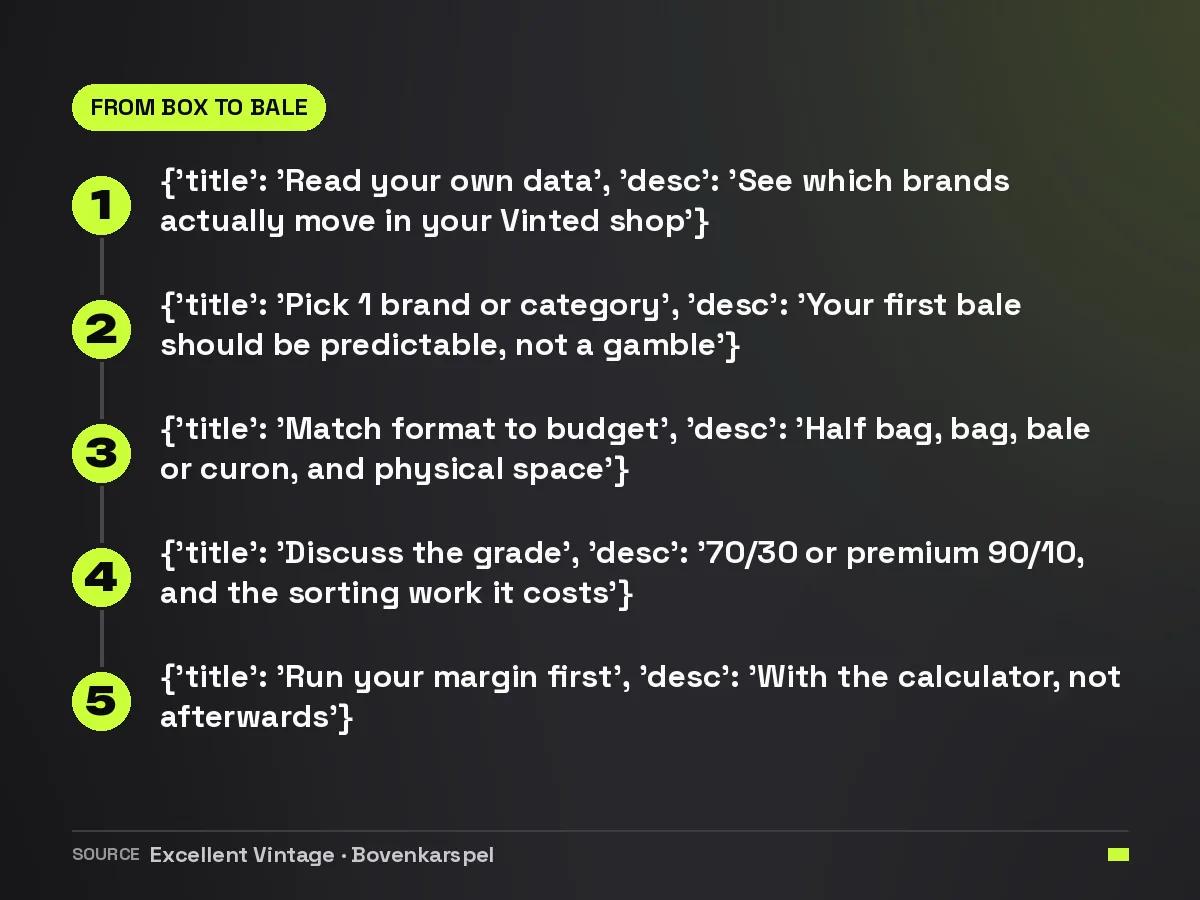
Start with your data, not your gut. Look at your own Vinted sales to see which brands and categories actually move for you. Not what you like, but what sells. That is your buying direction. Then pick one brand or one category you trust most, because your first bale should be predictable, not an experiment. Next, match the format to your budget and your space: a 12.5 kg half bag is a softer entry than a full bale, and you need physical room to photograph and store a hundred-plus pieces. After that, talk to the wholesaler about grade, so you know whether you are buying 70/30 or a premium 90/10, and what that means for your sorting work. And finally, run your margin before you order, not after.
Most people skip that last step, and it is the most expensive mistake. We built a separate profit calculator for a vintage bale for it, plus a full walkthrough of how to buy your first clothing bale. Run through both before you choose your first lot.
Choosing your first bale without gambling: the visit
The biggest fear with a first bale is "a pig in a poke". That fear is justified with an anonymous online order where you buy a sealed bale from a product photo. It largely disappears once you see the stock yourself.
That is why Excellent Vintage works by appointment. You reserve two hours exclusively on the bale floor in Bovenkarspel, pre-sorted by brand and grade. During that visit you choose which bales and bags suit you; you do not pick individual pieces. That sounds like a limitation, but it is the logic of the trade: at 15 to 20 tonnes a month, picking piece by piece is physically impossible, and it is precisely that hand-picking that makes a box expensive. So you choose at the level that matters, the lot, and you see with your own eyes what is inside before you decide.
Patrick welcomes every visit personally; he has done this work for 32 years and speaks Dutch, English and French, with no middleman or chatbot. There is no deposit to book, you can cancel free up to 24 hours in advance, and he calls you the day before to align on what you are looking for. What else to expect from a visit, from parking to how long you are really there, is in visiting our warehouse: what to expect. Want to know who is behind the counter? Read about Excellent Vintage.
Come and see the stock yourself in Bovenkarspel Reserve two hours exclusively on the bale floor, sorted by brand and grade. No deposit, free cancellation up to 24 hours ahead, and Patrick calls you the day before. Book a warehouse visit →
Four stubborn myths about wholesale for Vinted
A cloud of half-truths hangs around buying in bulk, often spread by whoever has something to sell. Four of them cost resellers money on a structural basis.
First: "wholesale is always cheaper". Not by itself. A bale is only cheaper per piece if you do the sorting work a box seller otherwise did for you. Leave your own hours out and it looks cheaper; count them and a bale only becomes profitable once you run enough volume to justify that work. That is why the box-to-bale move is a stage, not a switch.
Second: "grade A only is always better". Sounds logical, rarely is. A bale sold as 100% grade A is either bought in more expensively, or the seller quietly calls B an A. An honest 70/30 with well-treated B pieces often yields more margin than an expensive "all A" you pay for anyway. Always judge the price against the grade, never on its own.
Third: "a sealed bale online is safer". The opposite is true. A sealed bale you buy from a photo cannot, by definition, be inspected. Safer is a bale you see yourself before you decide, which is exactly why an appointment visit exists. You buy on what is there, not on what a product photo suggests.
Fourth: "buying more is more profit". Only if it sells. A second bale of a brand that sits unsold for you is not stock; it is money gathering dust in your hallway. Buy on your own sales data, not on the hope that volume solves itself. How to read that data and align your buying with it is in five mistakes new vintage resellers make.
The mistakes that eat your margin
A quick word on the pitfalls, because they cost almost everyone money at the start. The first is staying in boxes too long because it feels safe, while your volume has long passed the tipping point. The second is buying on your own taste instead of demand on your channel: your favourite jacket is not necessarily what the market buys. The third is confusing the weight of a bale with the number of pieces, and so misjudging your buy. The fourth is comparing a wholesaler's price without weighing the grade, so a "cheap" bale full of grade C ends up dearer than a clean 70/30. And the fifth is calculating your margin only afterwards.
We collected these and other pitfalls, with how to avoid them, in five mistakes new vintage resellers make. If you are just starting and want the whole picture, from budget to first sale, our complete guide to starting vintage reselling with €1,000 is the best starting point.
Frequently asked questions
Where do you buy vintage clothing in bulk for Vinted?
From a vintage wholesaler, not a regular webshop. For your first sales a curated box is enough; for volume you buy bales or pre-sorted bags by brand and grade. Excellent Vintage sells from a warehouse in Bovenkarspel by appointment, so you see the stock before you choose.
Is reselling vintage on Vinted profitable?
It can be, but the margin is in your buying, not your selling. Buy too expensively per piece through curated boxes while running on volume, and little is left. Moving to bales at the right moment is usually what turns a hobby into a profitable shop. Always run your margin in advance with a bale calculator.
Which brands sell best on Vinted?
Sportswear moves hardest, led by Nike and Adidas, with branded t-shirts the outright bestseller thanks to low cost and fast sales. Above that, heritage brands like Ralph Lauren, Tommy Hilfiger and Lacoste sell at a higher price, and workwear like Carhartt, Levi's and The North Face moves fast on the gorpcore trend.
How many pieces are in a bale?
It depends entirely on the category. A 45 kg by-weight bale yields about 225 t-shirts but only around 31 jeans, because heavier pieces give fewer pieces per kilo. A by-piece bale, like 200 Ralph Lauren shirts, has a fixed count you do not convert from weight.
What does a bale of vintage clothing cost?
There is no fixed price: it depends on brand, grade and season, with more than 400 categories whose demand shifts weekly. Send your brand and sales channel via WhatsApp for a current quote that matches what is in right now.
Ready to scale up?
Whether you are weighing your first bale or you have outgrown your curated boxes, the smartest next step is a conversation, not a blind order. Tell us what you sell, and we will think along on the right format and grade for your Vinted shop.
Want to talk through your sourcing? Message Patrick your brand and sales channel, and he will think along on the right format and grade. No obligation, reply within 1 hour, Mon-Fri. WhatsApp Patrick →
Rather see the stock right away? Book a two-hour visit to our warehouse in Bovenkarspel. Pre-sorted by brand and grade, no deposit, free cancellation up to 24 hours ahead. Book a warehouse visit →
Ready to buy?
Visit our warehouse · no deposit required · free cancellation.