Vintage reselling taxes in the Netherlands: KVK registration, VAT and income tax explained
In the Netherlands, buying clothes in order to sell them at a profit counts as a source of income for the Tax Administration, and there is no minimum profit before tax applies. A reseller who buys a…
By Patrick Libanon — founder, Excellent Vintage · Bovenkarspel, since 2012
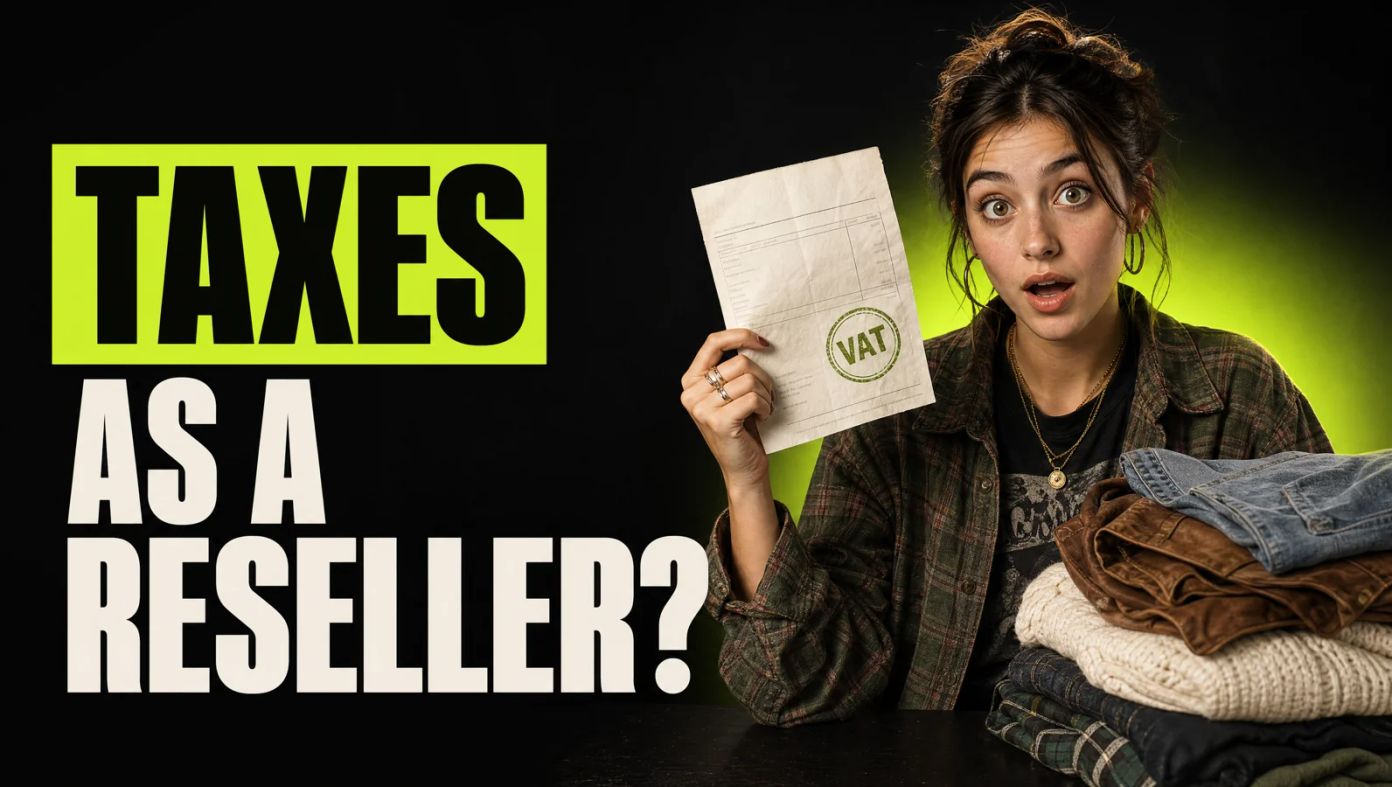
In the Netherlands, buying clothes in order to sell them at a profit counts as a source of income for the Tax Administration, and there is no minimum profit before tax applies. A reseller who buys a bale also faces three separate definitions of entrepreneur: at KVK, for VAT and for income tax.
I have run Excellent Vintage in Bovenkarspel since 2012, and the question I get asked most on the bale floor has nothing to do with clothing. Do I need to be registered to buy from you? What happens with the VAT on your invoice? Will the Dutch tax office know what I sell on Vinted, and from what amount? I am not an accountant and I will not pretend to be one here. What I can do is tell you what the official Dutch sources actually say, in plain English, and what that means on the day you pay for a pallet of second-hand clothing bales. Every rule below comes from the Netherlands Tax Administration, from the Netherlands Chamber of Commerce KVK, or from the government's own English-language business portal, and wherever I draw a conclusion of my own I will say so.
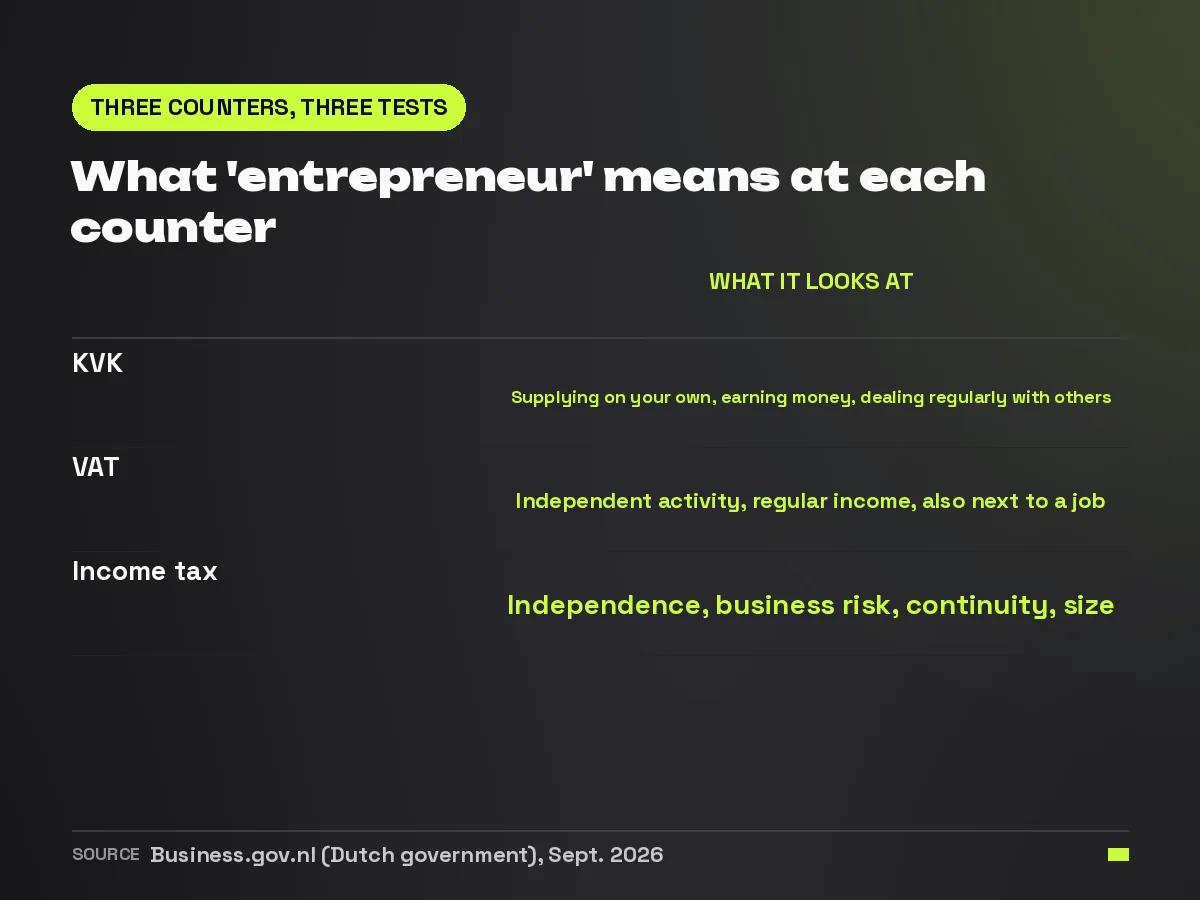
The most common misunderstanding I meet is that being an entrepreneur is a single switch: you register, and then you are one. The Dutch government says otherwise, in as many words. The requirements for being seen as an entrepreneur differ for the Business Register, for VAT and for income tax, and KVK and the Tax Administration apply different rules. Three counters, three tests, and a bale does not flip all three at once.
When does selling vintage online stop being a hobby for the Dutch tax office?
The Tax Administration has a dedicated page on selling goods through online platforms, and it is more concrete than most people expect. If you sell in a private or hobby capacity, you usually pay no income tax on what you receive. The examples the tax office gives are your own clothes or your family's clothes on Vinted, old furniture when you move house, a box of old comics. That is clearing out, not trading.
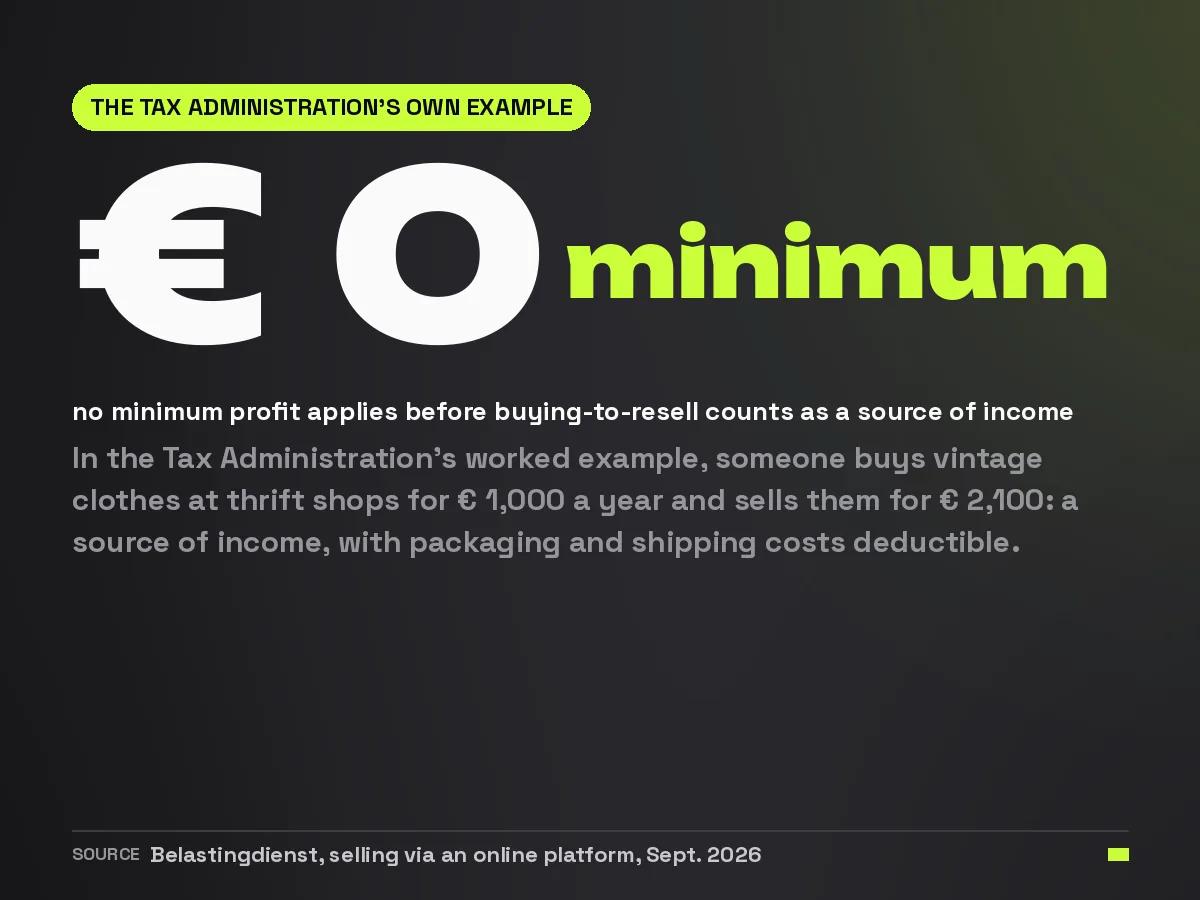
The line is not drawn at an amount but at an action. In the tax office's own words: if you buy goods and sell them and make a profit doing so, your activities are seen as a source of income, and you pay tax on the profit. Then comes the sentence that matters most to anyone who has ever bought a bale: no minimum amount of profit applies.
What strikes me about that page is that the Tax Administration picked our exact world as its worked example. Example two describes someone who notices strong demand for vintage clothing on a second-hand clothing site, visits thrift shops every week, buys clothes for one thousand euros a year and sells them for two thousand one hundred euros. That, says the tax office, is a source of income, with the note that costs such as packaging and shipping are deductible. The counter-example on the same page is baby clothes bought new for five hundred euros and sold a year later for one hundred and fifty: no source of income, because you got back less than you paid.
Put those two examples next to a bale and the answer is not complicated. Someone who spends two hours on our floor and pays for a bale of Ralph Lauren shirts is buying in order to resell. That is example two, only in a single purchase rather than weekly thrift runs. I do not say this to put anyone off. I say it because the reseller who knows it in advance keeps records from the first bale, and the reseller who only hears it when the tax return is due does not.
Do you have to register with KVK to resell vintage in the Netherlands?
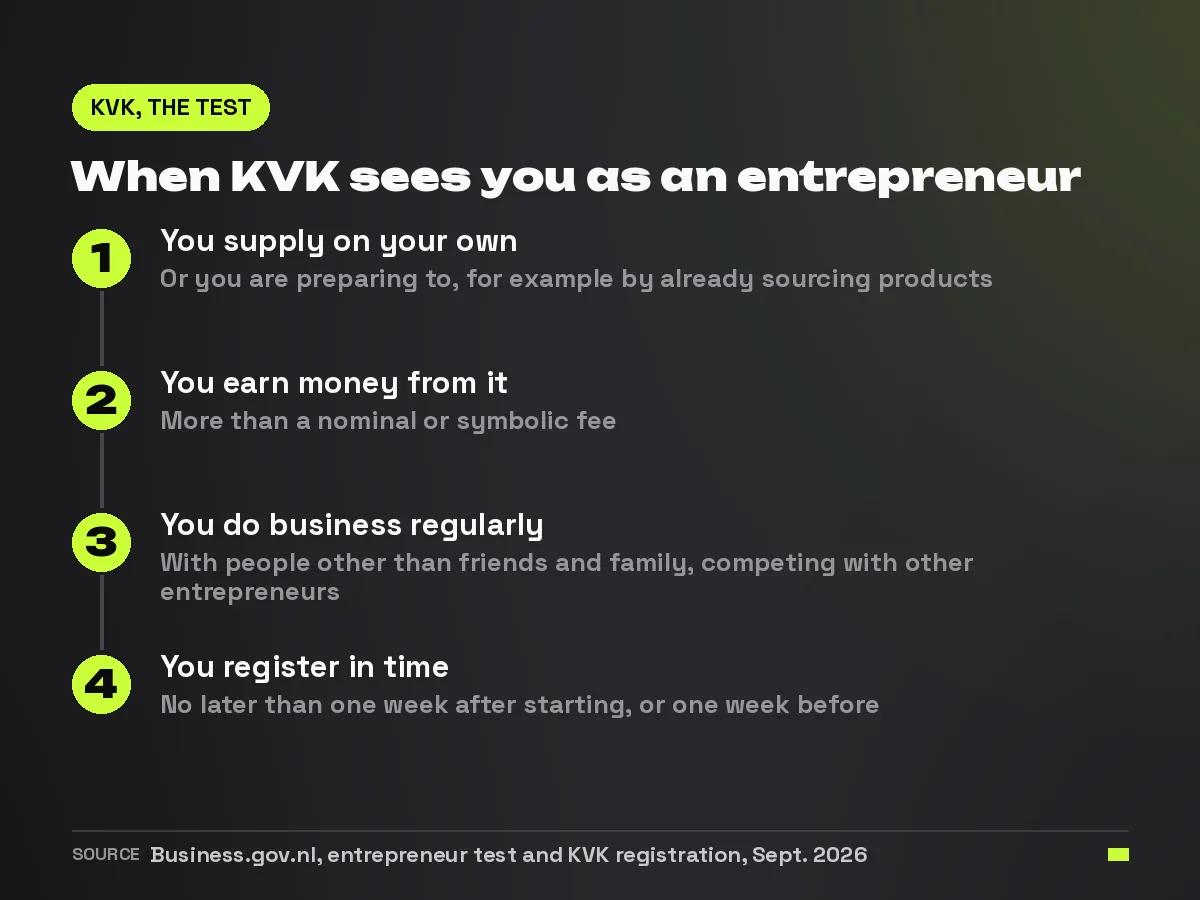
KVK, the Netherlands Chamber of Commerce, applies three criteria, and the first one lands on a reseller immediately. You supply goods or services on your own, or you are preparing to, and the government's example of preparing is that you have already started sourcing products. The second criterion is that you earn money from it, more than a nominal or symbolic fee. The third is that you regularly do business with people other than friends and family, and compete with other entrepreneurs who offer the same thing.
If you are unsure, there are four further questions, which I will not list because they all come down to one thing: are you investing time and money in something you intend to do more than once, for more than one customer, on your own terms. Anyone who unpacks a bale on Saturday, photographs on Sunday and ships during the week recognises themselves without help.
The timing is spelled out precisely. You register no later than one week after starting your business activities, or one week before, or earlier, in which case the registration becomes official one week before your start date. You may only begin trading from one week before your KVK appointment. After that you do not need to register separately with the Tax Administration, because KVK passes your details on automatically. That is the moment counter one and counter two get connected without you doing anything.
If you are based in Germany, Belgium or Denmark, your registration obligations are decided at home, not here; check with your own chamber of commerce. What we need from you is a valid business registration and an EU VAT number on the invoice, and I come back to what that changes for the VAT below.
On the bale floor this has a practical side. A wholesaler sells to businesses, and our invoice carries your business name and your KVK number, or your foreign VAT number. A first-time visitor who has not registered yet hears that from me rather than from the tax office, and a week early beats a week late.
Come and look before you register anything You do not need to be registered to visit. Book two hours on the bale floor in Bovenkarspel, walk the lots, and decide afterwards whether this is the business you want to start. No deposit, free cancellation up to a day before, and I call you the day before your visit. Book a warehouse visit
Is a wholesale bale a margin-scheme good? Why VAT works differently at a wholesaler
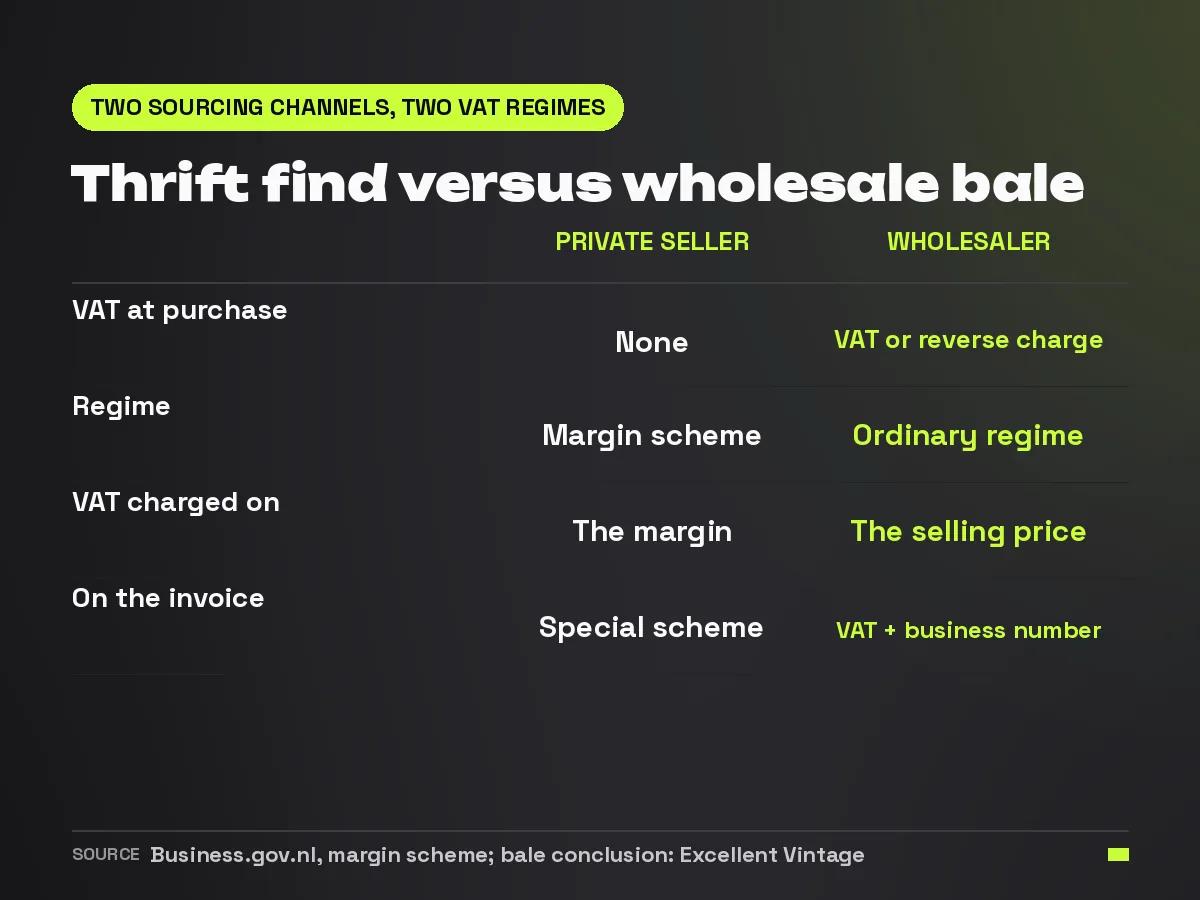
This is the part almost nobody explains to a reseller, and it decides what your bookkeeping looks like. The Netherlands, like the rest of the EU, has a margin scheme for second-hand goods. In the words of the government's business portal, it applies to most used goods that you have purchased without VAT, and goods you buy from a private individual always count as used. Under the margin scheme you do not charge VAT on the whole selling price but only on your profit margin, the difference between the selling price and the purchase price. Sell at a loss and the margin is negative: you enter zero, pay nothing and get nothing back.
For clothing, the globalisation method is mandatory: you calculate the VAT on the total margin of a return period rather than item by item. Your invoice shows no VAT but carries the Dutch wording for special scheme, used goods. For purchases of five hundred euros or more on which you pay no VAT, you draw up a purchase statement. It is a scheme built for the trader who buys from private individuals.
Now the sentence the whole article turns on, and this is my conclusion from that definition, not a quote. A bale you buy from a wholesaler was not purchased without VAT from a private individual. Our invoice shows Dutch VAT, or states that the VAT is reverse-charged if you buy from another EU country. Such a lot therefore falls outside the description of a margin-scheme good. For that bale the ordinary regime applies: you deduct the VAT on the purchase as input tax, and you charge VAT on the full selling price of every piece you sell on. The thrift find and the bale run in opposite fiscal directions, and a reseller who does both keeps them apart in the records. That last point is not my advice; the government portal states that margin goods must be kept separate from other goods in your administration.
For each sale you may also choose not to apply the margin scheme and to charge VAT on the selling price instead, which the portal recommends when your customer is a business that can deduct VAT. That is exactly why our invoices show VAT and all our prices are quoted excluding VAT: our customers are businesses, and an invoice with deductible VAT is worth more to a business than an invoice without.
What the small businesses scheme (KOR) changes for a bale buyer
The Dutch small businesses scheme, the KOR, sounds like a gift to a starter, and sometimes it is one. If your business is established in the Netherlands and your turnover is no more than twenty thousand euros per calendar year, you can opt in. The KOR is a VAT exemption: you do not charge VAT to your customers and you do not file VAT returns. Someone selling a few hundred euros a month on Vinted rightly sees the convenience in that.
But the Tax Administration adds one sentence that changes everything for a bale buyer: you also cannot reclaim VAT on your costs and investments. The VAT on your bale is then no longer input tax you get back but a cost you simply pay. On a thrift find bought without VAT that makes no difference. On a wholesaler's invoice it is the difference between a purchase price excluding VAT and one including it. I deliberately do not work that sum out for you here, because it depends on how much you buy, how much you sell and to whom; it is the kind of calculation you do once with an accountant and then know.
What I do see on the floor is the pattern. The reseller who starts small with thrift shops and bags picks the KOR and is right to. The reseller who scales up to bales discovers that the scheme which helped at first now works against them, and opts out. The Tax Administration also notes that doing business within the EU under the KOR comes with adjusted rules and sometimes an occasional VAT return, and that since 1 January 2025 there is an EU-wide small businesses scheme for people trading in other member states. Anyone selling from the Netherlands to German or Belgian buyers checks that before opting in.
Just ask Patrick If you are not sure whether a bale or a twenty-five kilo bag fits your turnover, that is a five-minute conversation. Message me with your platform and your category and you will hear what came in those weeks and what the invoice will look like. You speak to me directly, in English, Dutch or French. Message Patrick on WhatsApp
Buying from Germany, Belgium or Denmark: the reverse charge, and what it does not cover
Many of our English-speaking buyers do not live in the Netherlands at all. They come from Germany, Belgium and Denmark, and for them the VAT question looks different. A business buyer with a valid business registration and an EU VAT number buys from us with the VAT reverse-charged: we invoice without Dutch VAT, and you account for the VAT in your own country's return. Inside the European Union there are no customs duties between member states, so a bale crossing from Bovenkarspel to Hamburg or Aarhus carries no customs duties on top.
Two things the reverse charge does not do. It does not apply to a Dutch business buying from a Dutch wholesaler; a Dutch reseller pays Dutch VAT on our invoice and deducts it as input tax, unless they sit under the KOR. And it does not tell you anything about income tax in your own country. What Germany, Belgium or Denmark ask of a reseller's profit, I do not know and therefore do not write down. You check that at home. What I can tell you is that everything on our invoice is excluding VAT, and that the paperwork around business numbers and VAT numbers goes to a separate address, info@excellent-vintage.com, so it does not get lost between WhatsApp messages about bales. If you cannot travel, we also sell by video call over WhatsApp and ship the bales, and the invoice works the same way.
Profit from business or income from other work: the third counter
Anyone who has cleared the first two counters tends to think they are done. The government is explicit that they are not: if you are an entrepreneur for VAT, you are not automatically an entrepreneur for income tax. The Tax Administration decides for itself whether your income is profit from business activities, and looks at independence, business risk, continuity and size. Do you set your own prices and your own working hours, do you carry the financial risk if it goes wrong, do you invest time and money in finding new customers, do you have several customers and a certain yearly turnover.
Fall outside that and, according to the same page, you usually have income from other activities. You still file an income tax return on the profit and you may deduct your costs, but you have no right to the special schemes for the self-employed, such as the entrepreneur allowance. And, again in the government's own words, you may well still be an entrepreneur for VAT. The schemes that do exist, from the entrepreneur allowance to the SME profit exemption, additionally require you to meet the hours criterion; the number of hours is not on the page I am using, so I leave that to your accountant.
The practical consequence for a reseller is that whether you pay tax and which deductions you get are two different questions. The first, when you buy to resell, is almost always yes. The second depends on how seriously you run the business, and that is exactly where the bale comes back in: someone who buys regularly, serves several platforms and carries their own stock sees their business risk and their continuity grow on their own.
What DAC7 adds, in one paragraph
DAC7 has been covered on this blog before and will be again, so I keep it short. Platforms such as Vinted are required to report seller data to the Tax Administration once someone makes thirty or more sales in a calendar year, or sells for more than two thousand euros. The Tax Administration itself adds that this does not automatically mean you owe tax, not even above those thresholds. That cuts both ways: the report is not a tax bill, and the absence of a report is not an exemption. Whether you pay tax is decided by the question from the first section, buying in order to resell, not by the platform's counter.
What I see on the bale floor
We handle fifteen to twenty tonnes of clothing a month here, and the large majority of it goes to businesses that sorted all of this out long ago. It is the starter who interests me, because I can see the mistake coming. Someone arrives with a friend, wants to try a single bale, and asks whether it can be done without a business number because it is only a test. My answer is always the same: come and look first, that costs nothing and requires no registration, and decide afterwards. Two hours on the floor tell you more about whether this becomes your business than any page can.
What I also see is that the reseller who sets up the records properly from the first bale is later the fastest to grow. Not because the tax office rewards them, but because they know their numbers. They know what a bale cost excluding VAT, they know which share of a lot was grade A and which share grade B, and so they know what their margin per piece really is. Someone who ignores the fiscal side usually misses those other numbers too. For the arithmetic behind a bale there is an honest bale profit calculator on this blog, and anyone right at the beginning reads the complete guide to starting vintage reselling before worrying about the tax office at all.
For everything else the rule on every government page applies: when in doubt, call. KVK has an advice team, the Tax Administration has a helpline, and an accountant who knows resellers pays for themselves at the first return. I sell vintage wholesale clothing, not tax advice, and the reseller who keeps that distinction too gets the furthest.
Frequently asked questions
How much can you sell on Vinted in the Netherlands without paying tax?
There is no amount. The Tax Administration distinguishes by what you do, not by how much you turn over: clearing out your own things is usually untaxed, buying in order to resell at a profit is a source of income with no minimum. The threshold that is often quoted is the DAC7 reporting threshold, which only decides whether the platform passes on your data, not whether you owe tax.
Do I need a KVK number to buy vintage clothing bales?
If you meet the three KVK criteria, yes: you supply on your own, you earn more than a symbolic amount and you regularly do business with people other than friends and family. Sourcing products is the government's own example of preparing to be an entrepreneur. You register no later than one week after starting; if in doubt, call the KVK advice team. A buyer based in another EU country uses their own business registration and VAT number instead.
Do I pay VAT on a bale of second-hand clothing?
From us, yes: our invoice shows VAT, or the reverse charge if you buy from another EU country. What another wholesaler puts on its invoice, you ask there. If you are a VAT entrepreneur you deduct that VAT as input tax and charge VAT on your own selling price. If you are in the KOR you cannot reclaim it and it becomes a cost. The margin scheme, where you only charge VAT on your margin, is for goods bought without VAT from private individuals, not for a bale with an invoice.
Can I use the margin scheme for clothes from a bale?
Not according to the definition on the government's business portal: the margin scheme covers used goods you purchased without VAT, and a bale is purchased with VAT or under the reverse charge. If you also buy from private individuals, those pieces may fall under the margin scheme, with the mandatory globalisation method for clothing and separate records. Put your situation to an accountant before choosing either route.
Is the Dutch small businesses scheme worth it for a vintage reseller?
It depends on where you source. Below twenty thousand euros of turnover a year you may opt in, you then charge no VAT and file no VAT returns, but you also get no VAT back on your purchases. For someone who mostly buys from private individuals that barely matters; for someone who buys bales from a wholesaler, the VAT on every invoice suddenly becomes a cost. Do that sum once with an accountant before opting in.
Does a German or Danish reseller pay Dutch VAT on a bale?
Not if they buy as a business with a valid EU VAT number: the VAT is reverse-charged and accounted for at home. There are no customs duties between EU member states. What your own country asks of you in income tax is a separate matter, and one to check locally.
Anyone who would rather see what is inside such a lot before walking into any counter is welcome in Bovenkarspel.
Judge the lot before the bookkeeping starts Two hours on the bale floor in Bovenkarspel, four people at most, and you see per bale what is grade A and what is grade B before any invoice exists. No deposit, free cancellation up to a day before. Monday to Friday, nine to five, or by video call if you cannot travel. Book your visit
Ready to buy?
Visit our warehouse · no deposit required · free cancellation.