Vinted Pro or a private account: how your status changes what you buy
The form is the easy part. You enter your business registration number, you get a badge next to your name, and on paper little has changed.
By Patrick Libanon — founder, Excellent Vintage · Bovenkarspel, since 2012
The form is the easy part. You enter your business registration number, you get a badge next to your name, and on paper little has changed.
The change sits at the other end of your stock. On the buying side you face a wholesaler: business to business, and the bales are what they are. On the selling side you face somebody the law calls a consumer, with every right that comes with it. You sit between the two, and the gap between what you can demand on one side and what your buyer can demand on the other lands on you. It decides which bale you should carry out of the warehouse next time.
Vinted Pro is the status for anyone selling in a professional capacity: you register with your business details and your profile then shows them. Vinted's Pro-seller guides state that a buyer purchasing from a trader holds consumer rights, including a cooling-off period and a legal guarantee that also covers second-hand goods.
Where the line actually sits
How many sales before you need to go Pro? Vinted answers that qualitatively. The Pro-seller guide on Vinted's Dutch domain frames the criterion as a capacity: if you sell in a professional capacity, you must declare yourself as a Pro seller.
The Dutch guide grounds that duty in the EU consumer rights and unfair commercial practices directives, and notes that penalties vary by the country where you are registered. The guide on the UK domain instead cites the Consumer Contracts Regulations 2013 and warns that failing to declare can result in sanctions. The Dutch, UK and German guides all carry the same passage, which is the one that matters in practice: Vinted may ask you to create a Pro account if it holds information showing you meet the criteria, and may block your access if you do not register.
For anyone who drives to a warehouse and leaves with forty-five kilos of clothing, the question sits close to home. You bought stock in order to sell it on, piece by piece. Whether that puts you in the professional capacity Vinted describes is a legal question for your accountant or your national business register.
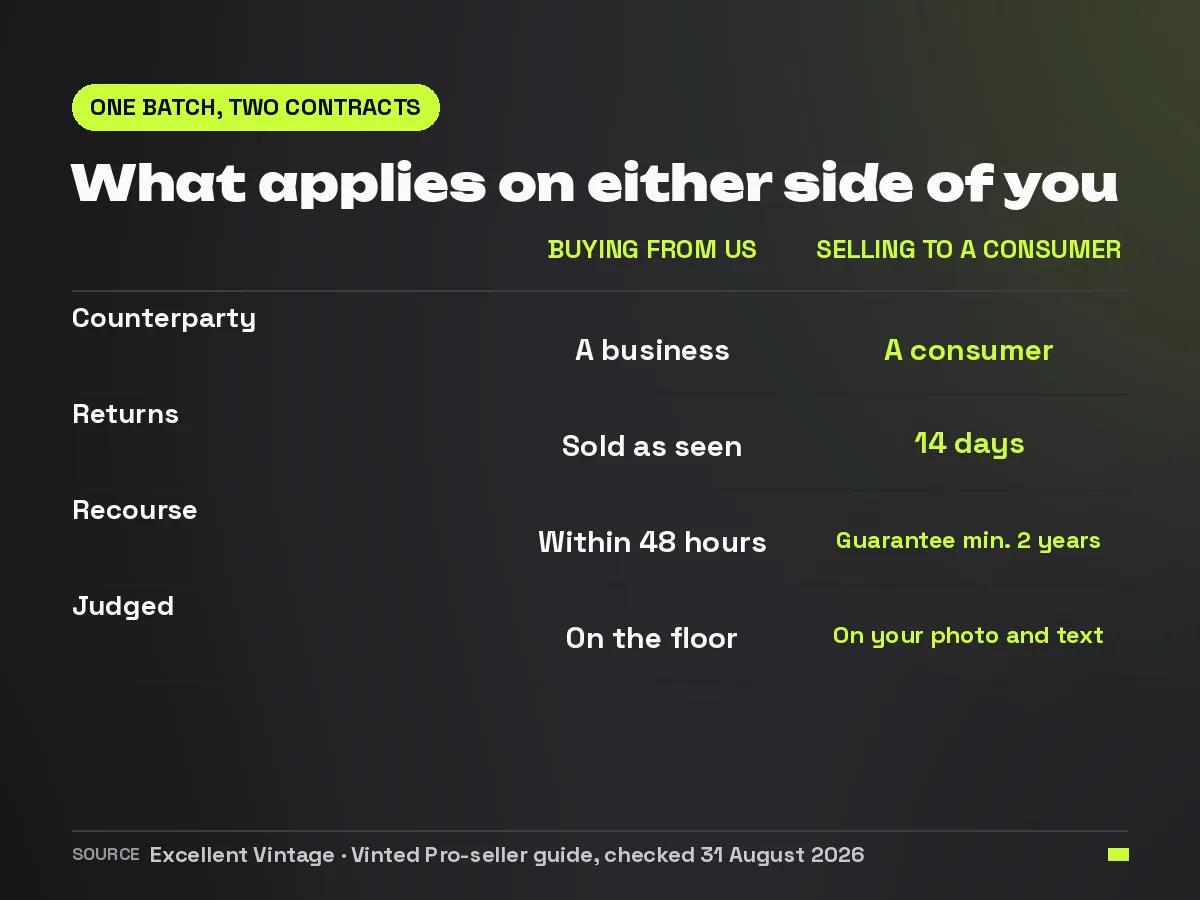
Pro and private, side by side
Put the two statuses side by side and the weight of the difference sits in the contract. On Vinted itself your working method stays largely the same.
The number of items you list stays unlimited either way, and Vinted states on its Dutch Pro page, checked on 31 August 2026, that Vinted Pro is free. Your business does become visible. A badge appears next to your name, and your profile page shows your business name, business number, contact details and business address; only sole traders can choose during registration to keep those details private.
The real shift is contractual. As a Pro seller you sell under Vinted's standard terms, with a template withdrawal form attached, and your buyer holds the rights a consumer holds against a trader. Those rights belong to the role you sell in; the button on Vinted is how the platform implements them. That is what shows up later in what you buy.
Who can register, and why you should read your own domain
Vinted's pages do not say the same thing on every domain, and the differences run deeper than wording.
The help page on registering as a Pro seller names sole traders, charities and registered companies incorporated in Italy, the Netherlands, France, Spain, Portugal, Luxembourg, Belgium or the UK. The Dutch help page carries that same list. The Pro guides on the Dutch and German domains give those countries without the UK, and add that more countries may follow and that you may notice Pro sellers elsewhere as part of a beta test, while the guide on the UK domain skips the list and simply addresses businesses registered in the United Kingdom.
The German-domain guide carries the same requirement passage as the others, which means the duty to declare yourself is written on domains whose own eligibility lists are shorter than the help pages'. The two kinds of page do not carry the same list. The source to rely on is the help page of the domain you actually sell on, on the day you need it. Those five pages were checked on 31 August 2026.
Whatever they say, one thing holds either way: the badge is a Vinted feature, while a trader's obligations come from consumer law. The cooling-off period and the guarantees attach to the capacity you sell in. What the button gives you is the standard terms, the withdrawal form and a profile that shows buyers who they are dealing with.
What you provide, and what you cannot change later
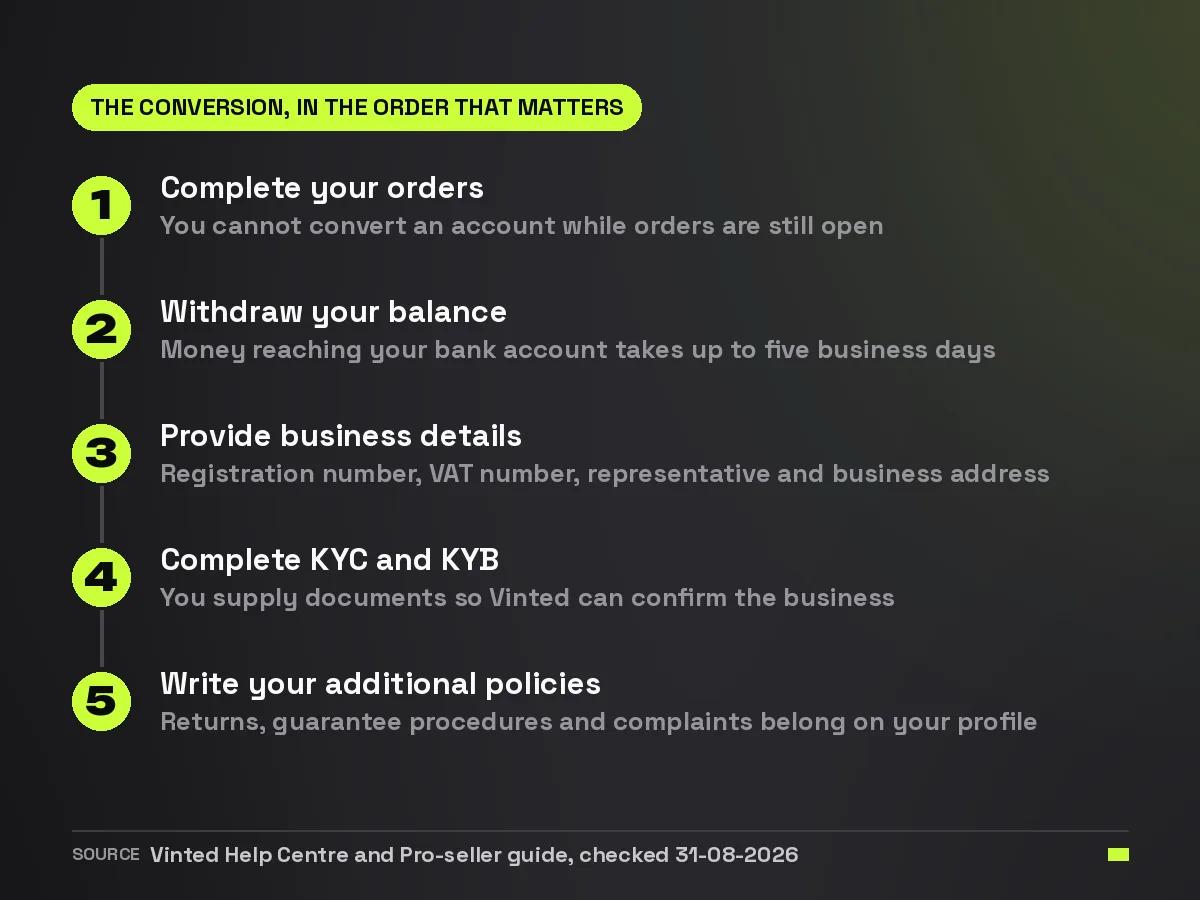
Registration itself is quick. You either sign up through the Vinted Pro page or convert your current account, and you provide business details: your business registration number, your VAT number if your business has one, the business representative's details and your business address. The exact fields follow your country. The UK page asks a sole trader for a National Insurance number, and charities and registered companies for a Tax Identification Number and a business registration number; the Dutch page asks for the KvK number, which Vinted describes as the eight-digit company identification number issued by the Chamber of Commerce. You then supply documents for the KYC and KYB process.
Two details from those pages are worth reading before you start the conversion. First: you cannot convert an existing standard account while you have ongoing orders. You wait until everything is completed and your balance has been withdrawn to your bank account, and that withdrawal takes up to five business days. Anyone deciding on a Monday to move across should plan around that. Second: some details can be managed in your Vinted Pro settings afterwards, such as your VAT number, while the Tax Identification Number, or the KvK number on the Dutch page, requires you to contact Vinted.
You may also hold one standard account and one Pro account side by side, as long as you register the second one with a different email address and phone number. That suits a reseller who keeps selling their own wardrobe alongside the business: business in one account, personal in the other, and no argument afterwards about which sale belonged to which capacity.
The fourteen days you cannot pass back up the chain
Once you sell as a trader, the Dutch guide gives your buyer fourteen calendar days to withdraw, counted from the day after delivery, without having to give a reason. It describes three ways to do it: pressing the button in the chat to say there is an issue, sending the template withdrawal form from the Pro terms, or making any other unambiguous statement. The buyer is reimbursed the full amount paid, including the delivery costs, and the direct cost of sending the item back sits with the buyer unless the additional policies Vinted asks you to publish on your profile say you cover it.
Now look at the buying end. In Bovenkarspel you buy what is in the hall, as seen. Nothing goes back unless that was agreed in writing, and a complaint is made in writing within forty-eight hours of receipt. That is an ordinary arrangement between two businesses, and it is also why you come and look first: you judge the batches yourself, with the bales in front of you. Our guide to buying vintage wholesale for Vinted sets out how that side works.
Those two regimes do not line up. That is how the chain is built: your customer's right to change their mind does not travel up to your supplier, it stops with you. Anyone meeting it for the first time during the third return of the same week has run into a buying problem, and it gets solved at the next batch they pick rather than at the parcel counter.
See the bales before the risk is yours If the returns land on your stock, you want to have seen the bales. You book two hours on the bale floor in Bovenkarspel, up to four people, and those two hours are yours alone. Booking costs nothing up front and cancelling is free up to twenty-four hours ahead. Patrick calls you the day before to go through the visit. Book a warehouse visit
Second-hand does carry a guarantee, and the wording differs by market
Beyond the cooling-off period, the Dutch guide states that everything you sell as a Pro seller is automatically covered by the legal guarantee of conformity, the guarantee that an item is what you said it is. Its German counterpart agrees with it on the substance: a minimum guarantee of two years that also applies to second-hand goods, reducible in some EU countries to no less than one year by agreement with the buyer. Whichever domain you sell on, your own consumer authority is the place to confirm which version applies to you.
The Dutch guide adds a guarantee against hidden defects, which the buyer can raise within two years of discovering the defect and up to five years after the purchase. Vinted publishes those periods without naming a country, and they do not appear in that form on every domain: the UK guide sets out a different ladder altogether, running through thirty days, six months and six years. Which periods apply to you, and how they work in practice, comes from your national consumer authority or a lawyer in your market.
What you do with it is where we can help. In the Dutch guide the test is whether the item is fit for normal use and whether it matches the description you gave, and that second half is the lever. A hidden defect is, by definition, one that was hidden; a pull on the sleeve that you photographed and named is, by the same definition, not hidden.
So the status of your product description changes. On a private account, an honest listing is a matter of decency and of your rating. As a Pro seller it is your file. The Dutch and UK guides put it in the obligations list in as many words: you describe the essential characteristics of the item, and you indicate if it is damaged or faulty in any way. And a description belongs with the sorting, with the garment in your hands, because that is when you see the details you would otherwise have to hunt for on a screen two days later.
What that does to the bale you choose
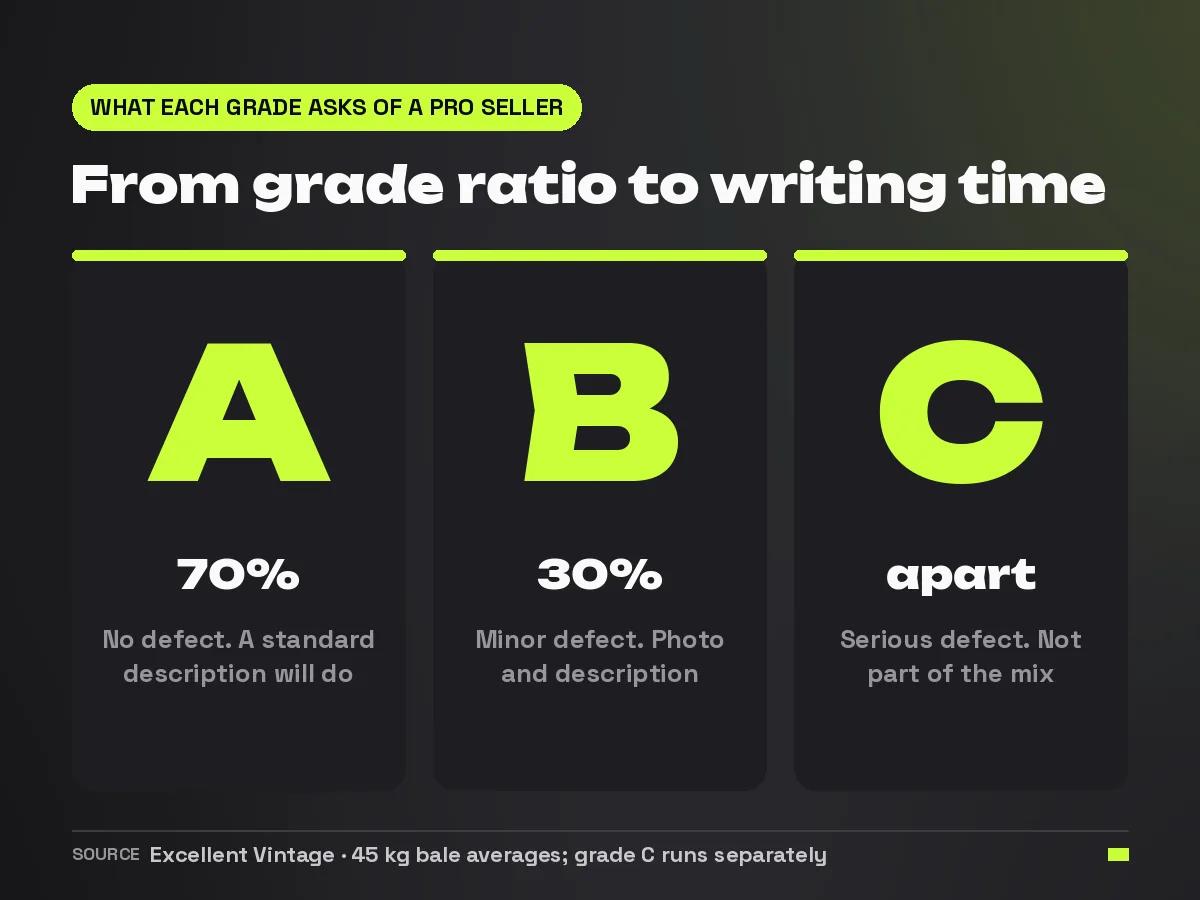
We work with four formats and three grades. A forty-five kilo bale averages seventy per cent grade A, garments with no defect, and thirty per cent grade B, with a minor one. A twenty-five kilo "mix premium US" bag averages ninety per cent A to ten per cent B. Grade C, a serious defect such as a hole or bleach discolouration, runs separately and is not part of those mixes. Those ratios are averages across the supply; a given batch can fall differently, and the piece on grade A, B and C goes deeper into what a defect means in practice.
For a private seller that difference is a margin question: more B means more work per piece and a lower average return. For a Pro seller a second layer arrives. Every grade B piece you list, you list with a detailed description of the defect, because that description is what protects you later. That takes time per item, and the time belongs in your calculation alongside the buying and the postage.
So the choice widens. Alongside volume against niche, a second question joins it: how much description do you want to write per piece? A reseller working at pace, who wants stock listed rather than described, tends to land on the higher grade ratio of the bag. A reseller who photographs and describes each piece anyway handles the thirty per cent of B in a bale comfortably and takes their volume from it. It only grates when you buy the bale with the pace of the bag in your head.
DAC7: the report and what it covers
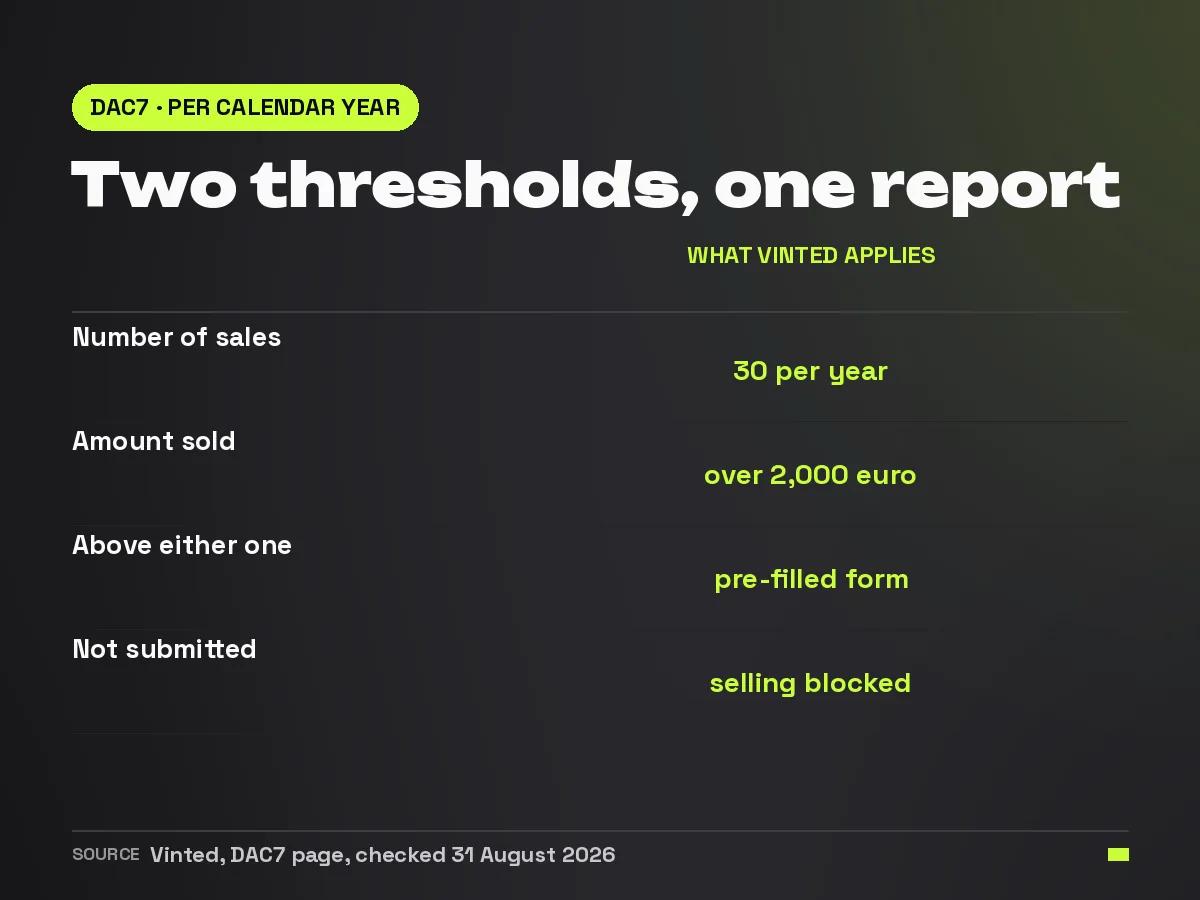
One more subject stands apart from your account status: DAC7. That reporting duty does not look at your badge, it counts your sales, per calendar year.
On its own DAC7 page Vinted explains that this is an EU reporting obligation for online marketplaces. It covers anyone making at least thirty sales in a calendar year, or selling for more than two thousand euro. If you meet either criterion, Vinted says you receive a largely pre-filled form that you finish yourself, forwards the information to the authorities the following year, and sends you a copy.
Two qualifications come with that, and they point in opposite directions. Vinted writes on that same page that meeting the criteria does not mean you owe tax on your Vinted sales. Conversely, the reassuring line on that same page, that selling second-hand is tax-free, is about clearing out your own belongings rather than about buying stock to sell on. The Dutch and UK Pro guides both state that you alone are responsible for registering with the business registry and for meeting your social and tax obligations. What that means for your situation comes from your accountant or your tax authority; for a seller registered in the Netherlands, our piece on taxes and registration as a vintage reseller sets out what the Chamber of Commerce, VAT and income tax each ask. Here we stay with what we see in the hall.
Ignoring the form costs more than filling it in. Vinted writes that you eventually lose the ability to sell, along with access to your Vinted Balance, until the form is submitted.
How this looks from our side of the floor
Excellent Vintage has been going since 2012 and processes fifteen to twenty tonnes of clothing a month from a 2,500 m² hall in Bovenkarspel. Patrick, thirty-two years in this trade, is on the floor himself for every visit, and the bales are pre-sorted by brand and grade before you arrive.
What you see during those two hours is partly the brands in stock and partly the questions that come with them. A buyer who asks how the grade split of a batch actually falls is thinking about what happens to those pieces after the purchase: who buys them, and what they have in hand if one comes back. That is the conversation we would rather have, because the answer decides which batch goes into the van, how much text each piece will need, and how the rest of the year's buying is going to look. A visit to the bale floor runs two hours and costs nothing up front.
The full offer, with the ten brands permanently in stock, is on our vintage wholesale clothing page.
Ask Patrick directly If you are weighing up whether a bale or a bag suits the way you sell, that is a five-minute conversation. Message Patrick with your platform and your category and you will hear what is on the floor that week. You get him personally, in Dutch, English or French. Message Patrick
Frequently asked questions
At how many sales do I need a Vinted Pro account?
There is no number to find. Vinted's guides tie the duty to the capacity you sell in, and the figure of thirty sales that circulates on forums comes from DAC7, a reporting rule that runs separately from your account status. Whether buying bales to sell on puts you in a professional capacity is a question for your accountant or your business register.
What is the difference between a Pro account and a private account on Vinted?
Listing, shipping and the wallet work the same way. What changes is who carries the risk of a disappointing piece: on a private account that sits with the buyer, on a Pro account it sits with you, through the cooling-off period and the guarantee, and your profile shows your business details to every buyer. That is why a Pro listing takes more writing per piece.
Can I register as a Pro seller on my own Vinted domain?
Vinted's help pages and its Pro guides do not publish the same eligibility list, and the guides add that more countries may follow and that Pro sellers may appear elsewhere as a beta. The only reliable answer is the help page of your own domain on the day you check it. What does not depend on the badge is the set of obligations a trader carries under consumer law.
What happens if Vinted asks me to become a Pro seller and I do not?
The Dutch, German and UK guides carry the same passage: if Vinted holds information showing you meet the criteria for a professional seller, it may ask you to create a Pro account, and it may block your access if you refuse. Registering yourself first also lets you choose the moment, since a conversion cannot start while orders are still open.
Where do my own return rules go as a Pro seller?
Into the additional policies Vinted asks every Pro seller to publish on their profile: whether you accept returns beyond the fourteen-day withdrawal period, who pays the return postage, and how a guarantee claim or a complaint is handled. The Dutch guide also lists the identification details that belong there, from the registered name and address to the registration number.
Can I keep a private account next to my Pro account?
Yes, one standard account and one Pro account, provided the second one is registered with a different email address and phone number. The line to hold is what gets sold where: stock bought in to sell on belongs on the Pro account, because a trader's obligations attach to the capacity you sell in, not to the account a listing happens to sit on.
Does a Pro account change how I should buy?
Our terms stay the same: a bale is sold as seen whatever your status. What shifts is your choice. Because you absorb your customer's withdrawal period yourself, the grade ratio of a batch becomes a risk decision on top of a margin decision, and describing your pieces becomes work you count in.
Come and judge the batches yourself The difference between seventy-thirty and ninety-ten is hard to read off a page. When you book, tell us which platform you sell on and which category you run, and Patrick will know it before you arrive. Mondays to Fridays, nine to five, in Bovenkarspel. Visit our warehouse
Ready to buy?
Visit our warehouse · no deposit required · free cancellation.