How to Date Vintage Nike Tags: Eras, Colours and the Code Hidden Under the Care Label
Every guide to vintage Nike tags promises years, and almost every one of them delivers eras. That comes down to the sources. Nike has never published a chronology of its clothing labels, so the…
By Patrick Libanon — founder, Excellent Vintage · Bovenkarspel, since 2012
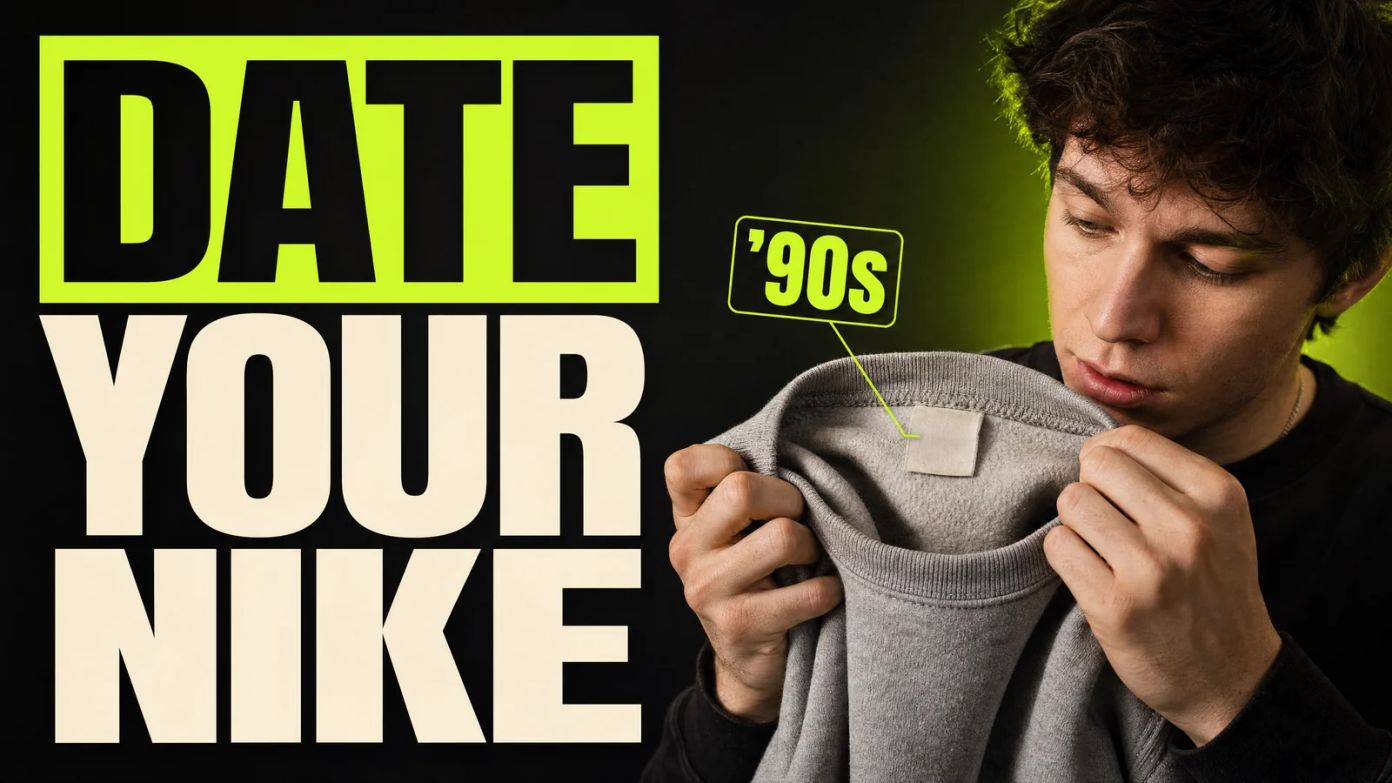
Every guide to vintage Nike tags promises years, and almost every one of them delivers eras. That comes down to the sources. Nike has never published a chronology of its clothing labels, so the timelines that circulate for the orange tag, the blue tag or the grey tag were pieced together by collectors and dealers from the garments that passed through their hands. The order they describe is remarkably consistent. The exact years are not, and treating them as fixed cutoffs is how resellers end up listing a sweatshirt half a decade earlier than it was made.
Here is the short version for anyone sorting at speed: The guides place an orange swoosh on white in the late 70s to 1983, blue in the mid 80s, grey with a red logo in 1987 to 1994, white-black-red in the late 90s and plain grey in the 2000s. An actual year sits in the code label under the care tag.
At Excellent Vintage we have been sorting in Bovenkarspel, in the Netherlands, since 2012, in a 2,500 m² warehouse where 15 to 20 tonnes of second-hand clothing bales pass over the tables every month. Nike is one of the ten brands we always keep in stock, in the sport and techwear cluster next to Adidas and The North Face. Patrick, who runs the floor and has 32 years in the trade, dates a Nike tag in the time it takes to turn the garment inside out. That reading routine sticks to what several of those guides actually document.
Why do Nike tags give you an era rather than a year?
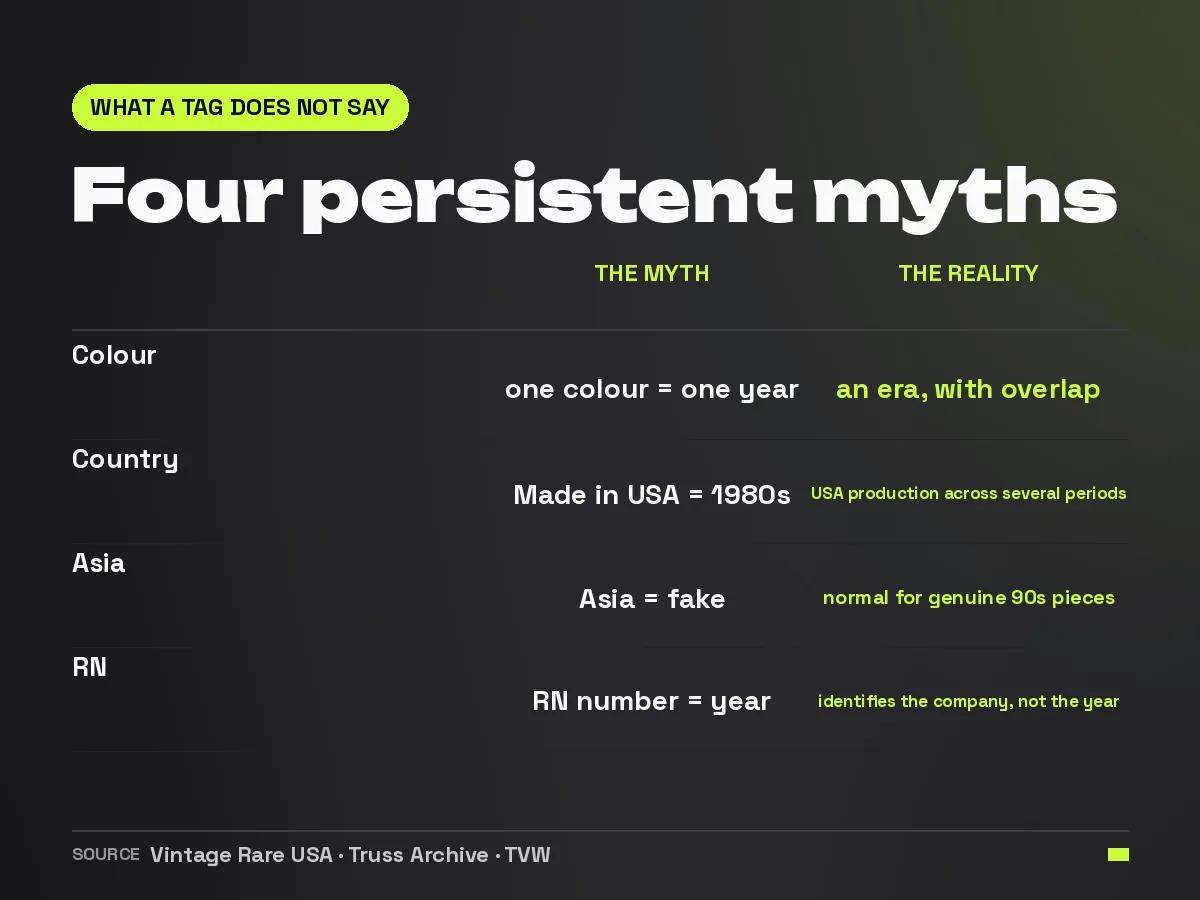
Because the knowledge comes from resellers, not from Nike. The most thorough of the tag guides, published by the American dealer Vintage Rare USA, says so in plain words: its dates are practical estimates rather than absolute cutoffs, Nike sometimes used several labels in the same period, certain product lines had specialised tags of their own, and label styles overlap in transitional production years. A guide that hangs one colour on one year is claiming more than its sources know.
What the guides agree on is the sequence. Whether you read the Dutch guide from Wildebras Vintage, the guides from Vintage Rare USA and Relic96, or the wholesale-side guide from TVW, the same order appears: pinwheel and orange swoosh, then blue, then grey with a red logo, then white with black and red, then the bare grey label of the 2000s. The edges move by a year or two from one guide to the next; the order never does. The sequence is solid ground. The exact years remain estimates.
There is a second reason to stay modest, and it trips up more people than the dates do: the guides use different names for the same tag. What Wildebras calls the "silver tag" of 1987 to 1994, a grey box with a bright red Nike logo, is the "grey tag" in Vintage Rare USA and TVW. And what Vintage Rare USA calls the "silver label" of the 2000s is the "grey label" in Wildebras. Search by the name and you can land a decade out. Look at the combination in your hand instead of the label a guide sticks on it.
Which tag colours belong to which decade?
The earliest clothing tags the guides document come from the late 1970s, and two designs recur. The pinwheel, a circle of swooshes arranged like a windmill, is placed between 1978 and 1982 by three separate guides and counts as rare; when a genuine one turns up, the print quality, font, stitching and fabric all deserve a second look before anyone calls it authentic. Alongside it sits the tag most people know as the oldest: a thin white label with the brand name in blue and an orange swoosh. Wildebras describes it as the label in use for the longest and has it ending in 1983; Vintage Rare USA gives 1978 to 1983. They agree on the end and disagree on the start, so the start stays open here.
Next comes the blue tag. Blue background, logo and lettering in silver-grey, the size usually printed in yellow according to Wildebras. The guides put it between 1983 and 1988, with the weight on 1984 to 1987. Relic96 and TVW both note that these pieces often read "Made in USA". It is also the era in which Nike signed Michael Jordan, in 1984, and according to Wildebras the garments of those years are noticeably brighter in colour and bolder in design than what came before; on the sorting table that shows up in the windbreakers and colour-blocked track jackets more than anywhere else.
The grey tag with the red logo is placed by the guides from around 1987 into the mid 1990s. Vintage Rare USA warns that several grey variants exist and that colour alone should never fix an exact year. TVW adds that the swoosh becomes slightly thinner and cleaner in this period, and that Nike was rolling out global production, so "Made in Taiwan" or "Made in Indonesia" frequently points to these years.
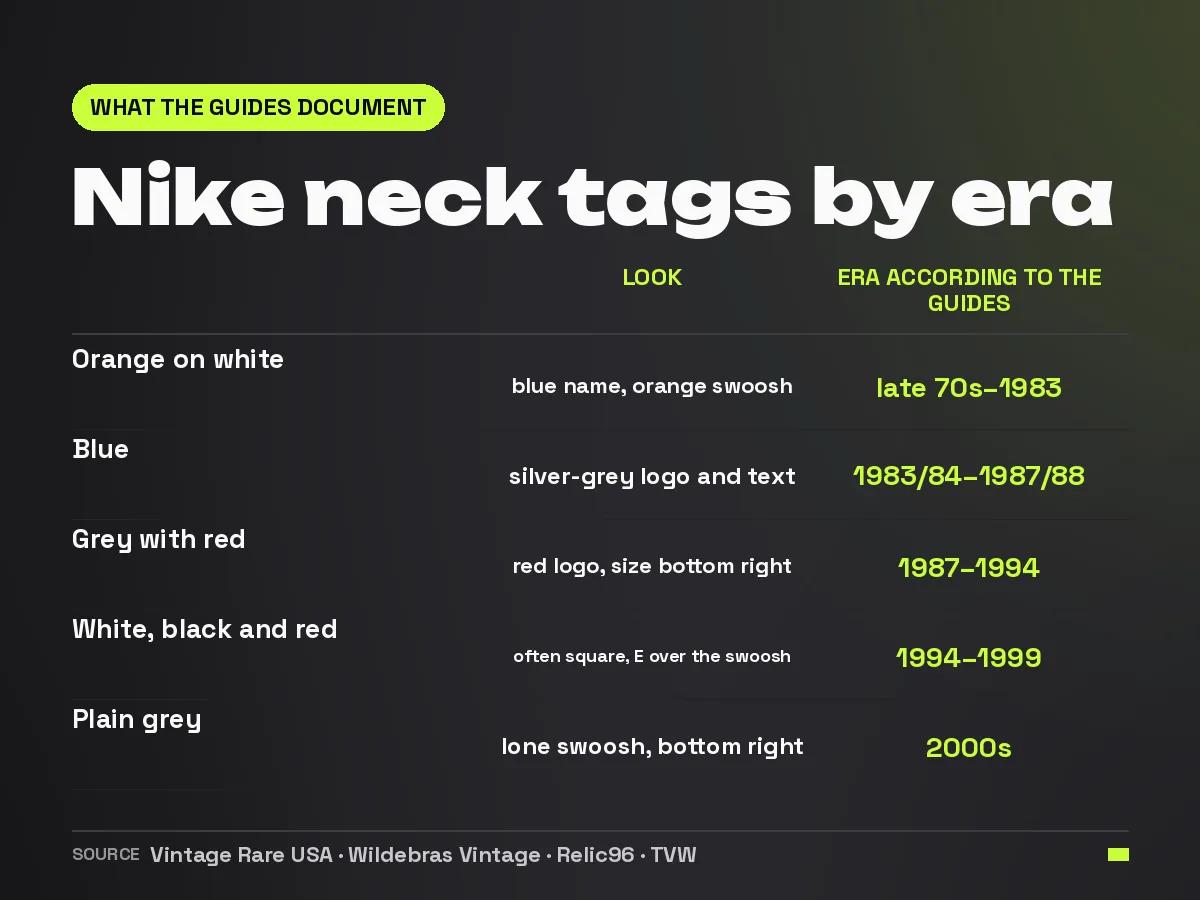
The guides place the white, black and red labels between 1994 and 1999, often square, sometimes rectangular. Wildebras points to a detail you learn to spot quickly: the Nike name sits closer to the swoosh, so the "E" hangs slightly over it. Vintage Rare USA also describes a black tag around 1994 and a red-and-black tag from 1997 to 1999 on sweatshirts, fleece and caps, but it is the only source to date those two, so treat them as a pointer rather than a rule. Vintage Rare USA describes printed white labels on t-shirts and woven white labels on jackets and trousers in the same period.
For the 2000s the guides describe the tag that turns up most often in second-hand clothing bales today: entirely grey, no brand name, just a swoosh sitting not in the centre but slightly bottom right. Vintage Rare USA stresses that this one, too, came in multiple variations across the decade, so "silver tag" never means a single year. According to Wildebras it is the last label Nike sewed into t-shirts; after it, tees moved to a heat-transfer print in the neck, while jackets and trousers kept a label. A printed neck therefore points to a more modern piece.
Where is the actual year, if there is one?
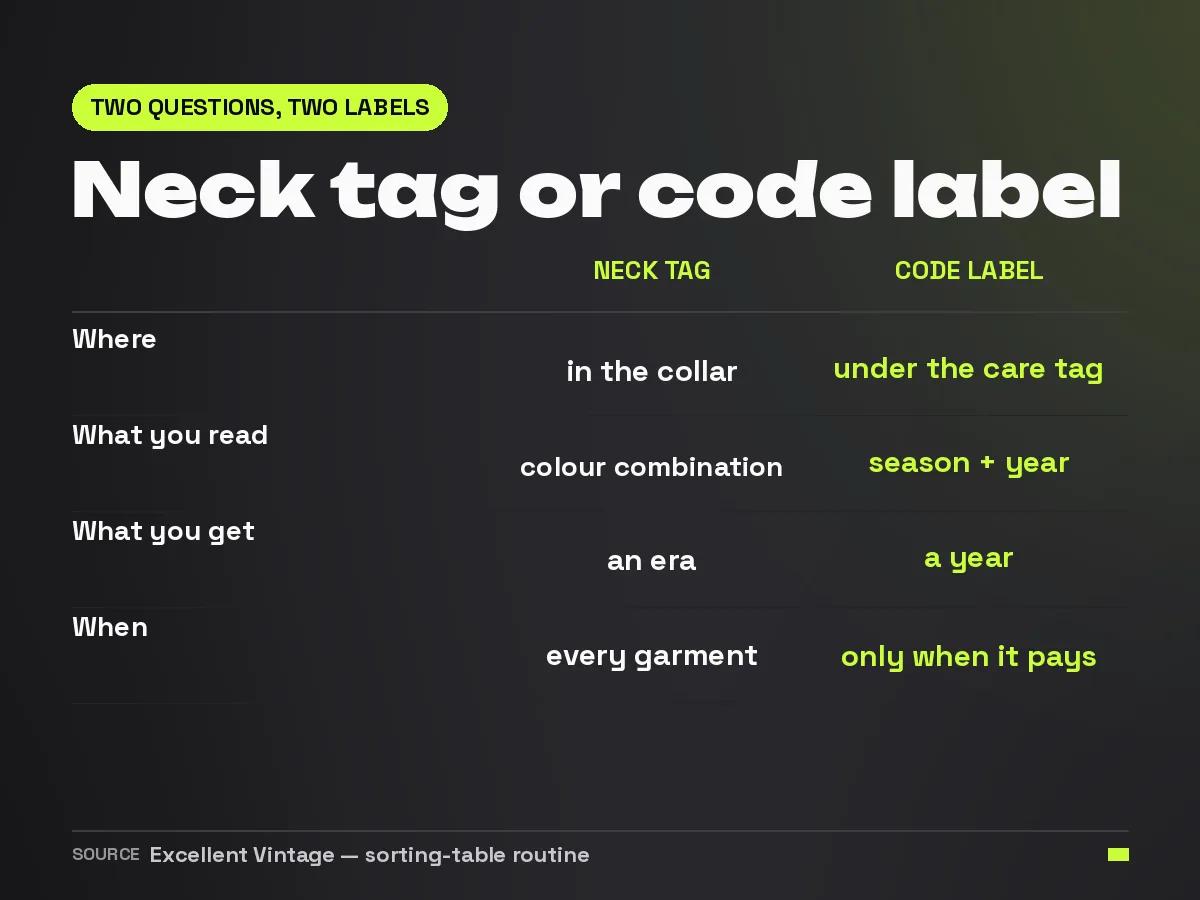
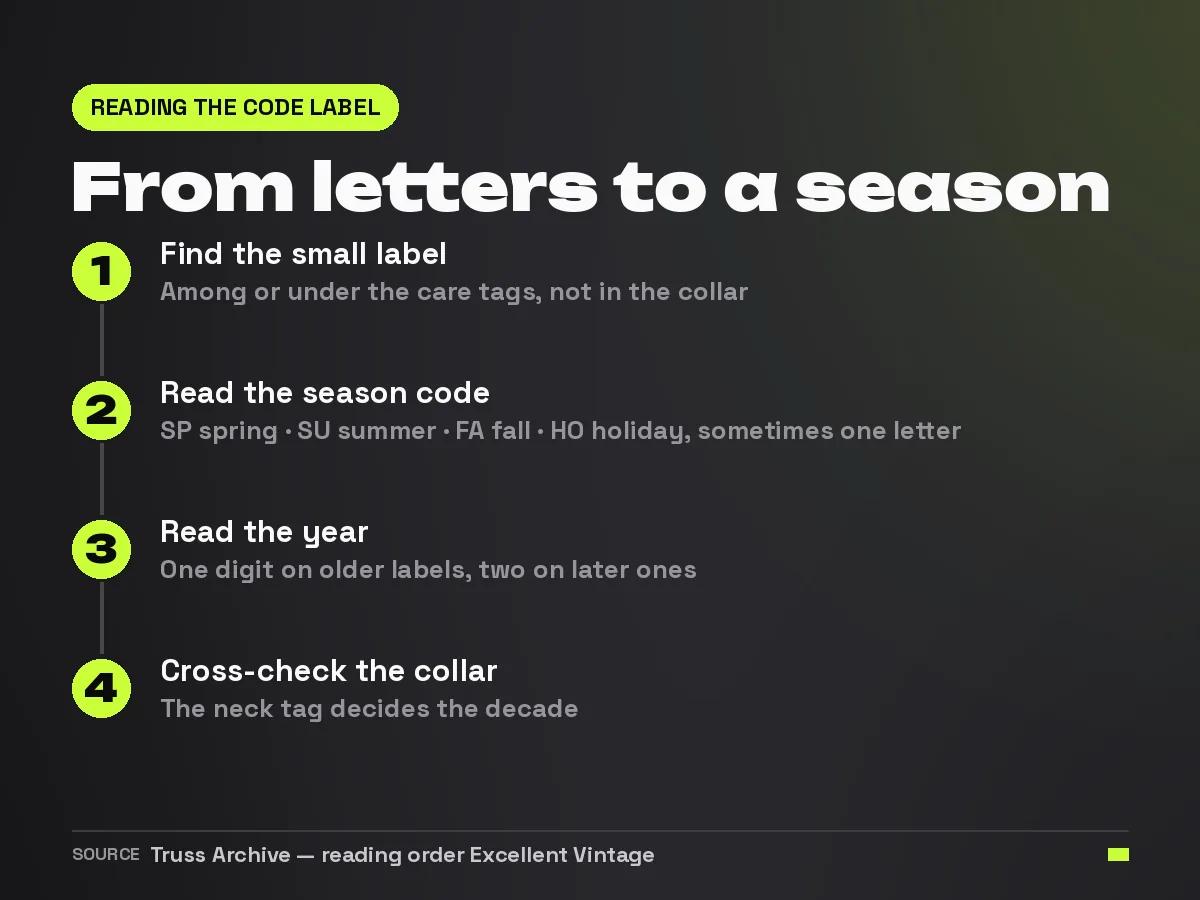
Not in the collar. When a year exists, it lives on a small label among the care tags. Truss Archive describes a code of six to twelve characters whose first characters give the season and the year. Nike, by that guide's account, works in four seasons: SP for spring, SU for summer, FA for fall and HO for holiday, sometimes shortened to a single letter. On older labels a single digit for the year follows, which means the decade has to come from the neck tag; an "F2" could be 2002, and that is exactly where the colour of the collar earns its keep. From the late 2000s, Truss says, the year became two digits, so "SP20" simply reads spring 2020.
The sources contradict each other here, and that deserves saying plainly. Relic96 describes a different format: a six-digit style code, a three-digit colour code, and a production date written year-then-month, so that 9807 would be July 1998. Both formats may have existed in different periods; there is no document from Nike to settle it. Read what is printed, check that it fits the era the neck tag suggests, and if the two disagree, trust the collar and file the code among the open questions.
Two numbers that appear on almost every Nike care label will not help you. Truss Archive lists RN 56323 and CA 05553 as the registration numbers Nike carries as a textile producer in the United States and Canada. At most they confirm the label belongs to a regular Nike product; a production date cannot be read from them. Vintage Rare USA says the same thing from a different angle: an RN number identifies the registered company, not the year. A date hung on the RN number is not reliable.
See what an era does to the resale price A 1980s Nike and a 2004 Nike are two different listings. For resellers we keep a database of what vintage clothing actually resells for on Vinted, Depop and closed eBay sales, by brand, category and grade, refreshed weekly. Ask Patrick to walk you through the Nike numbers. Message Patrick on WhatsApp
What do "Made in USA" and Asian production tell you about age?
Less than most listings claim, and the guides are unusually united on this. American production is common on pieces from the late 70s through the mid 80s; Fashion Rerun, TVW and Relic96 all name it as a feature of the early tags. But Vintage Rare USA is firm that "Made in USA" on its own proves no age at all: Nike went on selling USA-made garments across different periods, so an American label can sit on a later piece just as well. Country of origin is supporting evidence.
The reverse holds just as strongly. A garment reading "Made in Korea", "Taiwan", "Malaysia" or "Indonesia" is not a fake. Nike manufactured at scale in Asia from the 80s and 90s onward, and both TVW and Vintage Rare USA describe those countries as entirely normal for authentic 90s vintage. Fashion Rerun adds a detail worth keeping: labels from those factories carry more information, including washing instructions, while the early American labels are sparse. Lay a stack of Nike from one bale side by side on the sorting table and that is the first thing you notice: the barer the tag, the more likely you are looking at an early piece.
Which other details back up the tag?
The tag opens the reading. On t-shirts a single stitch at the hem and sleeve is a pointer to an older piece, but Vintage Rare USA is clear that it proves nothing on its own: some genuine vintage tees are double-stitched, and modern reproductions imitate single stitching on purpose. The stitching counts. It does not decide.
Fabric says more than most resellers expect. Fashion Rerun, written by a textile specialist, describes the late 80s and 90s as the years of nylon taffeta, ripstop and later polyester microfibre for jackets and windbreakers, polyester tricot for track pants, and jersey and French terry for tees and sweatshirts. Anyone who has worked through a few seasons of second-hand clothing bales knows the difference by touch: an early-90s taffeta jacket rustles differently from a late-90s microfibre one. Relic96 adds the tag itself as a clue: older labels feel stiffer, even papery, while 90s labels are softer and more often frayed.
Then there is wear. Genuine age lives in details nobody fakes convincingly: dull or scratched zips, fading around the collar and cuffs, cracking on old printed graphics, hook-and-loop closures that have lost their grip. Fashion Rerun turns that list into a reverse test: if only the fabric looks aged and the hardware looks new, you are probably holding a reproduction. Nike regularly reissues past designs, and those retro pieces carry contemporary labels, modern blends and current care instructions. Good garments, but not vintage, and they should not be listed as such.
Why is an era enough on the sorting table?
Because on a bale floor you date a Nike to put the garment on the right pile in seconds. A windbreaker with a blue tag and silver-grey lettering goes to the 80s and to the pile for Vinted and Depop shops with an eye for detail. A centre-swoosh sweatshirt with a grey tag and a red logo goes to "late 80s, early 90s"; a Tech Fleece jacket with a plain grey label and a printed neck is a modern piece for the youngest buyers. That distinction decides where the garment goes, how it is described and which reference it is priced against. A year to the season adds nothing to that decision for the vast majority of pieces. Patrick reads the collar; he checks the code label under the care tag only on the garments that justify the extra minute.
An era that holds up is worth more than a year that merely sounds precise, especially when a listing puts your name behind it. Compare it with dating a Carhartt, where the production date is printed straight on the care tag, or with dating a pair of Levi's, where stitching, rivets and patch are read side by side. With Nike the collar does the heavy lifting and the code label is the bonus.
Want to read Nike tags between real bales? Book two hours on the bale floor in Bovenkarspel, exclusive to you. Turn the collars yourself, see which eras each bale holds and pick the bales that fit your audience. No deposit, free cancellation up to 24 hours before, and Patrick calls you the day before. Book a warehouse visit
How buying vintage Nike by the bale works, which lines suit which sales channel and how grading plays out is covered in our guide to vintage Nike wholesale in the Netherlands; that article promised this dating guide, and here it is. The wider picture of formats, sorting and what a vintage wholesale clothing supplier actually delivers is in the complete guide to vintage wholesale in the Netherlands. And keep the grade A, B and C explainer next to this one: era and grade together decide how a piece is described and where it goes.
FAQ: dating vintage Nike tags
How can I tell how old my Nike shirt is?
Start with the neck tag and match its combination of background, logo colour and brand name against the eras above. Then look at the care label, the stitching, the fabric, the country of manufacture and the style of the print. When all of them point to the same period, you can date the piece with confidence; when one disagrees, you have a reason to look longer.
What years were Nike orange tags used?
The guides place the white tag with the blue name and orange swoosh in the late 1970s through 1983. They agree on the 1983 end and differ on the start, because Nike never published a chronology of its own. The rare pinwheel tag from the same years is placed between 1978 and 1982.
What years were Nike blue tags used?
The blue tag with silver-grey logo and lettering is placed between 1983 and 1988 by the guides, with most of the weight on 1984 to 1987. Many of these garments read "Made in USA", and according to Wildebras the clothing of this era is generally brighter than that of the orange tag.
Are Nike silver tags vintage?
It depends which grey you mean. The grey box with a red Nike logo belongs to the late 80s and mid 90s and is vintage by any definition. The plain grey label with only a swoosh comes from the 2000s; the earliest of those are now over twenty years old and are commonly sold as vintage, but age alone does not make a piece rare. Bear in mind that the guides use "grey" and "silver" interchangeably.
Does Made in USA guarantee that Nike clothing is vintage?
No. American manufacture is a useful clue, especially on the early tags, but Nike sold USA-made garments across several periods. The country confirms at most what the collar already told you.
Can I date Nike clothing from the RN number?
No. According to Truss Archive, RN 56323 and CA 05553 are the registration numbers Nike carries as a textile producer in the United States and Canada; they appear on almost every care label and say nothing about the year. The year, when there is one, sits in the small code label with the season code.
The reading routine in this guide comes off the sorting table at Excellent Vintage in Bovenkarspel — 2,500 m², run since 2012 by Patrick, 32 years in the trade, who prepares the floor for every visit himself. Want to read tags between real bales? Book a warehouse visit, or start with more about Excellent Vintage.
Learn to read tags between real bales Two hours in Bovenkarspel, the garments in your own hands, and you see which Nike eras each bale holds before you buy. Patrick walks the floor with you and points out the tags at the collar. Visit our warehouse
Ready to buy?
Visit our warehouse · no deposit required · free cancellation.