Removing stains from vintage clothing without damage
Never treat a stain on a vintage garment before you know three things: how old the stain is, whether it is water-based or oil-based, and whether the fabric can survive the treatment. Blot, never…
By Patrick Libanon — founder, Excellent Vintage · Bovenkarspel, since 2012
Never treat a stain on a vintage garment before you know three things: how old the stain is, whether it is water-based or oil-based, and whether the fabric can survive the treatment. Blot, never rub, and always test on a hidden area first. The real risk is rarely the stain itself — it is the one action that makes it permanent.
I have run Excellent Vintage from Bovenkarspel since 2012, and we move fifteen to twenty tonnes of clothing through this warehouse every month. So I have no romantic relationship with stains. Where a collector wants to rescue a single dress, I have to decide in seconds whether a garment in a bale is worth any of my time at all. That is a different kind of knowledge from the one you usually find online, and it is the kind a reseller actually needs.
Because the question everybody asks — how do I get this stain out — is almost never the first question. The first question is whether it is coming out at all. And by the time a piece of vintage clothing reaches you, that has usually been decided already.
What follows is what the two best sources on vintage care actually say, and what a wholesaler does with it on a working day. Nothing here is a recipe I invented: we do not wash and we do not treat, we sort, so the care advice comes from the people who do this for a living and the judgement comes from the floor.
Why the age of a stain matters more than the stain
The Smithsonian's Museum Conservation Institute puts it bluntly in its stain removal guidance, last revised in 2022: the older the stain, the harder it is to remove. Dry cleaners trained in stain removal prefer to work on fresh stains that have not had time to set or to react with the fabric, the dyes, the finish or the atmosphere.
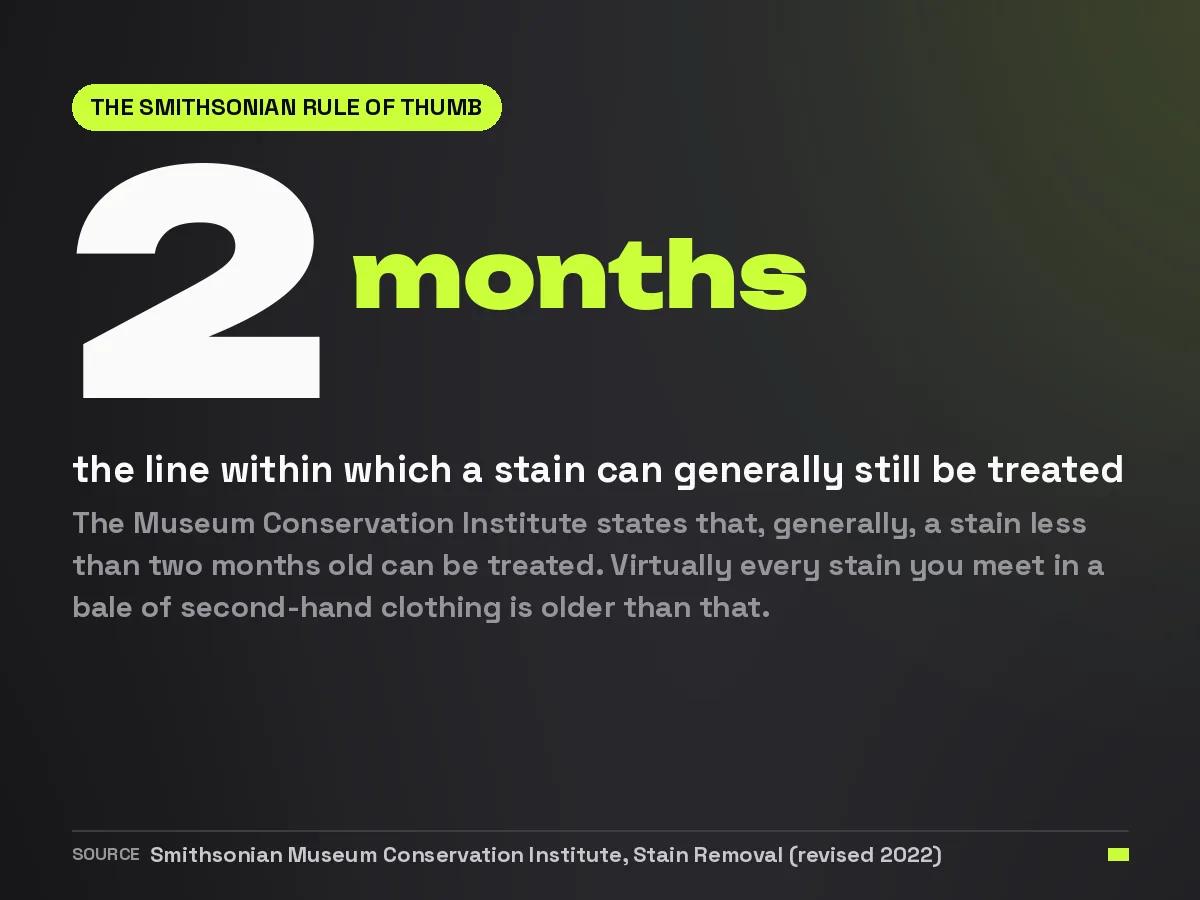
The rule of thumb it offers is useful and sobering at once. Generally, a stain less than two months old can be treated. A one-day-old stain is easier than a two-week-old one.
Now apply that to a bale. What you are opening is clothing that has been collected, sorted, stored and shipped. Every stain you find has passed that two-month line long ago. That is not a reason to despair, but it does explain why the tips on household blogs so often fail in practice: they were written for last night's red wine, not for a sweat mark from 1998.
The Institute gives one example that stays with you. Coffee is remarkably easy to remove if you catch it immediately — and permanent if it is left untreated. Cola and other soft drinks can be worse still: a stain that barely shows at first turns brown over time or with heat, because the sugar syrup caramelises.
What kinds of stains are there?
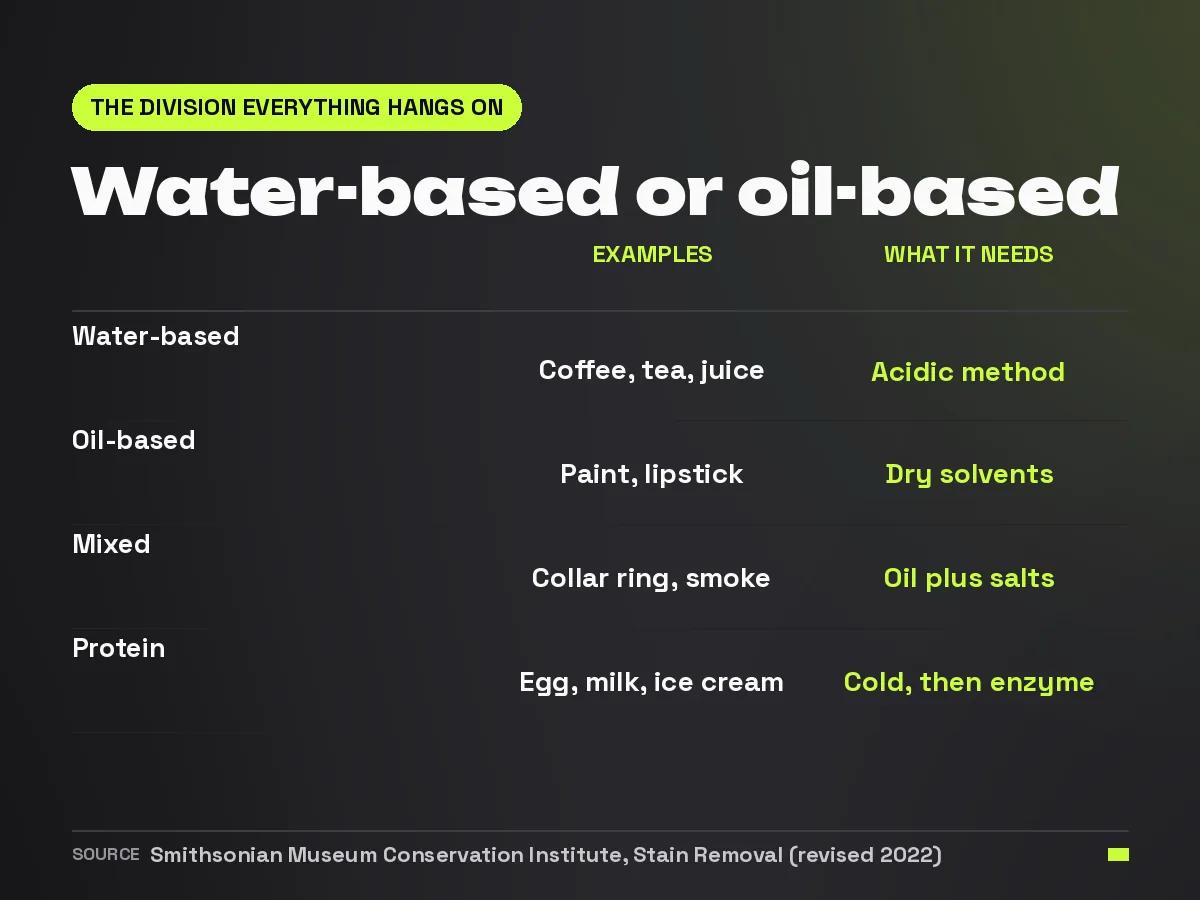
Everything that follows hangs on one division. The Institute states it simply: there are two fundamental types of stains, those that are water-based and those that are oil-based.
Coffee, tea and fruit juice stand for the first group. Those stains are acidic, and most food stains belong to them. Paint, lipstick and adhesives belong to the second, solvent-based group — including glues that start out containing water and then harden into something water can no longer touch. Hence the principle behind dry cleaning: those marks need non-aqueous, "dry" products.
The awkward part is that the stains you meet most often in second-hand clothing fall into neither box cleanly. A collar ring of body oil, or smoke damage, is described by the same source as a complex mixture: oily components, water-based salts and acids, and particulate matter such as carbon and dirt. Perspiration may be acidic or basic depending on the person, and is complicated further by whatever deodorant or perfume was used. Ballpoint and felt-tip ink carries pigments and water-soluble dyes at the same time.
That is the honest reason no universal cleaner exists. A mixed stain does not answer to a single approach, and the order in which you reach for products decides whether you make progress or lock the problem in.
Why the fabric matters more than the stain
This is where vintage most often goes wrong, and where household advice and conservation advice part company.
Water swells natural fibres but not polyester or acrylic. A water-based stain therefore travels deeper into cotton or wool than into a synthetic, while polyester and acrylic repel water and absorb oils instead. Whether a method works, the Institute says, depends as much on the fibre type and finish as on the stain.
Then there is the danger that rarely makes it into a blog. Older fabrics lose their resistance to tearing, to stretching and to rubbing. Removing a fresh stain from an old textile, the guidance warns, may require so much stress on the cloth that you are left with a tear where there was only discolouration before. That is exactly why many dry cleaners and conservators decline the risk.
Water on its own is not neutral either. It weakens silk and wool: those fibres stretch more easily and tear more readily when wet.
Which brings us to the one habit worth memorising. Apply anything by tamping — up and down, with a small cube of sponge or a cotton ball — or by rolling a cotton swab across the area. Never rub, because rubbing abrades or rips the cloth. And do not expect a result in one go: stain removal is sequential and repetitive, and each application only takes off a percentage. Five to seven repeats of the same sequence are ordinary.
What to have on the table before you start
The Institute also lists what it wants within reach before any liquid appears, and the list is a fair warning about how gentle and how slow this work is at home: plain 100 per cent cotton, absorbent paper or cloth, a non-porous work surface such as glass or formica, deionised water, good light — and, in its own words, peace and quiet and patience. None of that is a product you buy. It is a way of avoiding the two things that ruin vintage clothing, which are hurry and poor light. If you cannot give a piece that attention and that light, the honest move is to leave the stain where it is and price the garment accordingly.
Which habits make a stain permanent?
Most guides tell you what product to use. Very few tell you what locks a stain in, which is the part that decides whether a piece stays sellable. Every warning below comes from the Smithsonian guidance.
Why salt and sparkling water are the classic mistake
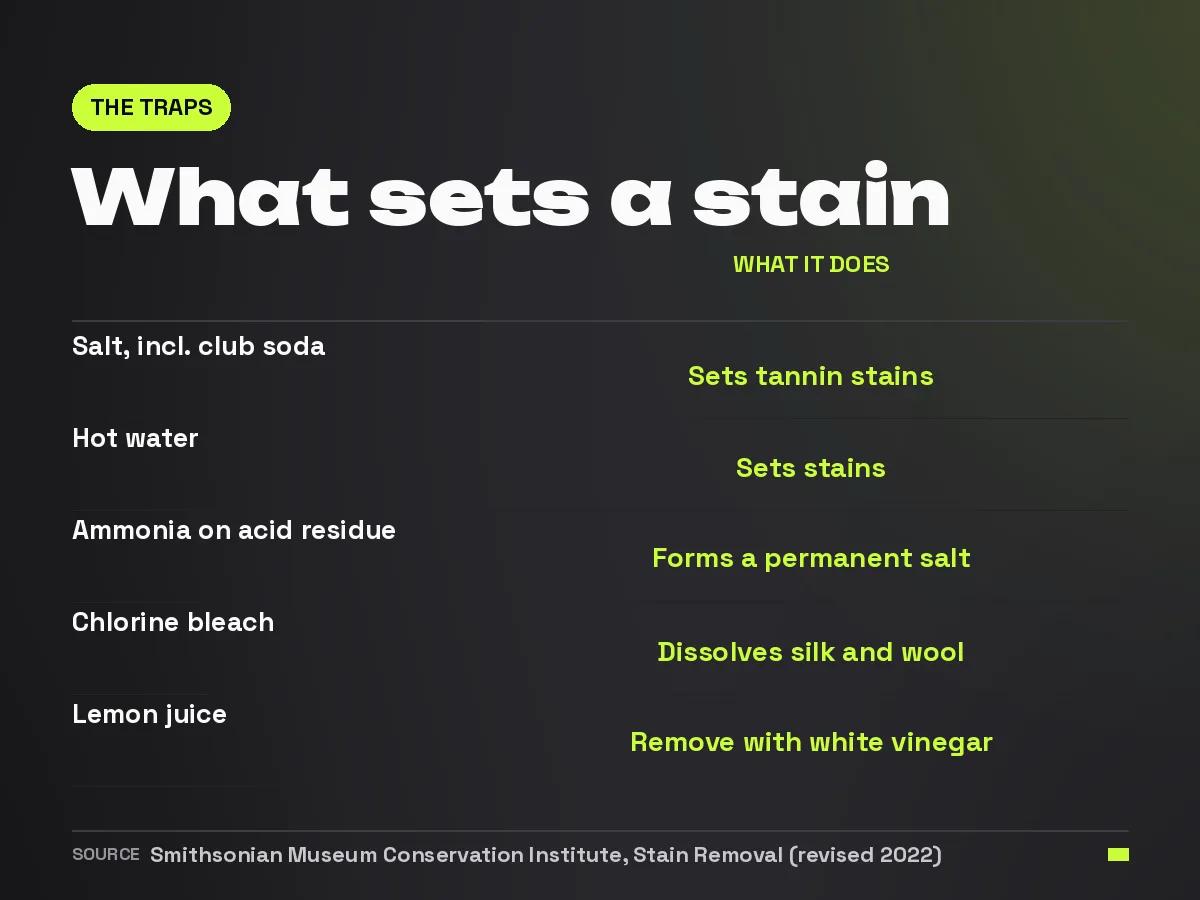
Salt sets tannin stains — wine, coffee, fruit juice. That includes club soda, which contains salt, so the familiar tip about pouring sparkling water on a fresh spill can anchor the mark instead of lifting it. Hot water sets stains too, which is why cold water is the safer reflex on anything fresh. And ammonia or any alkali reacts with acidic food residues to form a permanent salt — which is precisely what a permanent stain is.
What bleach does to wool and silk
Chlorine bleach is the most dangerous product in the cupboard. On silk or wool, bleach does not lighten the stain: it dissolves the fabric outright, and those fibres disappear. Cotton and linen are bleached at first, then yellow and weaken with time. The Institute calls chlorine bleach more damaging than hydrogen peroxide, and peroxide itself has only a limited action time, may decolourise some dyes, and weakens fibres slightly. Neither bleach is a good answer on a delicate item, and on wool there is no version of the answer that ends well.
Why lemon juice needs white vinegar after it
Lemon juice is acidic and cannot be left in the cloth; it has to be removed with white vinegar afterwards. Acetone lifts lipstick and nail polish effectively, but dissolves cellulose triacetate fabrics — including the linings of ties — into a plastic pulp. And oxalic acid works slowly on oxidised iron marks such as rust, while damaging cotton and linen in the process.
What I do see on the floor is bleached patches and holes that do not look like wear. Where they came from I cannot tell you — a bale arrives without a story. But the list above is how that kind of damage happens.
How do you test before you wet anything?
The Vintage Fashion Guild, an international body of vintage specialists, publishes a long care guide written for sellers by Hollis Jenkins-Evans. Her second golden rule is one I apply myself: when in doubt, don't. Washing is irreversible, and the possibility of ruining the garment is real.
The one-minute test
The test that comes first costs a minute. Take a damp cotton swab, press it on an inconspicuous area, and blot on a white towel. See whether any colour transfers. Then repeat the test with a little of the product you intended to use — the dyes may hold against plain water and lift the moment a detergent touches them. If nothing transfers on either pass, you can go on. If something does, you have just saved an item for the price of a cotton bud.
What to take off before anything gets wet
After the test comes the preparation people skip. Remove metal parts and buttons, including covered ones with a metal shank, because they rust. Take out shoulder pads, which leave large rings as the garment dries. Take off buttons set with rhinestones. And fasten everything that stays on, so it cannot catch during washing.
The do-not-wash list
There is also a category the Guild simply says not to wash. Velvet, in any form. Brittle or powdering fibres. Moiré, because the pattern disappears. Glazed cotton, because the glaze washes off. Silk embroidery, where the dye runs. Painted surfaces, leather, feathers, sequins that can melt, and and printed silk. And any garment combining several materials, where you risk different shrinkage rates, running colours and starched interfacings washing away all at once.
One last detail many people get wrong: never hang an old textile to dry. The fibres are at their weakest when wet, and gravity is unforgiving. Lay it flat, on clean towels.
Know what your brands actually resell for We keep live marketplace data for resellers on what vintage clothing genuinely sells for on Vinted, Depop and closed eBay listings, broken down by brand, category and grade. Message Patrick with the brands you sell and we will look at the numbers together. Talk brands with Patrick on WhatsApp
If you do decide to wash it, what does the sequence look like?
Assume you have tested the dyes, the item is not on the do-not-wash list, and it is a sturdy cotton or linen rather than something delicate. Both sources describe roughly the same shape of process, and the interesting thing is how little of it involves scrubbing.
Which product on a water-based mark
For a water-based mark specifically, the Smithsonian describes alternating a small amount of diluted shampoo — one with no conditioner, no perfume and no colour — or a plain dishwashing liquid with applications of white vinegar, which is a mild acid. The logic is dissolving like with like, while the detergent carries the acidic food residue away. Then rinse thoroughly with deionised water, blot, and let the area dry. White vinegar comes back repeatedly in this guidance precisely because it is mild: it does the acidic work without the risks that bleach or ammonia bring.
For protein marks — egg, milk, ice cream — the sequence is different. Rinse in cold water if you can; if not, let it dry and gently brush the solids off first to reduce what has to be treated. An enzyme product is what breaks that kind of residue down. But the Institute is explicit about the exception: silk and wool are themselves protein fibres, so a protein enzyme or an alkali can damage the fabric along with the stain. Enzyme products belong on cotton and linen, not on a delicate wool.
Which detergent, and how long to soak
For washing a whole garment, Jenkins-Evans is describing hand washing and drying flat, never a machine. Her own routine is a long, still soak rather than any agitation: a lukewarm bath, and she names a range of roughly 27 to 46 degrees herself, just deep enough to cover the piece, with a detergent dissolved before the garment goes in, and then simply letting it lie there. She writes that she has been told around forty-five minutes of soaking will neutralise a garment, and for heavily soiled items she changes the water and soaks again. The instruction that matters most is the negative one: do not agitate, rub or swirl the piece around while it soaks.
How many times do you rinse?
Rinsing is where people cut corners. She rinses at least four times with barely lukewarm water, pressing down lightly to push the water through the cloth rather than wringing it. Asked how clean the final rinse water needed to be, the curator of the Kentucky Historical Society told her: clean enough to drink. Cold water or lukewarm is the rule throughout, since hot water sets stains and heat is one of the things that ages a mark. If you are working on a genuinely good item, distilled water for the final rinse is worth the trouble.
Then lay clean towels over the garment and roll it up to draw the moisture out before you move it, and dry it flat with the fewest folds you can manage. Circulating air with a fan speeds the drying up in humid months. What you should not do is hang it, and what you should not expect is transformation: as the Guild puts it, all you may accomplish with washing is returning the garment to a clean, neutral state. You may not change its appearance at all.
What can you do without water?
More than you would expect, and it is almost always the sensible place to start. These are the tips worth applying to a whole batch of items before you decide which ones get any wet treatment at all.
Brushing and vacuuming
Brushing only lifts surface dust and dirt, but the Guild calls the difference it makes amazing. Vacuuming works too, with a soft attachment, and for fragile or delicate items through a screen, so the cloth is not pulled into the nozzle.
Airing, and what it does for odours
Airing is described by the same source as the gentlest way to lose an odour, and it lets creases relax before you bring steam anywhere near them. It costs nothing but time, and on a bale's worth of items that is the cheapest test you will run: what airs out is likely fine, what still smells once it has had its time needs a decision. For a musty or smoky smell, some dry cleaners offer an ozone treatment.
Mould asks for the same patience rather than a laundry product. The Guild's answer is to bring the humidity down, get air moving around the piece, and give it about an hour of daylight. An hour is what the guidance says, and on a coloured garment I would not stretch that into an afternoon in hard sun. Anything that has been damp needs to be properly dried before it goes back into storage, or the problem simply starts again.
Freezing, for insects
Against insects — moths, carpet beetles, silverfish — the freezer is, in the Guild's words, the easiest and most practical thing to do. The method it cites from Harold Mailand and Dorothy Alig's handbook: wrap the garment in acid-free tissue or muslin, seal it in plastic with as much air excluded as possible, take it to freezing temperature quickly so the insects cannot adapt, leave it a week, then let it return slowly to room temperature — around a day — before opening it.
And when pressing: use the coolest setting that still does something, work from the wrong side or through a press cloth, and move up and down rather than sliding, because the point of an iron catches threads and lace. Never press dirty cloth. It grinds the soil into the fibres.
What a sorter asks about a stained garment
Here is where the advice above and the work we do diverge, and it is the part you will not find in any conservation guide.
A collector has one dress and unlimited patience. A reseller has a bale. To give a sense of scale: sold by weight, forty-five kilos holds roughly two hundred and twenty-five t-shirts, or about thirty-one pairs of jeans — the category decides the count entirely. A bale averages around seventy per cent grade A and thirty per cent grade B, though that is an average across our intake and never a commitment on an individual lot. What grade A, B and C actually mean, we have written out separately in our guide to grading.
Put those two figures side by side and you can see why my question differs from a conservator's. Not "how do I save this piece", but "what is this item worth in minutes of my time". Spend twenty minutes on something that deserves five and you have not lost a garment, you have lost an afternoon.
The same reflex runs through the rest of the sorting work: you read the piece before you spend anything on it, exactly as you would when you date a pair of Levi's from its tab and its rivets instead of guessing at its decade.
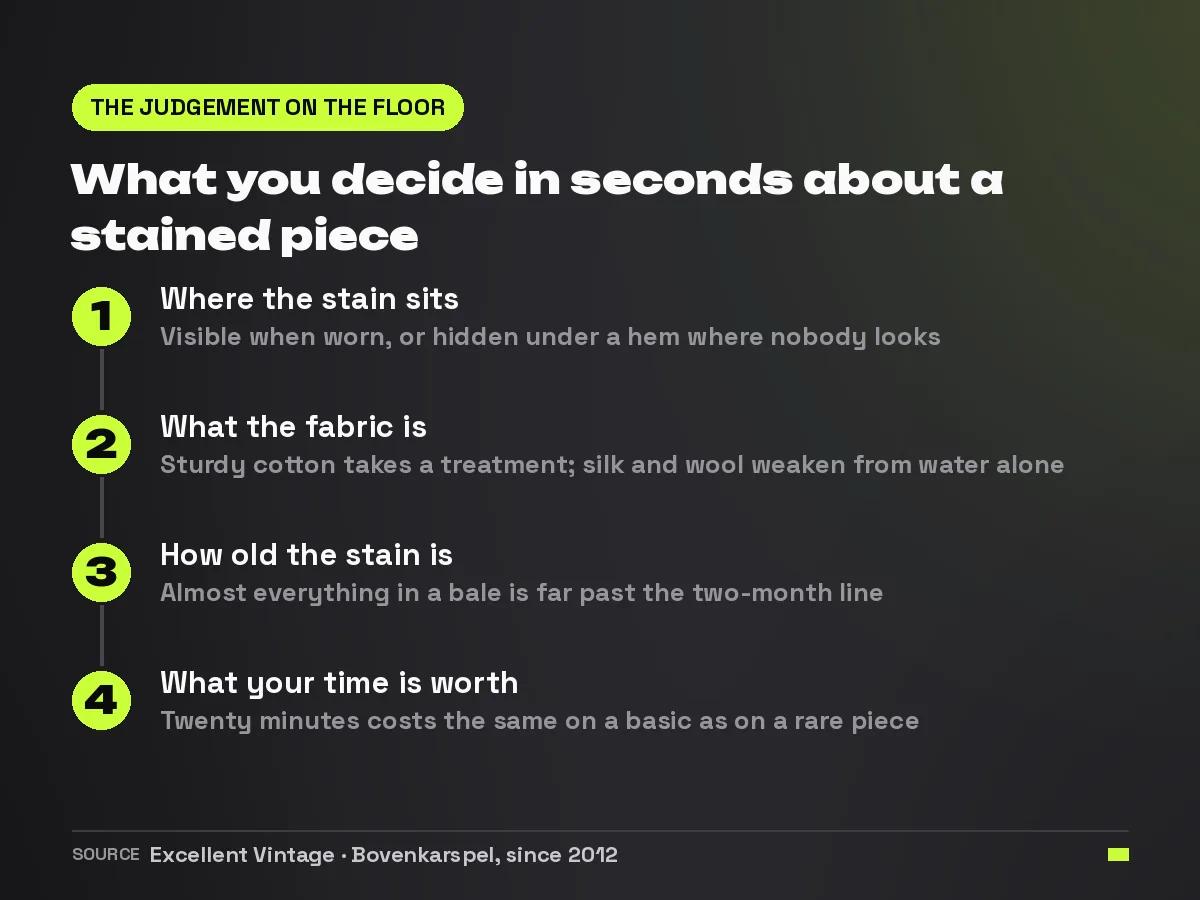
In practice it comes down to three judgements you make in seconds. Where is the stain — somewhere visible when the garment is worn, or under a hem? What is the fabric — a sturdy cotton that will take a treatment, or a delicate silk or wool that water alone weakens? And what is the piece worth if you succeed, given that the time costs the same on a basic t-shirt as on a rare jacket?
I have been in this trade for thirty-two years, and those three questions have not changed. What changes is how fast you answer them.
When do you let it go?
At some point somebody has to say it plainly, and the Vintage Fashion Guild does so in a text written expressly for sellers: the vast majority of stains do not come out. The solution, she writes, is to leave that piece alone or live with it.
The three ways spot cleaning goes wrong
For spot cleaning she lists three failure modes, and all three are familiar. You end up with the stain plus a dark ring of solvent around the spot. Or the item was evenly but unremarkably soiled, and you now have one clean spot in an otherwise dingy field. Or the cleaner was too harsh and you have a hole where the spot was. The shop-bought spot products are formulated for contemporary clothing, which is the best reason to try them on something you have nothing to lose on before you try them on anything you care about.
What dry cleaning does and does not do
She is equally direct about dry cleaning: about eighty per cent of the time it does not remove the stain or the soiling, and it does not take out body odours or underarm marks at all. She treats dry cleaning as reasonably safe on garments from the 1970s onward, and advises against it for anything before the 1940s.
Doing nothing is not the lesson here. The lesson is to know what you are starting, and to use that knowledge before you buy rather than after: a stained item you bought with your eyes open is a margin, a stained item you assumed would clean up is a loss. That distinction is exactly why we would rather have resellers choose their own bales on the floor than buy from a description. How that works in practice is set out in our complete guide to vintage wholesale in the Netherlands, and what we hold in stock is on our wholesale page.
Judge the goods yourself in Bovenkarspel You are welcome to spend two hours on the bale floor. You handle the pieces, you feel the cloth, and you decide which bales suit the audience you sell to. No deposit, free cancellation up to a day before, and I call you beforehand to prepare your visit. Book a warehouse visit
Frequently asked questions
Can you put vintage clothing in a washing machine?
When the Vintage Fashion Guild says washing, it means hand washing and drying flat. The agitation, the tumbling and the heat of a machine are too rough for an old textile, and you have no control over any of it once the drum starts. Its second rule applies here without qualification: when in doubt, don't.
Will an old sweat or underarm mark still come out?
Usually not completely. Perspiration may be acidic or basic depending on the person, and is complicated further by deodorant and perfume. On top of that, any stain in second-hand clothing is virtually by definition older than the two-month line the Smithsonian gives as a practical limit. The Vintage Fashion Guild adds that dry cleaning does not remove underarm marks or body odours either.
What do you do about a rust mark from a button or hook?
Remove the metal first, or the rust simply returns. The Smithsonian names oxalic acid as something that works slowly on oxidised iron marks, while warning that it can damage cotton and linen; more effective methods are left to dry cleaners working under controlled conditions.
Does sparkling water help on fresh wine?
That tip is riskier than it sounds. Club soda contains salt, and salt sets tannin stains — wine, coffee and juice. Hot water sets stains as well.
Are enzyme products safe on wool and silk?
No. An enzyme product is the standard answer to a protein mark such as milk or egg, but silk and wool are themselves protein fibres — so a protein enzyme, or an alkali, can break down the fabric along with the residue. Keep enzyme products for cotton and linen, and treat anything delicate as a case for cold water, patience, or a professional.
Is oxygen bleach safer than chlorine bleach?
Safer, yes; safe, no. What is sold as oxygen bleach works through hydrogen peroxide, and about that the Smithsonian is clear: chlorine bleach is the more damaging of the two, since chlorine dissolves wool and silk outright. Peroxide, though, has a limited action time, it can decolourise some dyes, and it weakens fibres slightly. A limited action time is exactly why it is not something to leave sitting on a garment while you do something else, and why the swab test on a hidden area comes first here as with everything else.
Can you use a shop-bought stain remover?
You can, with your eyes open. The Vintage Fashion Guild's point about the laundry aisle is that those products are formulated for contemporary textiles, and many cleaners would rather you did not use them at all, because a treated garment is harder for a professional to work on afterwards. Try one on a piece you have nothing to lose on before you try it on something you care about.
Is white vinegar safe on vintage cloth?
It is the mildest acid in this guidance and it appears throughout it, both as part of the treatment for water-based marks and as the way to neutralise lemon juice that has been used on cloth. That does not make it universal: it is an acid, it belongs on water-based marks, and it should still be preceded by a test on a hidden area like any other product.
Should you disclose a stain in your listing?
Yes, and it is in your own interest. A buyer who discovers an undisclosed mark is far more likely to open a dispute; a buyer who has already seen a sharp photograph of that same mark buys with their eyes open. In our own dealings the pieces sold with the flaw named are the ones nobody argues about afterwards. Photograph the area close up in daylight and name it in the description rather than retouching it away.
If you would rather learn these judgements once on the floor than a hundred times at the sink, come and see them: you handle the pieces yourself and you see straight away what a stain does to what a garment is worth.
Learn the judgement on the bale floor Two hours in Bovenkarspel, the pieces in your own hands, and you see per bale what you are getting in stains and flaws before you buy anything. No deposit, free cancellation up to a day before. Book your visit to Bovenkarspel
Ready to buy?
Visit our warehouse · no deposit required · free cancellation.