Vintage Wholesale Near Rotterdam: What a 130 km Sourcing Day Looks Like
Search for vintage wholesale near Rotterdam and the results hand you the retail side of the trade: pay-by-the-kilo stores, weekend vintage markets, guides to the city's best secondhand racks. Good…
By Patrick Libanon — founder, Excellent Vintage · Bovenkarspel, since 2012
Search for vintage wholesale near Rotterdam and the results hand you the retail side of the trade: pay-by-the-kilo stores, weekend vintage markets, guides to the city's best secondhand racks. Good places to find a jacket for yourself. None of them a floor where you buy secondhand clothing bales to resell.
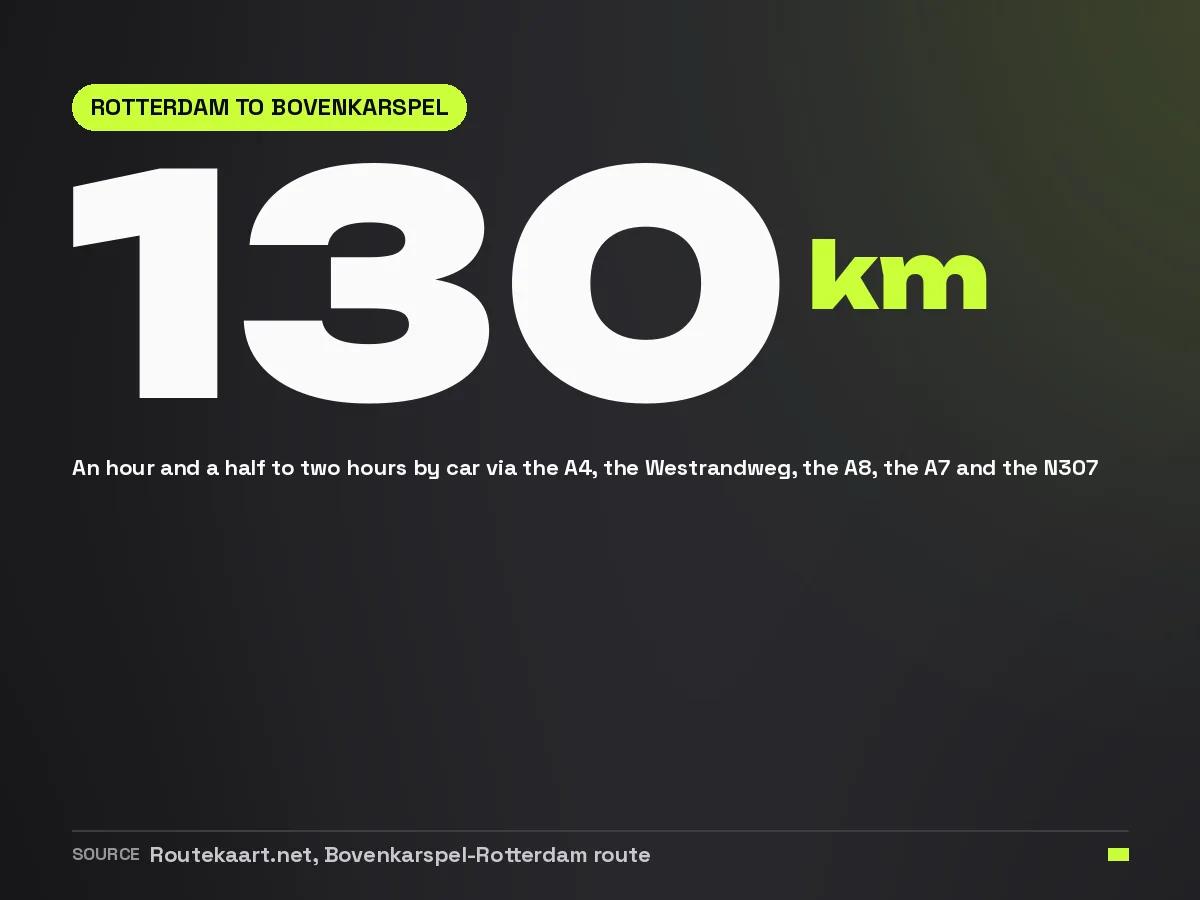
Our bale floor sits roughly 130 kilometres north-east of Rotterdam, in Bovenkarspel. That is an hour and a half to two hours by car on the A4 and around the western edge of the Amsterdam ring, or roughly two hours by train with one change.
Excellent Vintage has run that floor since 2012 out of a 2,500 m² hall. Patrick handles the trade, meets every visitor personally and has spent 32 years in the industry. Fifteen to twenty tonnes of clothing move through the building every month. How a vintage wholesale operation works from the inside is covered in our complete guide to vintage wholesale clothing in the Netherlands; this piece is about the journey there and what it does to the way you buy.
So it is not a quick errand. From Amsterdam a visit fits in a morning; from Rotterdam it eats half a working day. Buyers travelling from further out face a version of the same problem, which we covered in the guide for foreign buyers planning a sourcing trip. The distance is not an obstacle to explain away, though. It changes how you buy: when you set aside half a day, you prepare differently — and Patrick can tell which visitors did, from the questions they ask.
What 130 kilometres actually costs you
The route is dull, which is exactly what you want. North on the A4 past The Hague and Schiphol, onto the Westrandweg and through the Coentunnel, then the A8 and the A7 up past Zaandam and Purmerend as far as Hoorn, and finally the N307 Westfrisiaweg east into West Friesland.
The thing that decides your travel time is not the kilometres. It is that ring. Route planners put this drive somewhere between an hour and a half and two hours, and almost all of that spread sits around Amsterdam. Leave Rotterdam at eight in the morning and you join the ring at precisely the wrong moment. Leave at half past nine and you are at the bottom of that range. The return leg works the same way: still loading at four and you are heading into the evening peak with a full car.
In practice, book your slot towards the middle of the day rather than at either end. The warehouse is open Monday to Friday, nine to five, so there is room to do that, and parking at the door is free.
The train is a genuine option too. Rotterdam Centraal to Bovenkarspel-Grootebroek takes around two hours with one change, usually through Amsterdam. It is a fine way to come and see how a floor works for the first time. It is a poor way to carry two 45 kilo bales home, which is a real decision from Rotterdam rather than a footnote. More on that below.
Arrive with four answers already decided
Add the drive up, two hours on the floor and the drive back, and you are looking at five to six hours. That is most of a working day, and you do not want to spend it browsing.
There are more than 400 categories on the floor. Two hours is plenty of time to choose well and nowhere near enough to look at everything. The difference between those two outcomes comes down to what you settled before leaving: which platform you sell on, which category you want to run, which format suits it, and roughly what volume you can absorb. Four answers. Settle them on the floor instead and your first half hour goes on orientation rather than on choosing.
That is why Patrick asks in advance. The call the day before your visit is what lets him pull the bales that fit your story and stage them by brand and grade. Walk in with "I sell on Vinted, mostly sweatshirts, I want to scale this quarter" and your two hours start at the right stacks. Walk in with "let's see what's here" and they start at the beginning.
What else happens across a visit is set out in our piece on what to expect from a warehouse visit. Those two hours are exclusively yours, up to four people. You are not sharing the floor with three other resellers circling the same bale. That is the whole reason it runs by appointment.
Plan your sourcing day from Rotterdam Pick a slot in the middle of the day rather than in rush hour, and say in advance which platform you sell on and which category you run. The right corner of the floor will be ready the moment you walk in. Reserving costs nothing upfront and cancelling is free until the day before. Book a warehouse visit
Timing matters more when the drive is long
There is a second reason not to drop your visit on the first free Tuesday, and it has nothing to do with traffic.
Intake here runs on a clock: fourteen containers a year, eight to fourteen tonnes each, on a monthly cadence, alongside whatever comes in through three American and six European partners. The Atlantic crossing takes eighteen to twenty-two days, and it is another three to five weeks from port to floor. Apart from the raw mix, sorting by brand and category has already happened at the factory; here the consignment is received and staged by brand and grade.
Fifteen minutes down the road, that clock is trivia: you simply come back. Drive 130 kilometres and you want to know it. Arrive shortly after a fresh intake and you are choosing from a broad floor. Arrive at the tail of a cycle and the choice in your category is narrower. Not worse, just narrower.
You do not need to track any of this yourself. When you book, ask what has just landed and what is due in the category you run. One message, and it decides whether your half day produces a wide choice or a thin one.
Load it or ship it
At three quarters of an hour's drive this question barely arises: you load up and you are home quickly. At 130 kilometres it becomes arithmetic.
Start with weight, because on bales sold by weight it is the only hard number. A bale is 45 kilos. A curon is 50, a bag 25, a half bag 12.5. Four bales is therefore 180 kilos of load, before you have thought about the space four compressed blocks of clothing take up. At these formats the space in an ordinary car usually runs out before the payload does. If you are not sure what fits in your car, ask before you set off — it is a ten-second message and it saves an unpleasant discovery in the car park.
The second option is to drive back with only yourself in the car. You choose on the floor and the shipment goes to your address. Collection in person by appointment works too, when it suits you better to load without walking the floor.
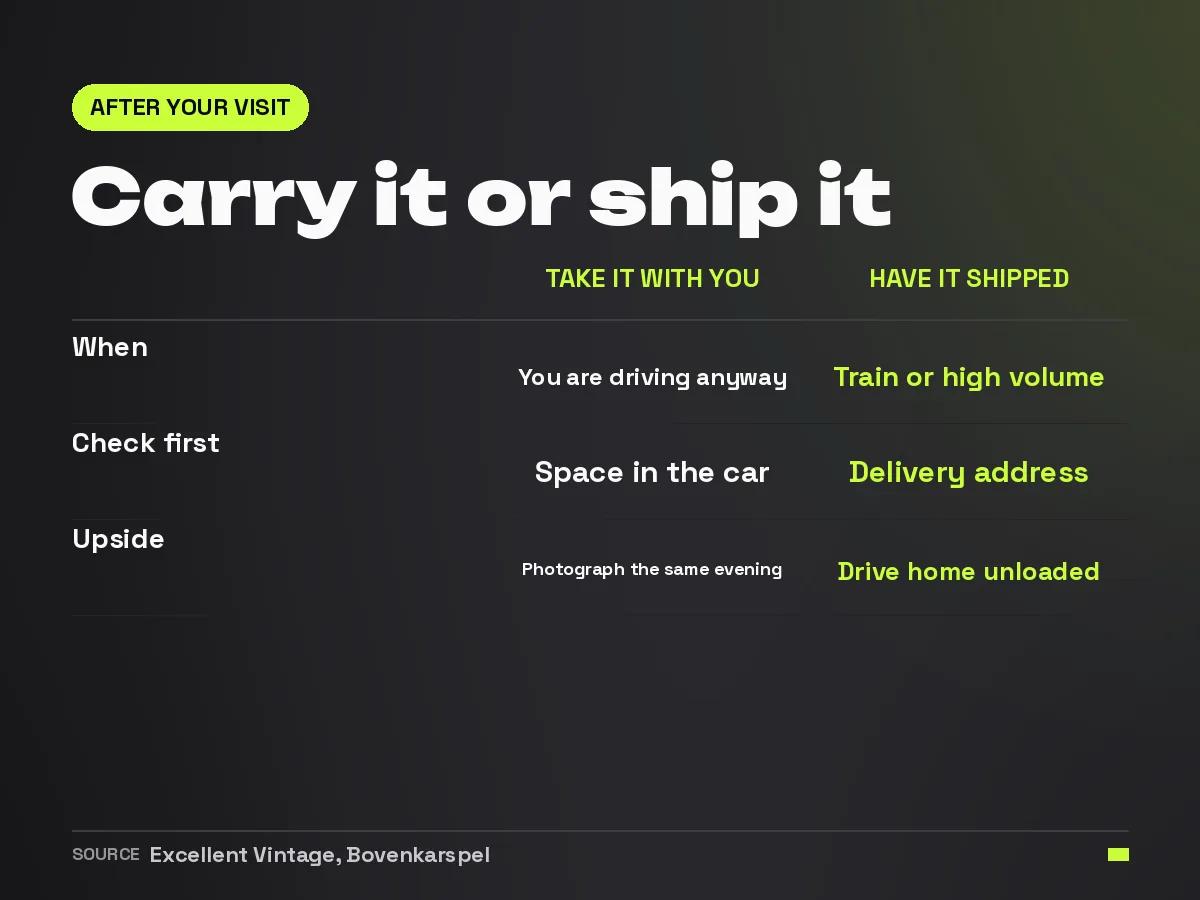
There is a third shape to this, and from Rotterdam it is a serious option rather than a fallback. You come once to learn how the floor reads, and after that you restock over WhatsApp or a video call, with Patrick walking the bales with a phone. That works because after the first visit you know what you are looking at: you have had the grades in your hands and you understand the difference between a category that weighs a lot and one that yields a lot of pieces.
What two hours on the floor are for
The reflex on the floor is to start hunting for good individual pieces. Understandable, and not what you came for. What you are buying is a distribution. Four things worth doing instead.
Do not judge the split on what you can see from the outside. A 45 kilo bale averages 70 per cent grade A against 30 per cent grade B — no defect versus a minor flaw. But that is an average across the intake, and the outer layer of a compressed block is not a sample. Ask how the ratio sits in this particular lot, and where that average comes from.
Feel the weight of the category. This is the number Patrick most often has to explain on a first visit. Forty-five kilos of t-shirts comes back as roughly 225 pieces; forty-five kilos of jeans as roughly 31. Same bale weight, an entirely different number of listings and an entirely different evening behind a camera.
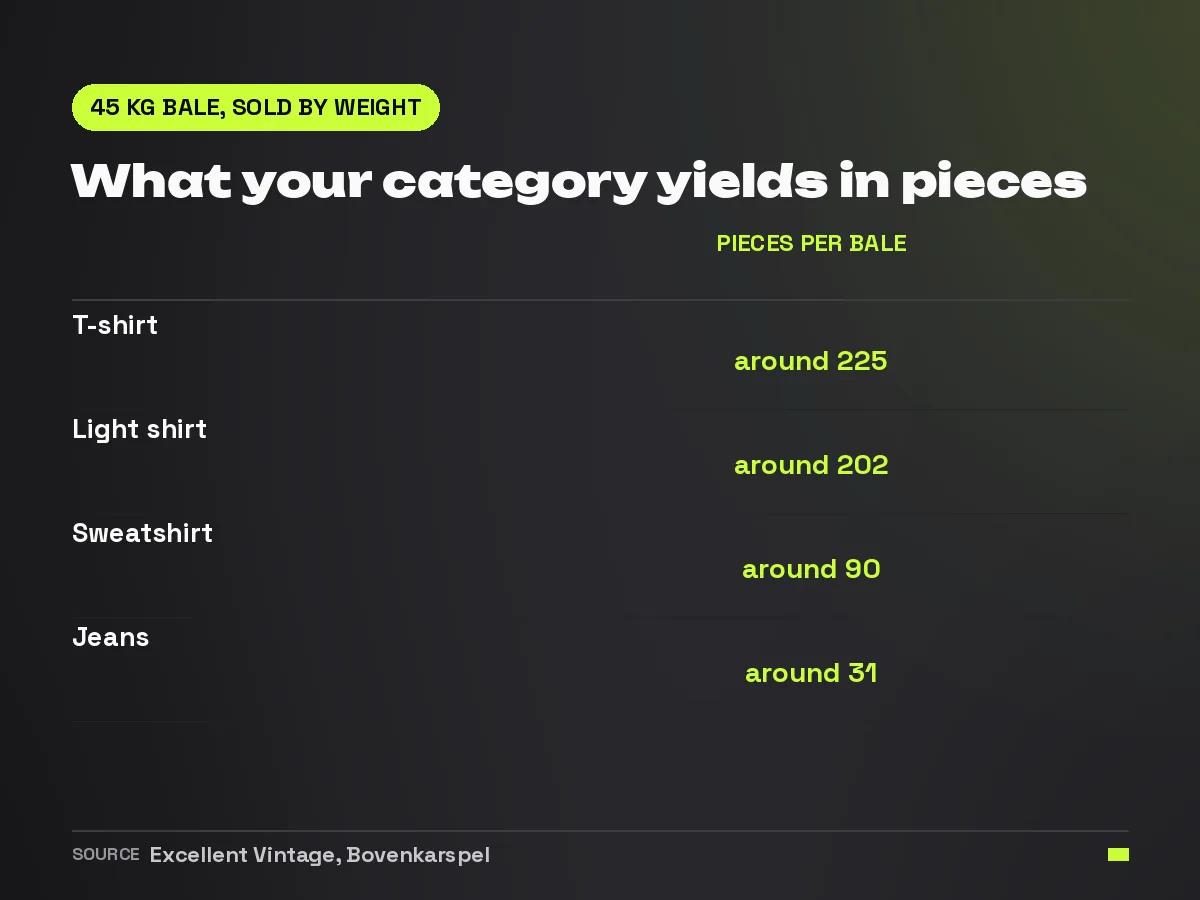
Ask for the count on anything sold by the piece. Not everything is priced by weight. Ralph Lauren shirts go per 200, Tommy sweaters per 100, denim shorts per 100. On those products the stated count is the honest figure, and kilo maths simply does not apply.
And ask whether you are looking at raw mix or pre-sorted stock. Mix arrives as it came in. Everything else is sorted by brand or category at the factory before it reaches this floor. That distinction decides how predictable your purchase is, and it is not something to discover after unpacking.
Which format goes home with you
There are four formats, and the choice says more about your strategy than your budget. The 45 kilo bale is the volume format: one brand or one category at scale, averaging 70/30 A to B. That is what you want if you are running on quantity across Vinted, Depop or Whatnot.
The 25 kilo bag of mix premium US sits differently, averaging around 90 per cent grade A against 10 per cent B. That is the niche format, for anyone specialising in a single category — Hawaiian shirts, say — or for a market stall or independent shop where per-piece quality has to be visible. The 12.5 kilo half bag is the same logic on a smaller scale. The 50 kilo curon is the high-volume format; ask which use it is best suited to.
This is exactly where the long drive earns itself back. Setting aside half a day leaves room to test more than one thing. A bale to run volume plus a bag to try a niche fits in the same car and sends you home with two answers instead of one. Those combinations are worth discussing on the floor, with the bales side by side, rather than off a product page. If this is your first purchase at this scale, read how to choose your first clothing bale before you commit.
One administrative note. If you are a registered business in another EU country — Belgium or Germany, say — with a valid EU VAT number, the purchase goes out under the reverse charge, because it is an intra-EU transaction. For a Dutch business the invoicing works differently. Either way, anything more specific than that general principle is a question for your accountant or for us — we do not invent tax rules here.
Want to think it through before you drive? Format, category, or simply how much will fit in your car: put it to Patrick over WhatsApp. You get him directly, normally inside the hour on weekdays, and he will say plainly when a video call saves you 260 kilometres. Message Patrick
Frequently asked questions
How far is Excellent Vintage from Rotterdam?
About 130 kilometres, in Bovenkarspel, which is an hour and a half to two hours by car on the A4, the Westrandweg and the Coentunnel, then the A8 and A7 to Hoorn and the N307 for the last stretch. Traffic around Amsterdam affects your journey more than the distance does, so aim for mid-morning rather than eight o'clock.
Can I get to a vintage wholesale warehouse from Rotterdam by train?
Yes. Rotterdam Centraal to Bovenkarspel-Grootebroek takes roughly two hours with one change. It works well for a first visit to see the floor. It works badly for carrying bales home, so have your purchase shipped if you come by rail.
How much does a bale weigh and will it fit in a normal car?
A bale is 45 kilos, a curon 50, a bag 25 and a half bag 12.5 — those are the formats sold by weight. Four bales is 180 kilos. In practice you run out of space before you run out of payload, so check your boot beforehand or send a quick message if you are unsure.
Do I have to take everything with me on the day?
No. You can choose on the floor and have the shipment sent to your address, or collect later by appointment. Coming once to learn how to read the bales and then restocking by WhatsApp or video call is a perfectly workable pattern when the drive is long.
Five to six hours, spent once and spent well
The distance between Rotterdam and Bovenkarspel turns a sourcing visit into a decision rather than an impulse, and that is a gain. You prepare properly, you ask sharper questions on the floor, and you drive back with a distribution you checked with your own hands.
That drive is no hardship, provided you know exactly what you came for. If you would rather know who you are dealing with first, here is the story behind Excellent Vintage; if you already know, pick a date.
Book two hours on the bale floor Two hours in Bovenkarspel that belong to you alone, up to four people, with free parking. Reserving costs nothing upfront, cancelling is free until the day before, and Patrick calls you the day before your visit. An hour and a half to two hours from Rotterdam. Book a warehouse visit
Ready to buy?
Visit our warehouse · no deposit required · free cancellation.