Buying vintage Burberry wholesale: why the check is rarer than the name suggests
Most enquiries for this brand arrive with a picture already attached to them. The buyer wants Burberry, and what they picture is that camel-and-red check spread across a table. Then the lot opens in…
By Patrick Libanon — founder, Excellent Vintage · Bovenkarspel, since 2012
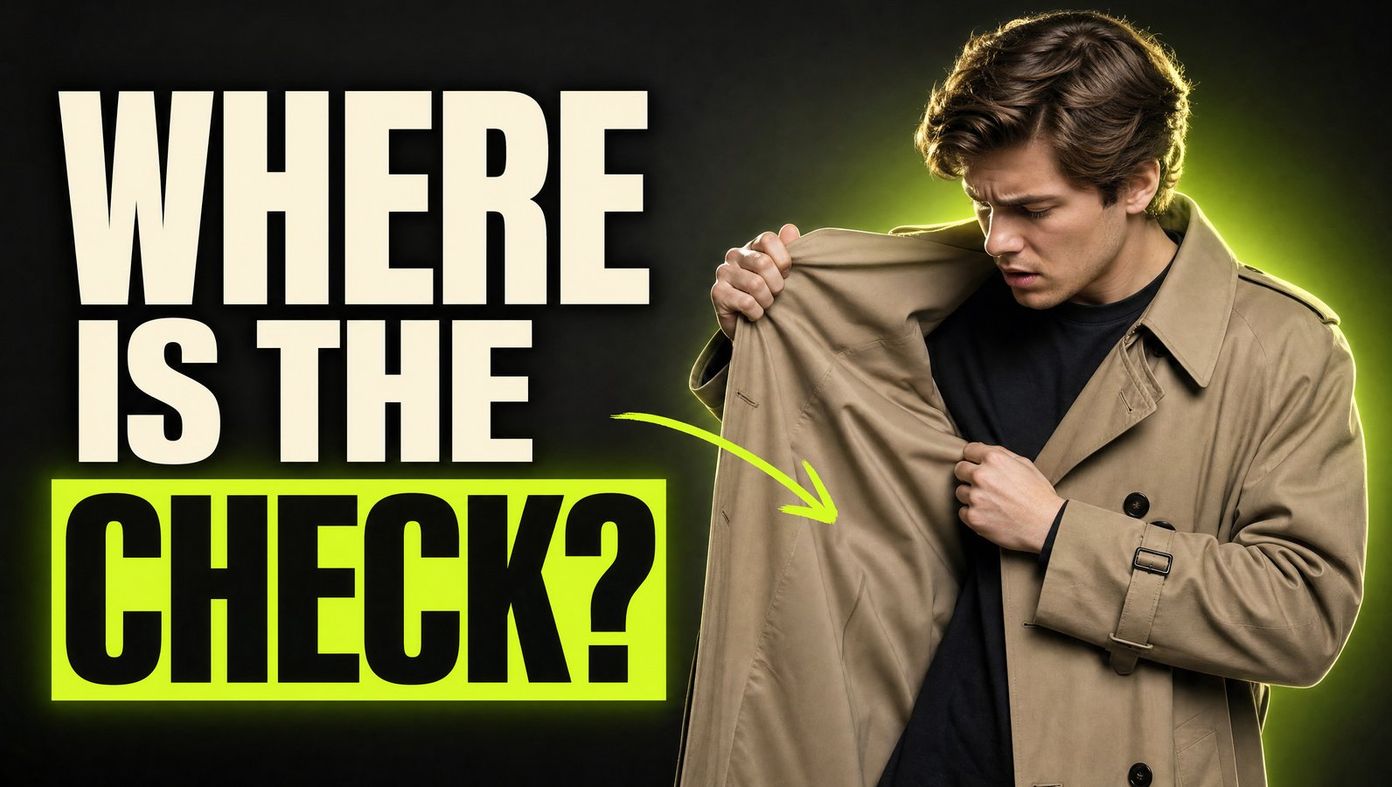
Most enquiries for this brand arrive with a picture already attached to them. The buyer wants Burberry, and what they picture is that camel-and-red check spread across a table. Then the lot opens in front of them and the pattern is nowhere in sight. Perhaps one coat with it tucked away inside the lining, invisible until you hold the thing open.
Nothing has gone wrong. That gap between what the name promises and what the house actually put on the outside of its garments is the most useful thing to understand before you spend money on it.
Vintage Burberry is bought wholesale by the bale or bag, pre-sorted by brand and grade. The famous check turns up far less often than the name suggests, because the pattern spent generations on the inside of garments and was later cut back deliberately. That gap decides how you identify and buy the brand.
We have been sorting vintage in Bovenkarspel, north-east of Amsterdam, since 2012 — a 2,500 m² hall that fifteen to twenty tonnes of clothing pass through every month. Burberry has been on our permanent list of ten brands throughout, with its own Burberry page, and it remains one of the brands buyers misjudge most. Patrick, thirty-two years in the trade, prepares the lots and meets every visitor himself; you can read the story behind the warehouse if you want the longer version.
Where the pattern actually went
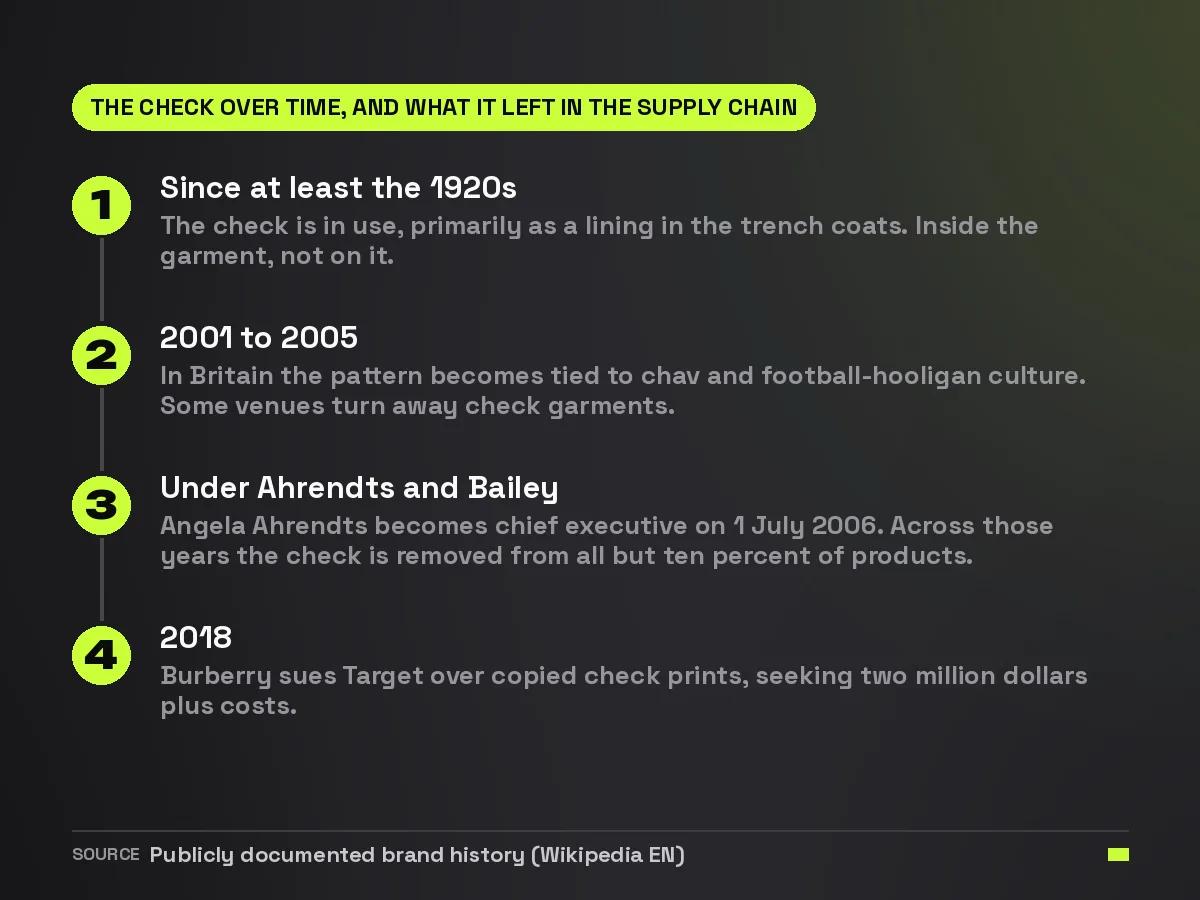
The Burberry check has been in use since at least the 1920s, and it was used primarily as a lining in the brand's trench coats. Inside the garment. For decades it was not something you spotted across a shop floor; it was something you found when you opened a coat.
That single fact explains the scarcity you will meet in a bale. A house that spent generations putting its signature pattern on the inside of things leaves far less outward-facing check in circulation than collective memory assumes. What filters down into the second-hand supply chain is therefore, in large part, clothing with no pattern showing on it at all.
The practical consequence lands on your sorting table. Carhartt or Levi's you identify across a room by cut and label placement. Burberry you identify with your hands in the collar: reading the neck tape, feeling the cloth, opening a coat to see what is behind the shell. Anyone hunting this brand out of a pile by pattern alone will walk past most of it.
A generation of Burberry with no check on it
Between 2001 and 2005 Burberry became associated in Britain with chav culture and football hooliganism. Three causes sat alongside one another, none decisive on its own: cheaper products, the proliferation of counterfeit goods adopting the check, and adoption by celebrities identified with that culture. The association ran deep enough that some venues banned check garments outright.
The response was blunt. Angela Ahrendts, who took over as chief executive on 1 July 2006, and designer Christopher Bailey reversed the damage in part by stripping the check from all but ten percent of the company's products. They also brought the fragrance and beauty licences back in-house and bought out the Spanish franchise, which had accounted for a fifth of group revenue.
Trace that forward to what sits in front of you. A large part of what Burberry produced from the late 2000s through the 2010s carries no check at all — and that is exactly the production decade now reaching the second-hand market in volume. A Burberry from those years is not a lesser Burberry. It is the standard of its moment, and it sells on the name and the cloth rather than on pattern recognition.
Which channel you sell through decides what to do with that. On a marketplace where buyers search by brand name it barely matters: someone types Burberry, finds a shirt, buys a shirt. If you run a curated shop where the image does the selling, a pattern-free piece is harder to photograph and you will need a story that is not the check.
Ask what is on the floor this week The mix shifts with every container, so last month's answer is worthless. Message Patrick and ask what Burberry is actually graded and ready before you plan anything. Ask Patrick what is graded
Licences, not years: what the label really tells you
With Levi's, someone who knows the labels can place a pair of jeans in a decade with real confidence. Burberry does not work that way, and knowing the difference matters before you price a guess.
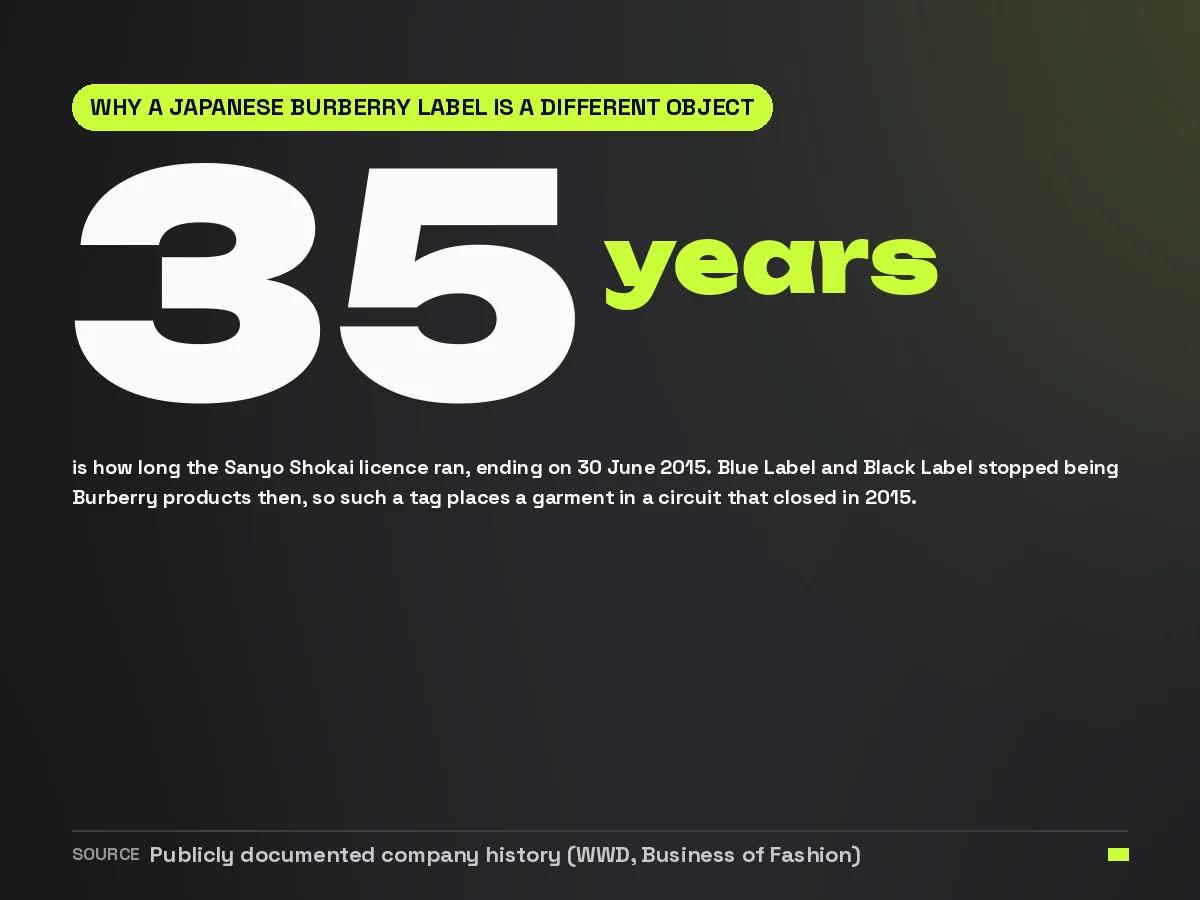
The company ran on licensees for a very long time. As early as the 1970s it signed agreements with manufacturers worldwide, Mitsui among them, to produce goods complementing the British collection. That arrangement grew large. By 2005 Sanyo Shokai held the ready-to-wear licence in Japan, at a retail value of roughly 435 million euros. Revenue from licences like that was not consolidated into the parent company's accounts, and still contributed substantially to the brand's performance.
The Japanese licence ran thirty-five years and ended on 30 June 2015, at which point Burberry took the Japanese business under direct control. The two diffusion lines that existed only for that market — Blue Label and Black Label — stopped being Burberry products in the process: Sanyo Shokai continued them from the autumn/winter 2015 season without the Burberry name, under the Crestbridge label.
So when a neck tag points at a Japanese line, you are holding a piece from a circuit the London house did not run directly, with its own sizing and its own home audience. Such a piece can sell perfectly well. It simply is not evidence of a production year, and it is not evidence of anything being wrong either. It tells you which market the garment served.
Then there is the detail the resale market leans on: the trailing s. Within the trade, "Burberrys" or "Burberrys of London" on a neck tape is read as a marker for pre-1999 production. We use that rule of thumb too, and we are straight about what it is — a convention of the resale market, built from dealer guides, not a date code the manufacturer publishes. Treat it as a rough boundary you can discuss with a buyer, not as a year you put in a listing.
Two clusters, one buying decision
We keep ten brands permanently and group them by how they behave in resale. Burberry lands in two groups at once, which is not sloppiness in the filing. It belongs with the heritage names — Ralph Lauren, Tommy Hilfiger, and Barbour, whose waxed jackets sit in the same corner — the labels a broad audience keeps searching for. It also belongs to our mixed pro stack, together with Polo Sport, Barbour and The North Face: the corner where price per piece runs higher and boutique sellers take their margin. Barbour and The North Face straddle two groups as well, so Burberry is a clear example rather than an exception.
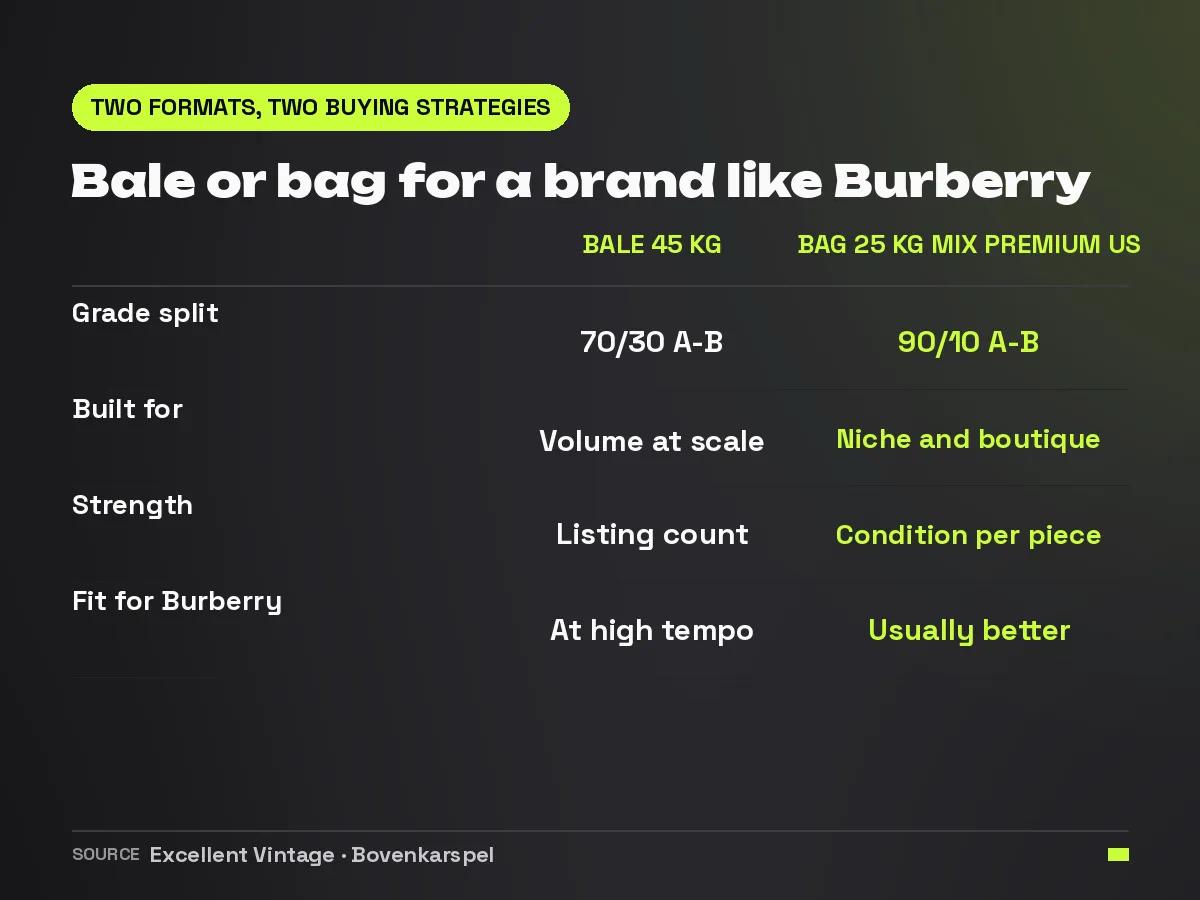
What follows from that is a format decision. When a brand's value concentrates in individual pieces, the heaviest option is not automatically the right one. A 45 kg bale averages seventy percent grade A to thirty percent grade B and exists for volume — one brand or one category at scale, feeding hundreds of listings. A 25 kg bag in the mix premium US composition runs closer to ninety percent A against ten percent B, and serves the specialist who buys less and better.
For Burberry the second route is more often the sensible one. Not because the bales are worse, but because with a brand that lives or dies on individual sales you would rather buy a higher average condition than more kilos. We work in four formats: the 12.5 kg half-bag, the 25 kg bag, the 45 kg bale and the 50 kg curon. Which of them exists as Burberry on a given week depends entirely on intake. The difference between heavy bales and pre-sorted clothing is worth reading before you choose.
The few pieces that pay for the lot
This is the miscalculation we watch buyers make most often with this brand. They model Burberry the way they model a t-shirt label: so many kilos, so many pieces, times an average sale price. The arithmetic is sound and the commercial conclusion is wrong.
With a brand in the mixed pro stack, your month is not made by the piece count you extract from a lot. It is made by the handful of garments you place at a multiple of the average, while the rest covers your time. That changes what you look at while walking the floor: not whether there is a lot in there, but whether the top of the lot is strong enough.
In practice that means reading cloth and cut instead of pattern. A dense knitted jumper, a shirt whose collar has kept its shape, a coat with the lining intact — those are the pieces a boutique seller photographs and sells with a story. Grade A here is a garment carrying no defect at all; grade B carries a small one. Grade C, meaning a hole or bleach discolouration, is handled separately and is not part of those mixes at all. Our grading guide sets out where the lines fall.
What we will not do is tell you what is inside a specific lot. Nobody can do that honestly. Stock arrives in fourteen containers a year of eight to fourteen tonnes each, on a monthly rhythm from three American and six European partners, and everything but a raw mix is sorted by brand and category before it reaches us — but nobody counts how many Burberry coats travelled in a given shipment. Ask what is on the floor now rather than working from what was there last month.
Judge the lot yourself Two hours on the bale floor, up to four people, and Patrick beside you the whole time. Nothing is committed until you have judged the lots and put your questions to Patrick. Reserving costs nothing. Reserve two hours on the floor
Why this brand rewards a floor visit
There is one more reason this brand sits badly with blind ordering, and it comes from its own history. Counterfeiting is one of the causes named for the reputation damage of the early 2000s, and the house defends the pattern in court as well: in 2018 it sued Target for two million dollars plus legal costs.
We do not publish a checklist for telling genuine from fake. Those lists circulate freely online, they are rarely complete, they age the moment a better generation of copies appears, and a reseller leaning on one has outsourced their risk management to a stranger's homework. What we do instead is simpler and holds up better: you stand among the bales yourself before anything becomes yours.
That is not a slogan, it is how the hall is arranged. Visits run by appointment, in a two-hour block that belongs to you and up to three colleagues, with the relevant lots pulled and graded before you arrive. You choose which bales and bags leave with you, you handle the cloth of what is standing open and ready, and you ask how the split sits in that particular lot; at fifteen to twenty tonnes a month we work by the lot rather than by the garment. Committing to a lot of this brand from a photograph means buying an assumption. If travelling is what stops you, the same walkthrough happens on a video call: Patrick carries the camera down the row and you judge from wherever you are. What a visit looks like in practice is written up separately.
On the commercial side: everything is quoted excluding VAT. A business registered in another EU member state — Germany or Denmark, say — is invoiced with VAT reverse-charged once its registration and VAT number check out, because that is the cross-border intra-EU mechanism; a Dutch-registered buyer is a domestic supply and is billed differently, so check your own case with your accountant. Nothing moving inside the EU attracts duty. Collection in Bovenkarspel is possible by appointment and shipping is quick. Payment runs by SEPA transfer, card without surcharge, or cash on site. The formats we work in are set out on our wholesale page; what exists as Burberry in any given week is a question for Patrick.
Frequently asked questions
Is Burberry always available?
It is one of ten brands we hold permanently, so it belongs to the standing assortment. How much is on the floor at any moment, and in which categories, moves with intake — fourteen containers a year on a monthly rhythm, each with a different split. Ask for the current position before you plan around it.
Will there be check pattern in a Burberry lot?
Usually far less than buyers expect. The pattern was historically used mainly as a lining, and under Angela Ahrendts and Christopher Bailey it was cut back to ten percent of the brand's products. Treat check as the exception rather than the rule, and identify the brand by its label and cloth instead.
Can you date a Burberry from the label?
Not reliably. The manufacturer publishes no date code. What a label can indicate is the circuit a garment came from, such as the Japanese licence lines that ran until 2015. The rule that "Burberrys" with an s means pre-1999 is a resale-market convention rather than a factory record — useful in conversation, not a year to print in a listing.
Is Burberry sold by weight or by piece?
Both models exist and it varies lot to lot. Some products we sell by weight, others as a fixed piece count where the weight is not exactly on the mark. For Burberry it follows what comes in, so ask per lot instead of calculating it.
Bale or bag for this brand?
The difference is average condition and what each format is built to do. The bale is the volume route, the mix premium US bag the selective one. With a brand whose value concentrates in individual pieces, most buyers land on the selective route — though what is actually graded and ready that week has the final say.
How does VAT work for a German or Danish business?
It depends on where the business is registered, as set out above: outside the Netherlands but inside the EU is a different invoice from a Dutch registration. Put your own case to your accountant — we do not invent tax rules.
The habit that pays for itself
Burberry gets bought badly whenever the buyer follows the image in their head instead of the brand in front of them. Everything above comes back to one habit: with this label you verify by hand what other brands let you verify by eye.
Get that straight and the questions you ask on the floor change — what is graded and ready today, how this particular lot is sold, and how strong the top of it looks. Those answers move your margin more than any brand name does. The complete guide to vintage wholesale in the Netherlands covers the wider picture if you are still mapping suppliers.
Come and handle the stock With Burberry a photograph hides what your hand works out immediately. Reserve two hours in Bovenkarspel, walk the lots with Patrick and decide afterwards. Free cancellation up to 24 hours before. Come and see the lots
Ready to buy?
Visit our warehouse · no deposit required · free cancellation.