Handling offers on Vinted as a reseller: decide your floor before the offer arrives
Offers are easy to treat as a matter of mood: a message pings, a number looks cheeky or fair, and you answer. That is workable for someone clearing a wardrobe. It works less well when you buy bales.…
By Patrick Libanon — founder, Excellent Vintage · Bovenkarspel, since 2012

On Vinted a buyer can offer up to 40% below your price, and no offer is binding. A reseller answers with a number, not a mood: work out the lowest price each piece can sell for, and accept, counter or decline against that floor.
Offers are easy to treat as a matter of mood: a message pings, a number looks cheeky or fair, and you answer. That is workable for someone clearing a wardrobe. It works less well when you buy bales. Every piece you list has a cost that you paid before anyone made an offer, and an offer that arrives at 11 at night is a poor moment to start calculating it. Excellent Vintage has sold clothing bales from Bovenkarspel since 2012, and the habit I'd want any bale buyer to have is knowing their number before the phone buzzes.
This article covers what Vinted's offer function does according to its own help pages, how to turn your bale cost into a floor price per piece, what the 40% cap does to your listing price, and how to decide between accepting, countering and declining. The rules come from the Vinted Help Centre, checked in the UK and the Dutch version on 7 October 2026. Vinted changes its app and its rules, so check the help pages of your own country as well. Pricing strategy itself, meaning what to list a piece at in the first place, is a separate subject and isn't covered here.
What does the offer button actually do?
Vinted describes offers as a way for buyers to bargain, and for sellers to offer a potential buyer a lower price to encourage them to buy faster. There are two directions, and they work differently.
A buyer taps "Make an offer" on your listing, or opens a conversation with you and makes the offer there. The price they can pick is up to 40% less than the original price. You then accept it, reject it, or answer with a counteroffer. If you accept, the buyer still has to press "Buy now" in the conversation to finish the purchase.
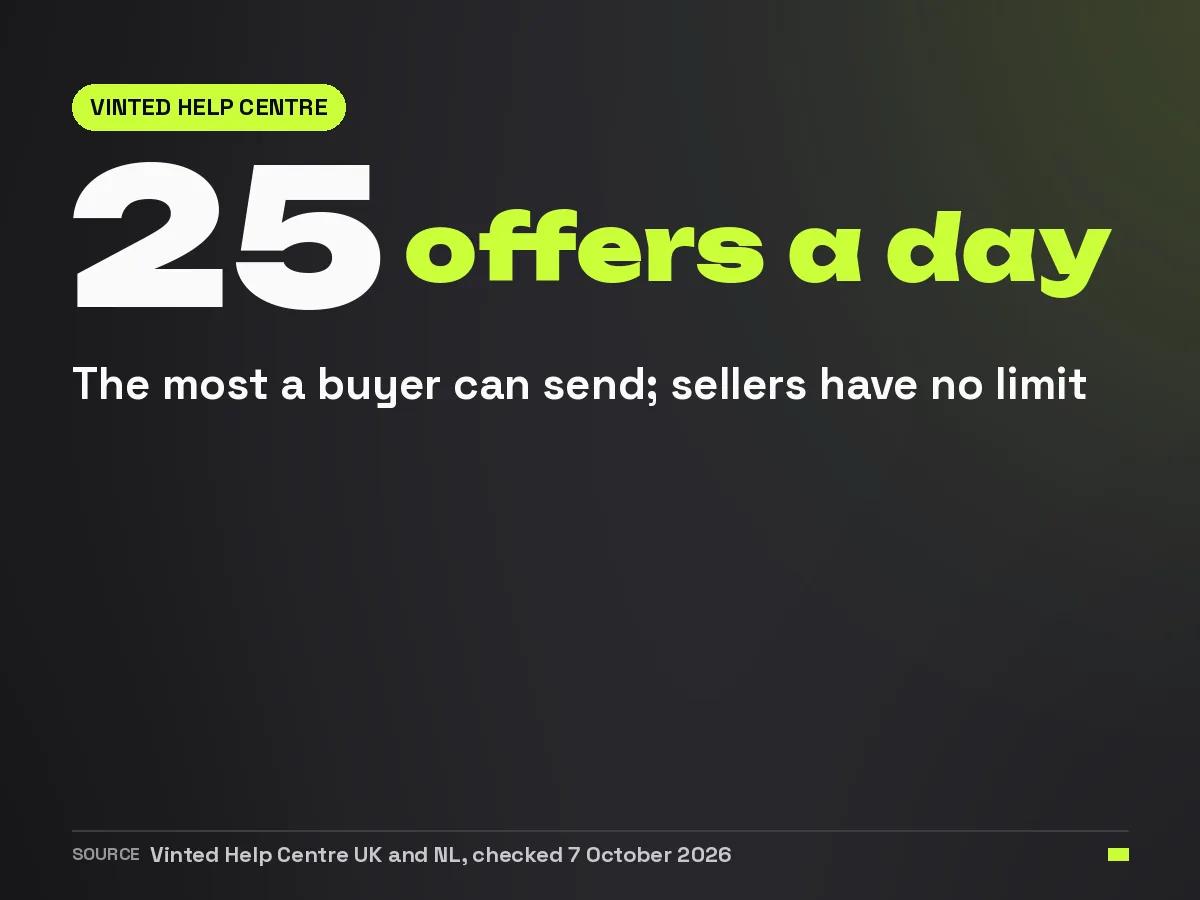
You can start the other way round. When a potential buyer has started a conversation on one of your listings, you can offer them a lower price, again up to 40% off, and the new price is visible only to that member. Everyone else keeps seeing the original price. Vinted gives no limit on the number of offers a seller can make, while a buyer can send up to 25 offers per day.
Three details matter more than the rest. Offers are not binding: even if you accept, the item stays available to every other member until the buyer presses "Buy now", and the buyer doesn't have to buy. Other members can also keep making offers or buy the item while you negotiate with one person. And an offer applies to the item only, so nobody can negotiate postage or fees through it.
Why does a reseller need a floor price per piece?
A private seller has one question when an offer comes in: do I want this money for this jumper? A reseller has a different question, because the jumper was never bought alone. It came in a bale, and the bale had a price.
The calculation is short. Take what the bale cost you and divide it by the number of pieces you will really list. That is your cost per usable piece. Add what each sale costs you outside the purchase price, such as packaging and the time it takes, and add the margin you need for the work. The total is your floor: the lowest price at which a sale is still worth making.
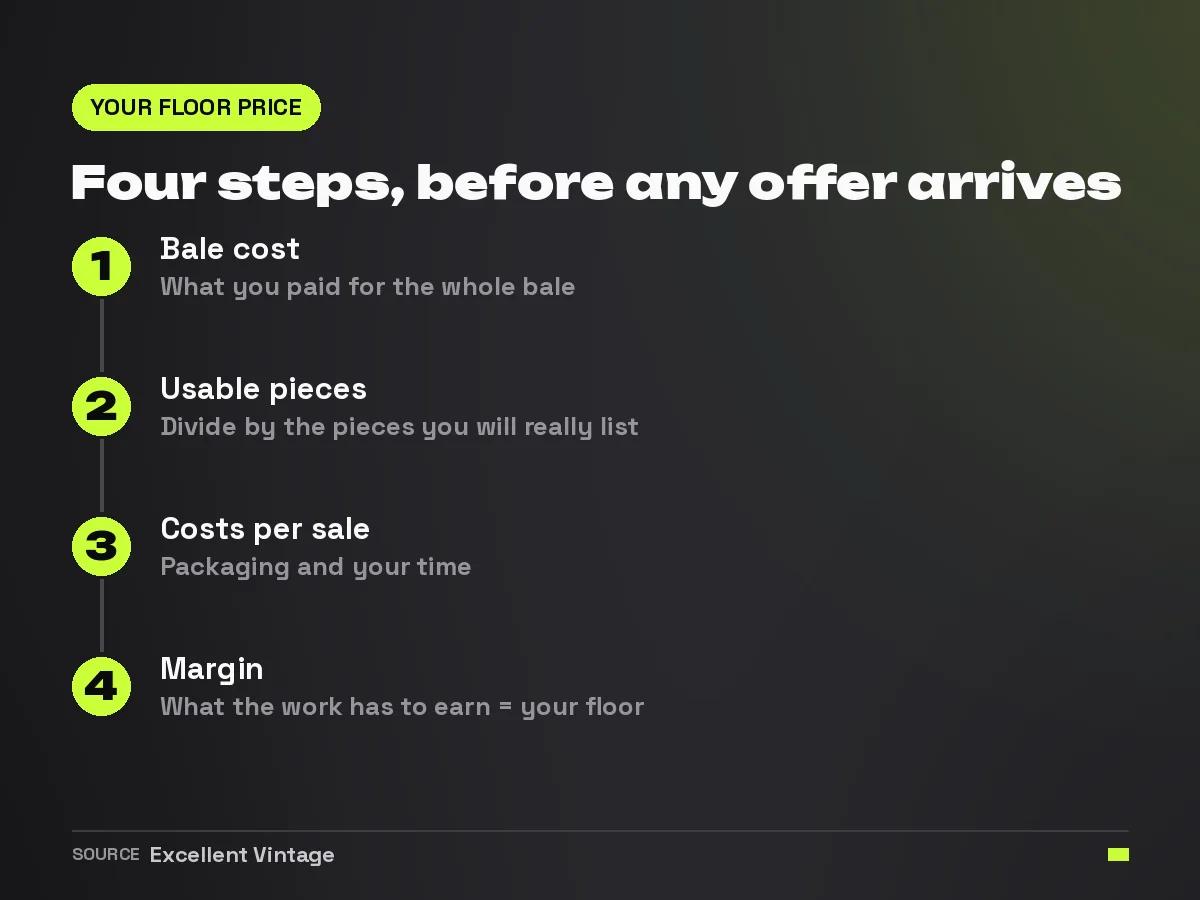
The count is where bale buyers go wrong, because the number of pieces differs enormously per category. By weight, a 45 kg bale holds roughly 225 t-shirts, around 90 sweatshirts or around 31 pairs of jeans. The same bale price spread over 225 pieces gives a very different cost per piece than spread over 31, and the floor follows. That conversion holds for bales sold by weight. A bale sold by the piece comes with a fixed count, such as 100 Tommy Hilfiger sweaters, and you simply divide by that.
Two more things decide the "usable" part. A bale averages roughly 70% grade A and 30% grade B, an average over many bales, and any single bale can differ. Grade A pieces have no defect. Grade B pieces have a minor one, which is why a bale's floor is rarely one number for every piece: a B piece has to be listed with its flaw shown, and it may need a lower floor or a repair before it is worth listing. If you decide not to list a few pieces at all, they don't belong in the count, and their share of the cost lands on the others. The profit calculator walks through the whole bale, and grade A, B and C explained shows what the classes mean.
A floor per bale and category is enough. You don't need 225 different numbers for 225 t-shirts from one bale. They cost the same, so they share a floor, which turns a stack of offers into a quick check against a figure you already know. Pieces that stand out, a rare brand or a piece with a flaw, get their own. How many pieces a bale gives you in the first place is a question of its own, and it comes first, because it is the number you divide by.
Know what a bale costs per piece before you buy Your floor starts with the bale. Tell me what you sell and where, and I'll tell you which bale fits, in person on the floor in Bovenkarspel or over a WhatsApp video call. No deposit. Book a visit
What does the 40% cap do to your listing price?
The cap is a limit on how low an offer can go, and it matters for your own arithmetic. If a buyer can offer up to 40% less, the lowest offer that can ever reach you is 60% of the listed price. On a listing of 100, that is 60.
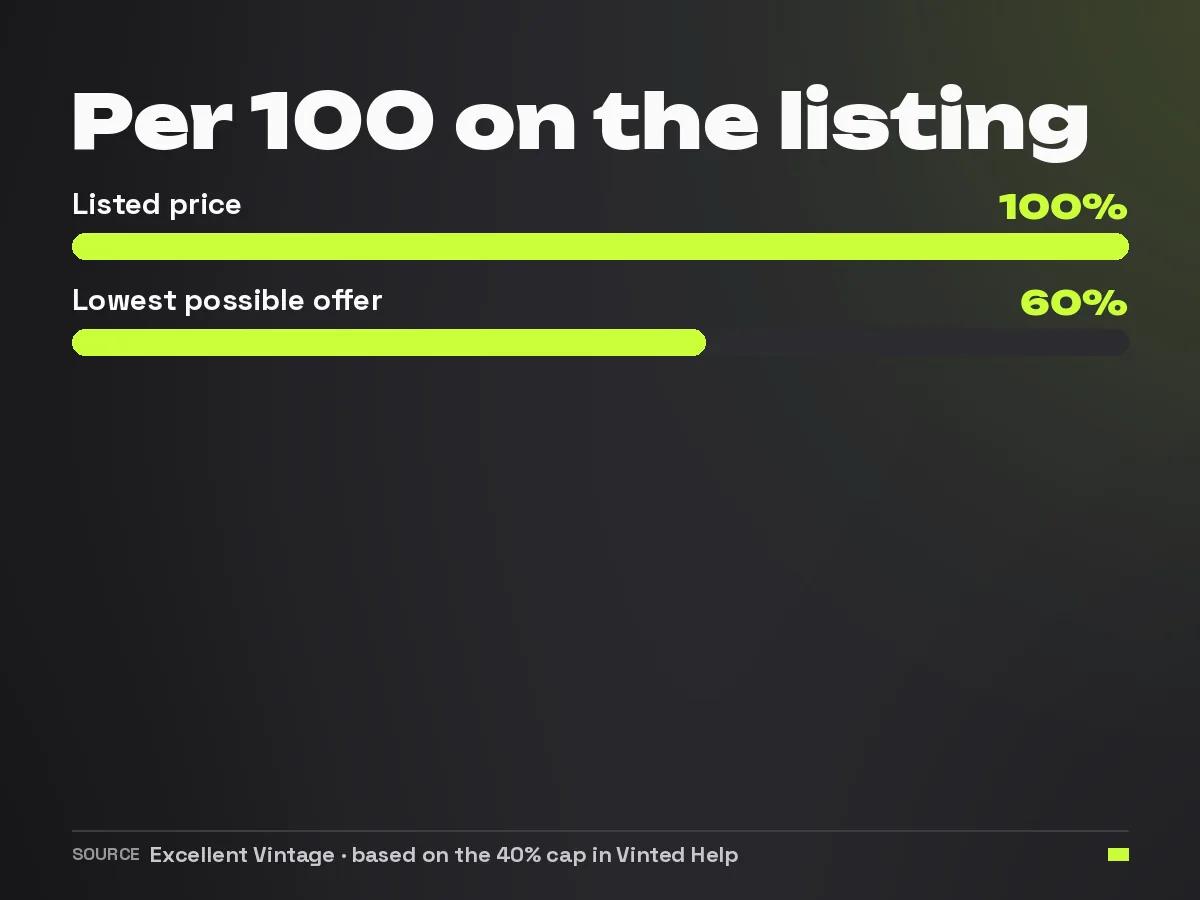
That gives you a test you can run on any listing. Is your floor at or below 60% of what you listed it for? Then every offer Vinted lets through is one you could accept without dropping below your floor. Is your floor higher than that? Then the cheapest allowed offer is already below your floor, and you will be declining some offers by design. Neither is wrong. It tells you how much room you have, and it shows early that a piece listed close to its floor will draw offers you can only decline.
The same cap applies to you when you offer a buyer a lower price: up to 40% below the original price, so a discount deeper than that isn't possible through the offer function. If you want to give a buyer more than that, that is a separate question, and for several items in one order it is a question about bundles. How bundle discounts work, and who can set them, is in bundling on Vinted.
Accept, counter or decline: how do you decide?
With a floor, the decision becomes mechanical, which is the point.
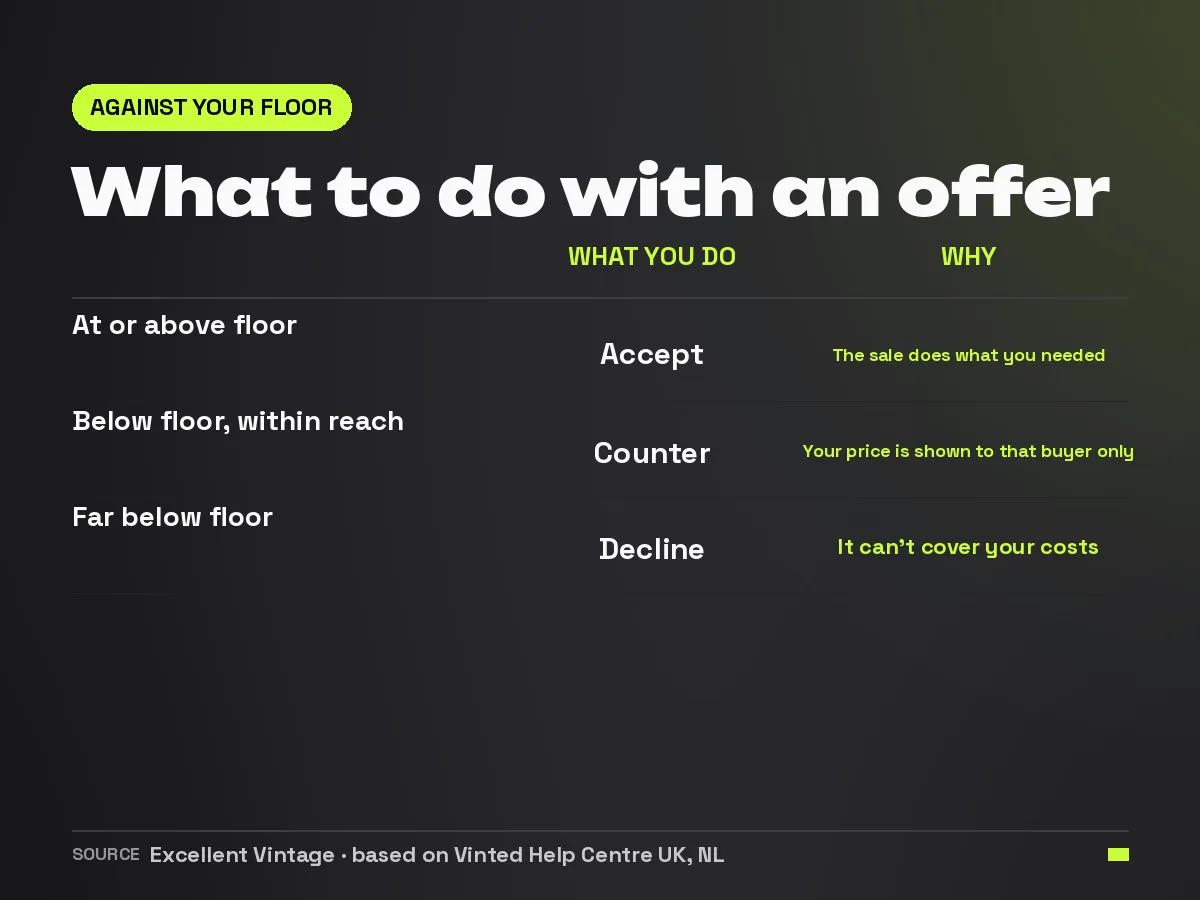
An offer at or above your floor is one you can accept, because the sale does what you needed it to do. Whether to wait for a better one is a fair question, but nothing guarantees a better offer will come, and the item stays available to everyone else while you wait. An offer below your floor but within reach calls for a counteroffer. You decline the buyer's offer in the conversation and press "Make an offer" to suggest your own price, which only that buyer sees. An offer far below the floor is a decline, or you let it go.
Grade B deserves a special look. A buyer who points at the flaw in an offer isn't always haggling for sport. If you disclosed the flaw in the description and on the photo, which Vinted asks sellers to do, the buyer is pricing something real, and a counter that meets them partway can be reasonable. If you didn't disclose it, the offer is the least of your problems, because a buyer can request a return when an item is significantly different from the listing.
One more thing that Vinted's pages leave open: how long an offer stays alive. I found no stated time limit, so don't promise a buyer one.
What if every offer lands below your floor?
Sometimes you see a pattern. One listing draws a low offer, which means little. But if most offers on pieces from one bale land below the floor you worked out, that is information about the bale and not about the buyers.
There are two explanations. Your listing prices may sit too high for what that kind of piece fetches, which is a pricing question for another day. Or the bale simply cost too much per usable piece for what the pieces sell for, and the floor you calculated was never going to be reached. That second case is worth learning from before the next purchase. Compare it with the same exercise on the next bale, and use the diagnosis for items that don't sell if offers aren't the issue at all.
At the warehouse we sell bales and not pieces, so the numbers I can speak to are the ones on my side: the grade split, the piece count by category and what a category tends to look like. The prices a piece reaches on Vinted are yours to find out.
Should you send offers yourself?
Vinted suggests it: if a buyer favourites your item or asks about it, you can send them an offer, which may help them decide. The offer goes only to that member, and the only rule that matters for a reseller is that you send one you could stand behind, at or above your floor. Where a quiet listing breaks in the first place is covered in the diagnosis for items that don't sell, and what to do with grade B and leftovers covers the pieces that stay. Your seller status also affects other parts of selling, and Vinted Pro or a private account goes through them.
A routine for offers
Make it small enough to survive a busy week. Before you list a batch, work out the floor for the bale and the category and write it down where you can see it. When offers arrive, compare, answer and move on. Look at what happened after the batch is sold or stalls: how many offers came in, how many were below the floor and whether the bale paid. That record is what you take into the next purchase.
Tell me about your last batch Tell me which category you sold and how the offers went. I'll say honestly whether it sounds like pricing or like the bale. I answer myself, usually within an hour on working days. WhatsApp Patrick
Frequently asked questions
How many offers can you make on Vinted?
A buyer can send up to 25 offers per day, according to the Vinted Help Centre. Sellers can make as many offers as they want.
What is the biggest discount you can offer on Vinted?
Offers can go up to 40% below the original price, for buyers and for sellers. Offers only apply to the item itself, so postage and fees can't be negotiated this way.
Do you have to sell if you accept an offer on Vinted?
Accepting doesn't complete the sale: the item stays available to other members until the buyer presses "Buy now", and Vinted says offers are not binding.
Should you accept the first offer on Vinted?
It depends on your floor. An offer at or above the lowest price a piece can sell for is usually worth taking. One below it is a reason to counter, not to accept.
Can other buyers see the lower price I offer?
No. When you offer a lower price, the new price is visible only to that member. Other prospective buyers still see the original price.
Written by Patrick of Excellent Vintage in Bovenkarspel: 2,500 m², since 2012, 32 years in the trade, for resellers who buy bales and want to price what is in them. Sourcing bales for your own shop? Read about our wholesale offer, book a warehouse visit, or ask on WhatsApp. For the larger picture of buying for Vinted, see buying vintage wholesale for Vinted.
See your bales on the floor before you commit Pick your bales over two hours on the floor in Bovenkarspel, where they're pre-sorted by brand and grade, or remotely on a WhatsApp video call. No deposit, free cancellation up to 24 hours before. Monday to Friday, nine to five. Pick a time
Ready to buy?
Visit our warehouse · no deposit required · free cancellation.