What to do with unsold vintage inventory: a reseller's exit plan for grade B and leftovers
On a first visit to our bale floor in Bovenkarspel, north of Amsterdam, resellers talk to me about brands, formats and grades. Around the third or fourth visit a different question tends to come up,…
By Patrick Libanon — founder, Excellent Vintage · Bovenkarspel, since 2012
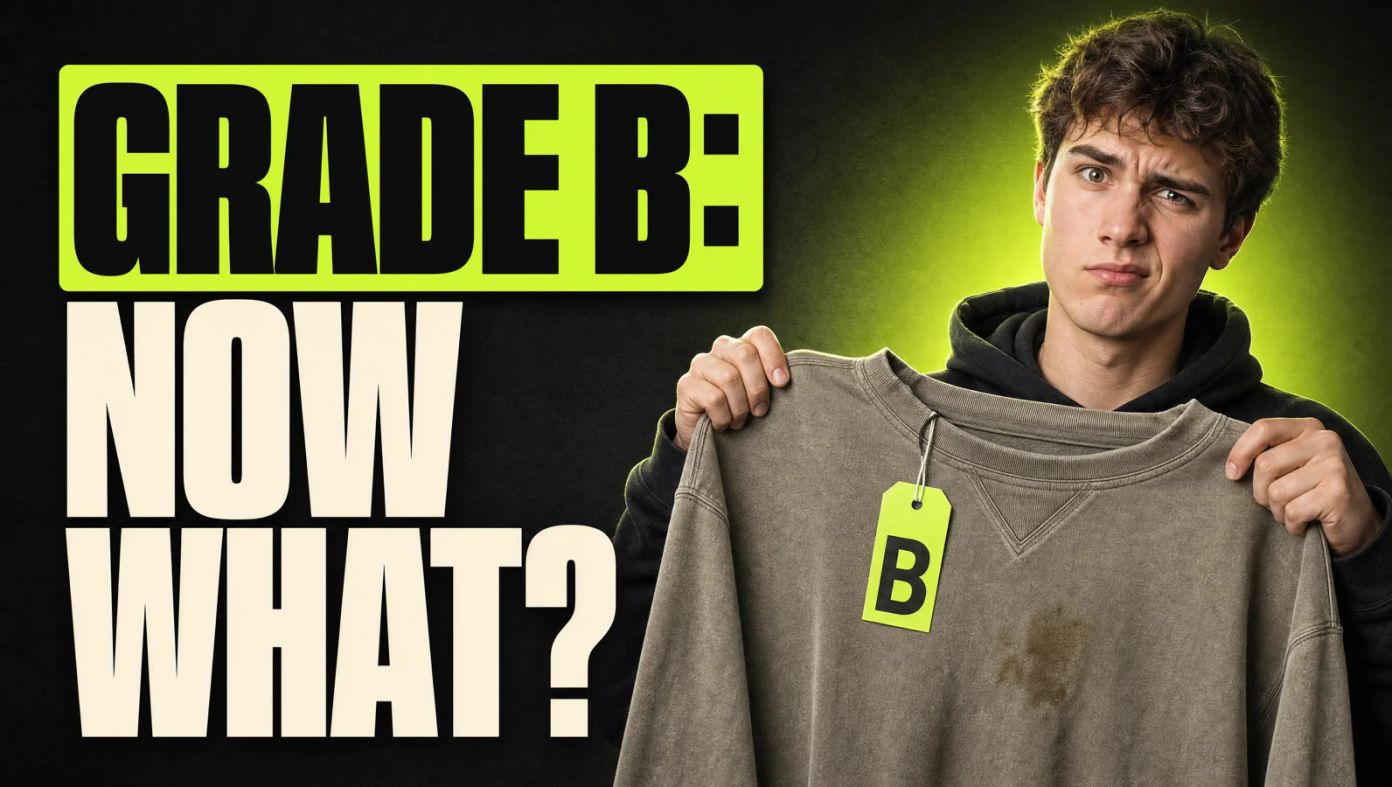
Unsold vintage inventory is a sorting decision you have put off. Work down from the top: repair what can become grade A, sell grade B honestly with the flaw in the photo, lot it or change channel, donate what still wears, and only then hand the rest in as textiles. Never the general bin.
On a first visit to our bale floor in Bovenkarspel, north of Amsterdam, resellers talk to me about brands, formats and grades. Around the third or fourth visit a different question tends to come up, usually as an aside while someone is going through a stack of sweatshirts: "And what do you actually do with the rest, Patrick?" I have run Excellent Vintage since 2012, and behind that question there is nearly always the same corner at home. A few pieces with a mark, a couple with a dropped hem, and a handful that are perfectly fine and still haven't sold. The corner grows.
What I ask back is which items in that corner already have somewhere to go. Usually none of them do. The corner exists because everything went into it at once, with the plan of looking at it later. This piece is about that later: how to take a pile of unsold clothes apart item by item, which exit fits which flaw, and why the outlet you have for grade B should be settled before you buy.
Why is unsold inventory really a sorting decision?
Second-hand clothing is sorted from start to finish, and at every step someone asks the same question: where does this item go next? The Dutch sorting company Wieland Textiles describes on its own website how that starts there. The first rough sort produces two piles, wearable goods on one side and textiles that will continue as raw materials on the other. After that, sorters learn to tell roughly three hundred kinds of clothing and materials apart, by quality, fashion, season and by what different export markets are asking for. Only the most experienced people sort the top quality. I mention the company only because it describes its process openly, and you can see in it how sorters think.
What reaches us pre-sorted has been sorted by brand and category along the way. So a reseller who takes home second-hand clothing bales from our 2,500 m² warehouse gets clothes that have already been through several sorting decisions. The last call, item by item, is made by the reseller at their own table.
Seen that way, leftovers get handled differently. A waste problem you clear in one go, by getting rid of everything at once. A sorting decision you make item by item, and then the one corner breaks up into five or six smaller piles, each with its own destination.
What can fashion brands no longer do with their unsold stock?
It helps to look at what the big players in the fashion industry are now required to do. Since 19 July 2026, large companies in the EU may no longer destroy unsold clothes, clothing accessories and footwear. The rule comes from the Ecodesign for Sustainable Products Regulation (ESPR), and the European Commission published its own announcement when the ban entered into application. Medium-sized companies follow in 2030. Small and micro businesses are exempt.
Instead of destroying goods, those companies have to keep products in use. The Commission names three ways to do that: selling them, explicitly including through discounts or alternative markets; donating them to charities or social enterprises; or preparing them for reuse by repairing or refurbishing. Destruction is only allowed in defined cases, for example for damaged or unsafe products, or when a charity turns a batch down. Even then, recycling comes first under the waste hierarchy.
Textiles are the first product group the ban applies to, and it comes with paperwork. A fashion company that still destroys unsold goods under one of the exceptions has to be able to prove why, with documents or test results, and has to publish each year what it discarded. National authorities check compliance and can impose fines, and companies keep their records for five years. For large companies in the fashion industry, any destruction that still happens is now reported each year.
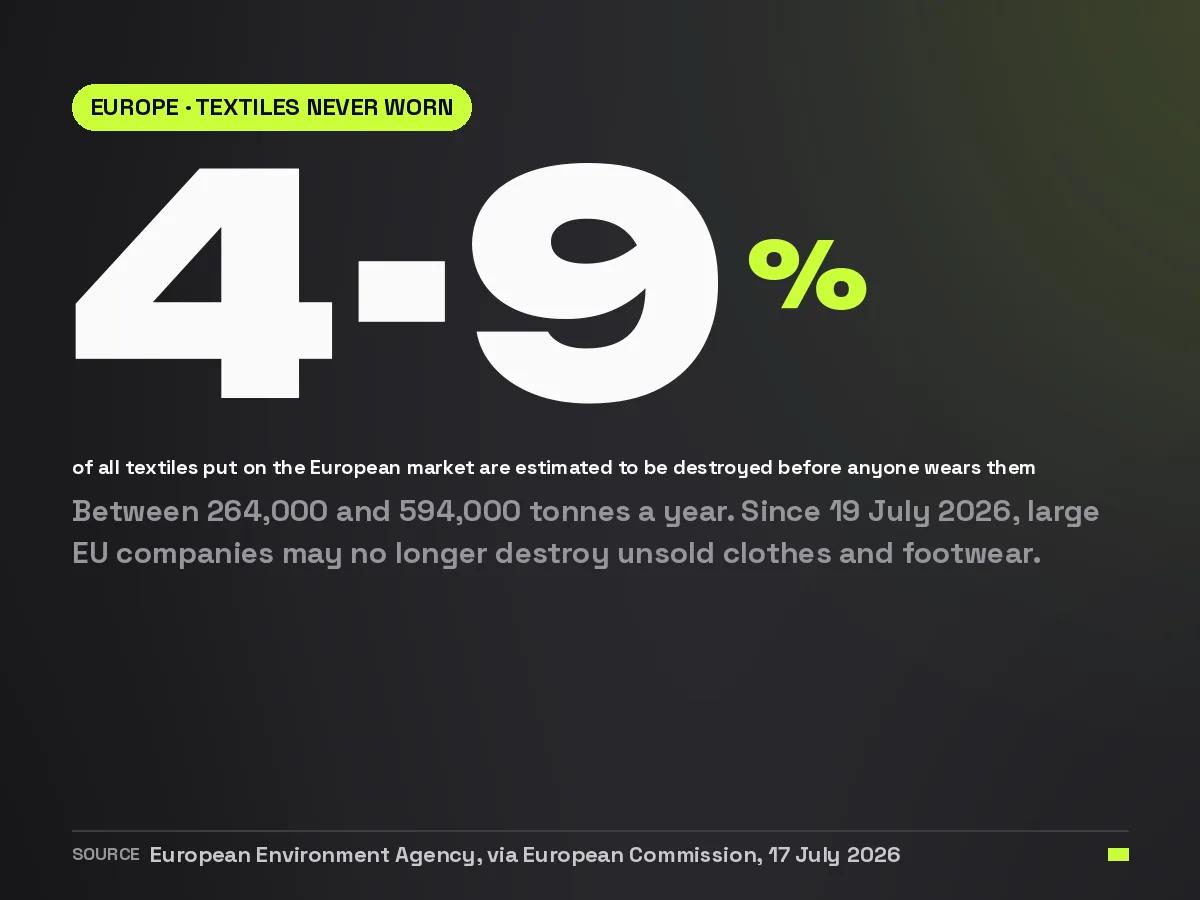
The reason sits in figures the Commission takes from the European Environment Agency. An estimated 4 to 9 percent of all textiles put on the European market are destroyed before anyone has worn them, between 264,000 and 594,000 tonnes a year.
A well-known case in luxury fashion is Burberry. In its annual report for 2017/18, the company disclosed that it had destroyed £28.6 million of its own finished goods over the year, to keep them away from counterfeiters and the grey market, as Fortune reported at the time, citing The Times. In September 2018 Burberry announced it would stop destroying unsold goods and would reuse, repair, donate or recycle them instead.
For most resellers the law has no consequences, because small and micro businesses are exempt. The framework is still useful. What it says, in effect, is: keep a product in use for as long as you can, and only let it continue as raw material when that no longer works. We built the exit ladder below on that principle. The order is ours, set by what an item can still earn a reseller, from the most revenue at the top to the least at the bottom.
What does a reseller's exit ladder look like?
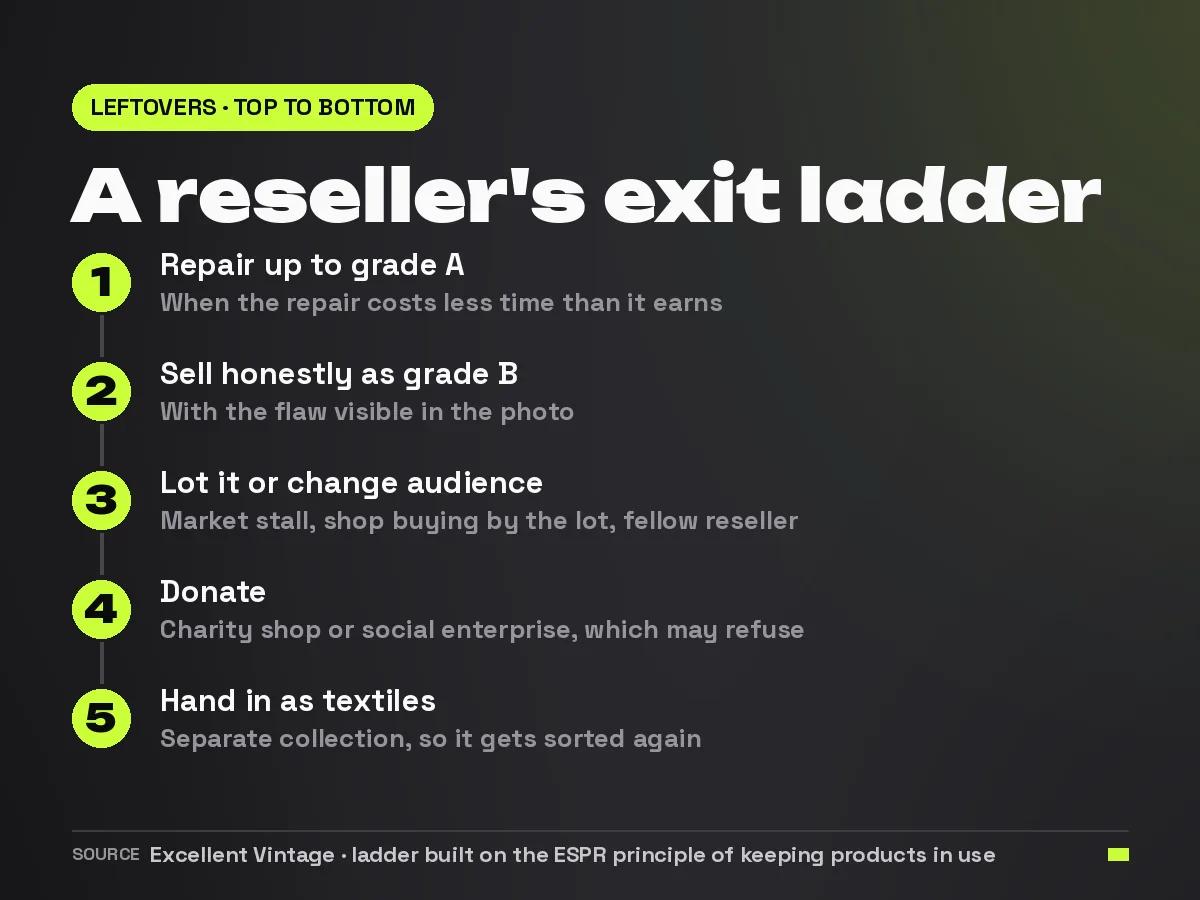
At the top is repairing a piece up to grade A. Part of what comes in as grade B has a light mark, a loose button, pilling or a hem that has slipped, and that is simply maintenance. We have written up how to treat a mark without damaging the fabric in removing stains from vintage clothing without damage. On this rung you ask one honest question: does the repair take less time than the extra value the piece brings as grade A? If the answer is no, you step down.
Below that is selling the item as it is, as grade B, with the flaw in the photo. Vinted says as much in its own guidance on photos: show the item's defects, because if you don't mention them, the person buying might want to cancel the order and return the item. What resellers tell me on the floor matches that: a small mark shown clearly causes less trouble than a description that talks around the flaw.
The third rung is a different form or a different audience. What doesn't sell as a single item sometimes goes as a lot of a few pieces from the same brand. Other pieces suit a market stall better, or a second-hand shop that buys by the lot, or a fellow reseller who works on volume in that category. The Commission also names alternative markets as a way to keep unsold clothing in use. Many of the resellers I talk to clear their loose leftovers on this rung.
On the fourth rung you donate, to a charity shop or a social enterprise. It brings in no sales revenue, but it frees up space, and the garment gets a chance to be worn again. Expect that not everything will be accepted. The Commission also lists rejection by a charity as one of the exceptions to the ban.
At the bottom is handing items in separately as textiles, for sorting and recycling. Since 1 January 2025, every EU member state has had to organise separate collection of textiles, and the revised Waste Framework Directive of October 2025 requires separately collected textiles to be sorted before any onward shipment. An item that lands here goes back to a sorting table, like the clothes your bale was made from.
What that sorting looks like is described by KringTex in Amersfoort, another Dutch sorting company that publishes its process. Everything that comes in is weighed and registered, pre-sorted into around 34 categories, and then split across three departments: wearable clothing for the Dutch and foreign markets, textiles for recycling, and a remainder that goes to incineration with energy recovery. Recyclable material is pressed into bales. So the textile bank starts another round of sorting, in which wearable clothes get a second chance and part of the rest becomes materials for recycling.
Pick your bales on the floor, not on paper In Bovenkarspel you choose your bales yourself, pre-sorted by brand and grade, and I tell you for each bale which brand and grade it has been pre-sorted to, before you pay for anything. Two hours on the bale floor, up to four people, no deposit and free cancellation up to a day before. I call you the day before to go through your category. Book a warehouse visit
Which grade B flaw belongs on which rung?
In practice you sort by flaw, because two grade B pieces can need very different answers. In the trade, grade B means a garment that is wearable but shows visible wear: a light stain that may still wash out, noticeable fading, pilling, a small defect in a print, a seam that has come slightly loose, a missing label. Where exactly the line sits differs between wholesalers, because there is no industry-wide grading standard. How we draw ours is set out in our vintage clothing grading guide.
A stain that may wash out, a loose seam and pilling, which can often be shaved off, belong on the top rung. Fading rarely repairs well. On workwear and denim a bit of wear is part of the appeal for many customers, so selling honestly as grade B tends to work well there. A missing care or size label is harder than it sounds, because customers rely on it for size and fabric content. That kind of item often does better inside a lot from the same brand than as a single listing. A garment with several of these flaws at once usually ends up on one of the bottom two rungs.
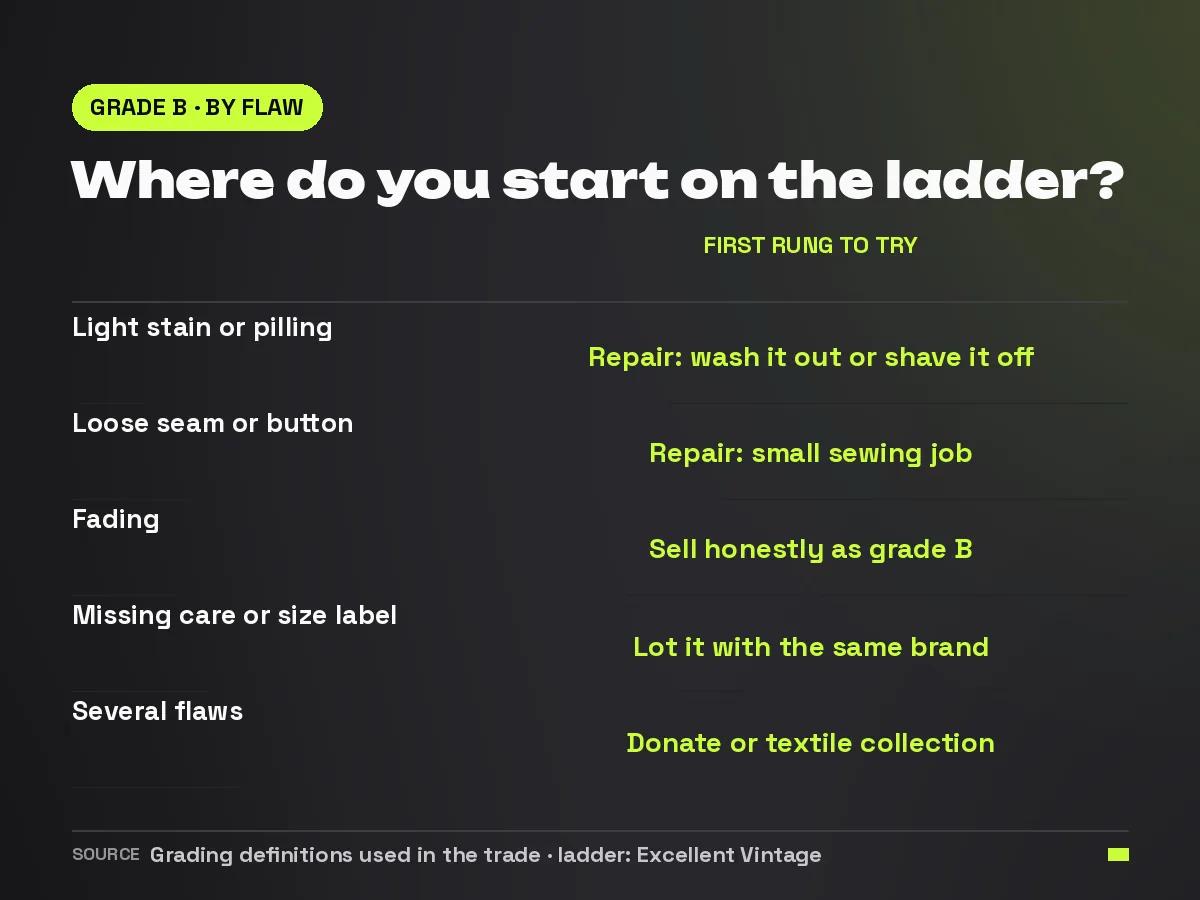
Use the table to give each piece a first rung; if in doubt, start one rung higher.
Is an unsold grade A item the same problem?
This is the mix-up I come across most often. A corner of leftovers usually holds two kinds of stock side by side: grade B, where something is wrong with the garment, and grade A that is fine and still hasn't sold. With the second kind, the issue is timing or audience.
Take a heavy winter coat listed in July. That coat is in the wrong season, the same problem fashion retailers face every year with end-of-season stock. The same goes for a size your customers rarely wear, or one of the brands your audience doesn't know yet. For those items the ladder is shorter. Repair makes no sense and the textile bank is a long way off; they belong to a different moment or a different customer. Put grade A and grade B on one heap and you end up treating flawless clothes as though something were wrong with them, and selling them below their value.
My advice is to keep the two apart: grade B works its way down the ladder, and grade A that isn't moving goes back on sale, online or off, at another moment or with another audience.
Why doesn't retail advice on excess inventory fit a vintage reseller?
Look up what to do with unsold inventory and most of the advice you find is written for the fashion industry, for brands and retailers. For retailers it makes sense. A retail business buys new products in quantity for one season, based on a forecast of demand. When demand comes in lower than planned, the excess inventory is dozens of identical items in the same sizes, all leaving the collection at the same moment. Their toolkit therefore runs on the calendar: end-of-season discounts, outlet stores, selling a whole batch of excess stock to another business in one go.
A vintage reseller's stock is built differently. Nothing in your pile is identical; each item has its own size, its own condition and its own label. It wasn't bought against a forecast either, because it came in by the kilo or by the piece, as part of a bale whose mix you knew on average. And much of it doesn't date the way a new collection does, especially with brands such as Carhartt or Levi's.
So the retail playbook needs translating before you use it. A store-wide discount makes sense when you hold dozens of copies of the same shirt. With one-of-one second-hand fashion, a blanket price cut mostly gives away value on pieces that would have sold anyway. What does carry over is the principle behind the retail advice, the same one the EU has now written into law for large fashion companies: keep the product in use for as long as you can, only as a reseller you apply it item by item.
Why does your grade B outlet decide which format you buy?
This is the part I most want resellers to hear before their first bale, because it changes how they buy.
At our warehouse a 45 kg bale averages 70 percent grade A and 30 percent grade B. A 25 kg "mix premium US" bag averages around 90 percent A and 10 percent B. Those are averages across what comes in, not a promise for any single bale: one lot comes out a little better, another a little worse. Set those percentages next to the number of items and it becomes concrete. A 45 kg bale of T-shirts holds around 225 pieces on average, since a T-shirt weighs about a fifth of a kilo, and at 30 percent grade B that is roughly 68. Take the same category in a 25 kg "mix premium US" bag and you have around 125 T-shirts on average, with about 12 to 13 in grade B.
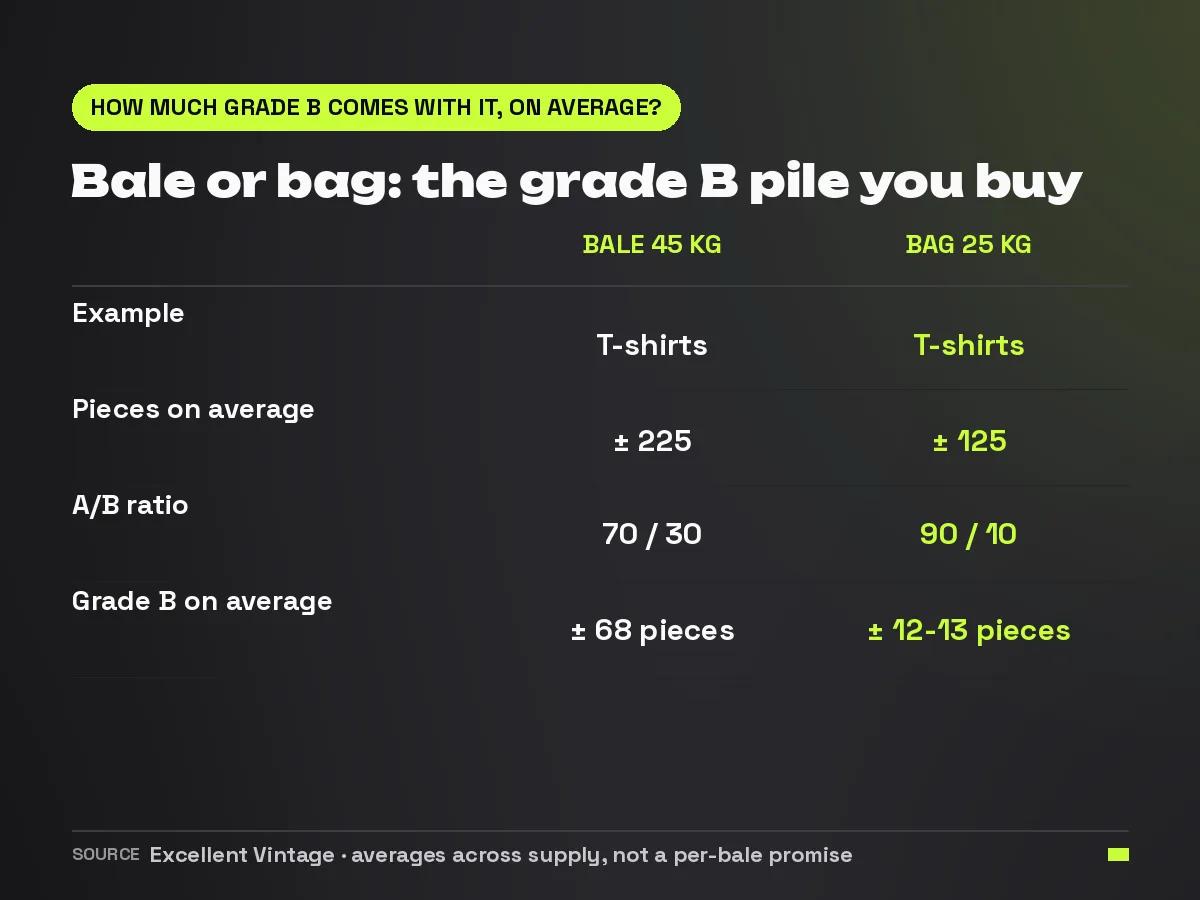
A grade B pile of that size is a second stock, and it needs an outlet that exists before the bale arrives. If you run a market stall, sell lots, or know a colleague who works on volume in that category, the bale works. The grade B items have somewhere to go, and the bale's volume then works in your favour. If you have no such outlet and only sell single items to customers who come for perfect condition, a bale brings in a pile you have no channel for. A 25 kg bag with a higher share of grade A is then the more logical choice, even at lower volume.
I see both kinds of reseller on the floor, and both make a good choice as long as they know where the grade B share is going. To run those numbers for your own category, use the bale profit calculator. Which format fits which selling strategy is covered in our guide to buying vintage wholesale for Vinted reselling.
Tell me where your grade B goes Send me your category and how you sell today: single items, lots, a market stall. I will tell you whether a bale or a 25 kg bag suits your outlet better, and what we currently have in that category. You get me on the line, in English, Dutch or French. Message Patrick on WhatsApp
Where does grade C fit into this?
Grade C covers garments with a serious defect: a hole, a bleach mark, damage that won't come out. In the trade those go to upcycling, industrial wiping rags or textile recycling. At Excellent Vintage grade C is not part of the standard mix in our bales and bags; we keep it separate. Most of what would otherwise end up at the bottom of the ladder has therefore already been sorted out before a bale reaches you.
Your leftover corner therefore holds mostly grade B, plus grade A that hasn't found its customers yet, and for those items the higher rungs of the ladder are still open. If you still come across something you didn't expect when you open a bale, raise it with us rather than quietly sorting it away. Complaints about a delivery need to reach us in writing within 48 hours of receipt, at info@excellent-vintage.com.
What do resellers who stay on top of their leftovers do?
The resellers who have been at this for a few years ask about leftovers earlier than everyone else. On the floor they ask about more than brands and categories; they also ask what kind of flaws to expect in the grade B of that lot. Whoever asks that already knows which rung those items will land on, and does the maths before buying.
They also go back over the pile regularly, at a moment they choose themselves: when a new bale arrives, when the season turns, or simply when the corner catches their eye again. They don't work to a fixed number of weeks, because that differs by category and by channel. In each round they check, item by item, whether it can move up a rung or has to move down.
And they keep track of what leaves the table: a lot going to a colleague, a bag for the charity shop, a sack for textile collection. If you are still working out how to start with bales, starting Vinted reselling with vintage bales, step by step is a good place to begin.
Frequently asked questions
What should you do with unsold vintage clothing inventory?
Work down the ladder from the top. What can still sell, you try as a lot or with another audience, such as a market stall, a shop that buys by the lot or a fellow reseller. What is wearable but doesn't sell can go to a charity shop or social enterprise, although they may refuse it. What remains, you hand in separately as textiles so it gets sorted again.
Is a reseller allowed to throw away unsold clothes?
The EU ban on destroying unsold clothing applies to large companies since 19 July 2026 and to medium-sized companies from 2030; small and micro businesses are exempt. For a reseller, throwing clothes away is still the worst exit: EU member states have had to organise separate textile collection since 2025, and clothes don't belong in the general bin.
When is it worth repairing a grade B item?
When the repair takes less time than the extra value the item brings as grade A. A light stain that may wash out, pilling that can be shaved off, or a loose seam or button often qualifies. Fading rarely repairs well; that kind of item you sell honestly as grade B, with the flaw visible in the photo.
What do you do with an unsold grade A item?
Keep it apart from grade B. A grade A item that hasn't sold is fine; the cause lies in the timing or the audience. A winter coat in July waits for its season, and a size or brand your customers don't look for suits another channel better. A price cut is rarely the first step.
Should you buy a bale or a bag if you only sell single items?
That depends on where your grade B can go. On average a bale brings many more grade B items than a 25 kg "mix premium US" bag. If you have no channel for grade B items, the bag usually fits better; if you also sell lots or run a market stall, the bale works.
Buy the grade that fits your exit Two hours on the bale floor in Bovenkarspel, where you choose your bales yourself, pre-sorted by brand and grade. No deposit, free cancellation up to a day before. Monday to Friday, nine to five. Visit our warehouse
Ready to buy?
Visit our warehouse · no deposit required · free cancellation.