Sourcing Vintage Wholesale From The Hague: One Connection Decides Your Day
No train takes you from Den Haag Centraal to Bovenkarspel-Grootebroek in one go. Look the route up and there is a second oddity: among the services we checked, the quickest carried two changes and…
By Patrick Libanon — founder, Excellent Vintage · Bovenkarspel, since 2012

No train takes you from Den Haag Centraal to Bovenkarspel-Grootebroek in one go. Look the route up and there is a second oddity: among the services we checked, the quickest carried two changes and the slower one carried a single change.
That inversion is not a quirk of the timetable. It decides what a sourcing day from The Hague actually looks like, and where it parts company with the same day out of a town closer to West Friesland.
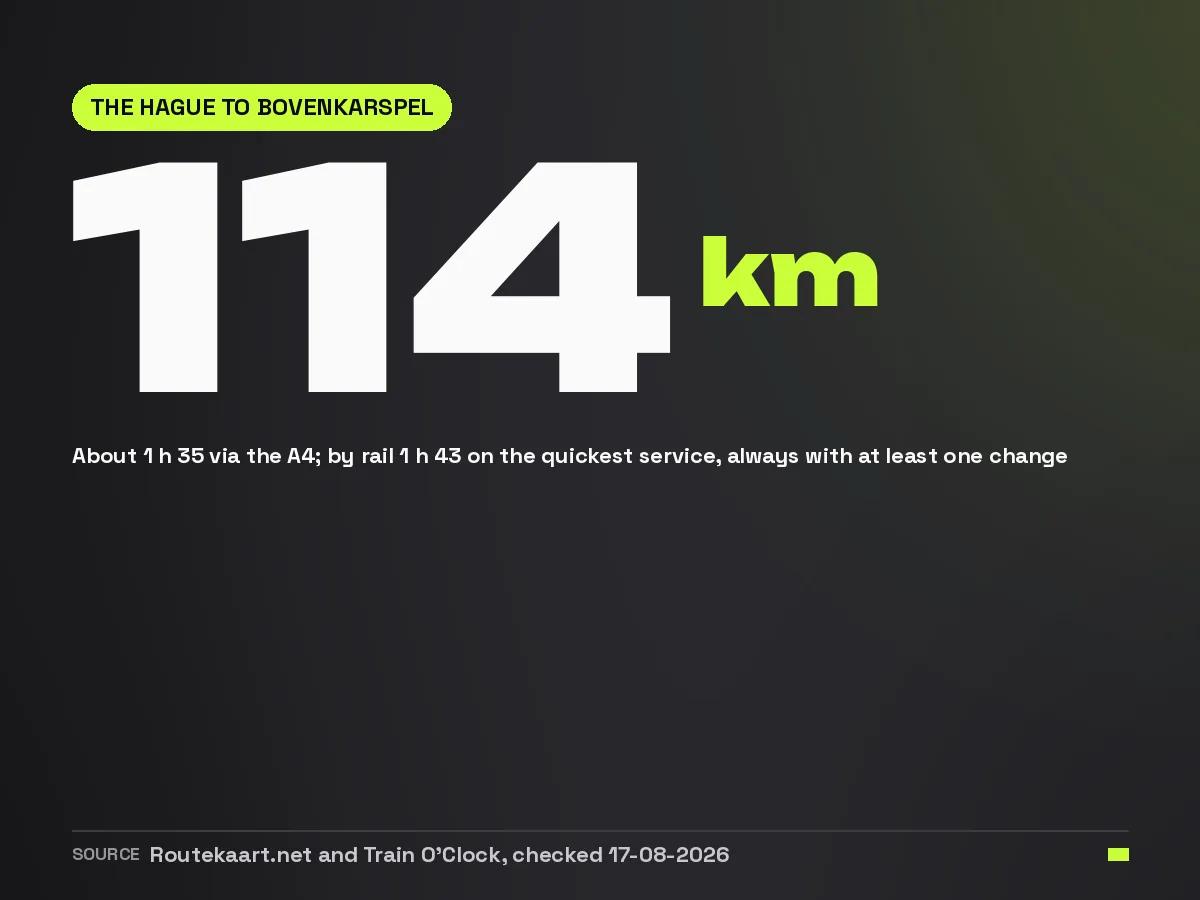
The bale floor is on Stede Broecweg in Bovenkarspel: 114 kilometres of road from The Hague, roughly an hour and thirty-five minutes on the A4. Train O'Clock puts the rail journey at one hour thirty-six, though the quickest service we checked took one hour forty-three. Buying is by appointment, in two-hour blocks.
We have been running Excellent Vintage from that warehouse since 2012. It measures 2,500 m², fifteen to twenty tonnes of clothing pass through it every month, and Patrick runs the floor and greets every visitor himself. If you want the chain explained first, from container to rack, that is what the complete guide to vintage wholesale in the Netherlands is for. This piece is narrower. It is about what changes once your journey is built around a connection, and which decision that pushes forward in your day.
One hundred and fourteen kilometres with a hinge in the middle
By car the route is less straight than the map suggests. You leave The Hague on the Utrechtsebaan, join the A4, meet the Amsterdam ring, and leave it again through the Tweede Coentunnel heading north. Only then does the last stretch begin, over the Westfrisiaweg and the Markerwaardweg into Bovenkarspel. For scale, the leg from Amsterdam to Bovenkarspel is 56 kilometres on its own — just under half your drive sits beyond Amsterdam.
The rail journey has the same shape. Every service we checked out of Den Haag Centraal ran through Amsterdam Sloterdijk, and the onward train towards Hoorn and Bovenkarspel leaves there at 24 and 54 minutes past the hour. That last leg takes fifty minutes, calling at Hoorn, Hoorn Kersenboogerd and Hoogkarspel. Whatever you gain or lose in transit, you gain or lose it on that one platform at Sloterdijk.
On a straight run, a ten-minute delay costs you ten minutes. Here it costs you half an hour, or nothing at all. Your arrival is a short list of fixed moments, and the time you leave The Hague decides which of them you land on.
Why the itinerary with an extra change lands at the same minute
Put two services side by side, as they stood on Monday 17 August. One leaves Den Haag Centraal at 12:21 and runs through without a change via Leiden, Heemstede-Aerdenhout and Haarlem, reaching Sloterdijk at 13:04. The other leaves ten minutes later at 12:31, changes once at Leiden on the way, and gets in at 13:19. Both then change at Sloterdijk, which is what makes the second itinerary a two-change journey.
Both travellers step onto the platform at Bovenkarspel-Grootebroek at 14:14. They are on the same 13:24 departure. The first waited twenty minutes for it; the second waited five. One journey is listed at one hour fifty-three and the other at one hour forty-three, and the extra change costs nothing at the far end — it buys ten more minutes at home.
Which is also why the time a planner quotes is rarely the time you spend. That one hour thirty-six only exists if your connection lines up; every minute you arrive early at Sloterdijk, you sit out on the platform. What sets your journey time is how close your arrival falls to 24 or 54 past.
You can work with that, and it is easiest worked backwards. To be on the floor at eleven, it is the 54-past connection out of Sloterdijk you want: fifty minutes on, that puts you at Bovenkarspel at 44 past ten, five minutes' walk from the door. To make it you leave Den Haag Centraal a little under an hour earlier — the run up takes three quarters of an hour, and you do not want to arrive with nothing in hand. Miss it and you are on the floor half an hour later. So the order runs: book the two-hour block first, then find the train that fits it.
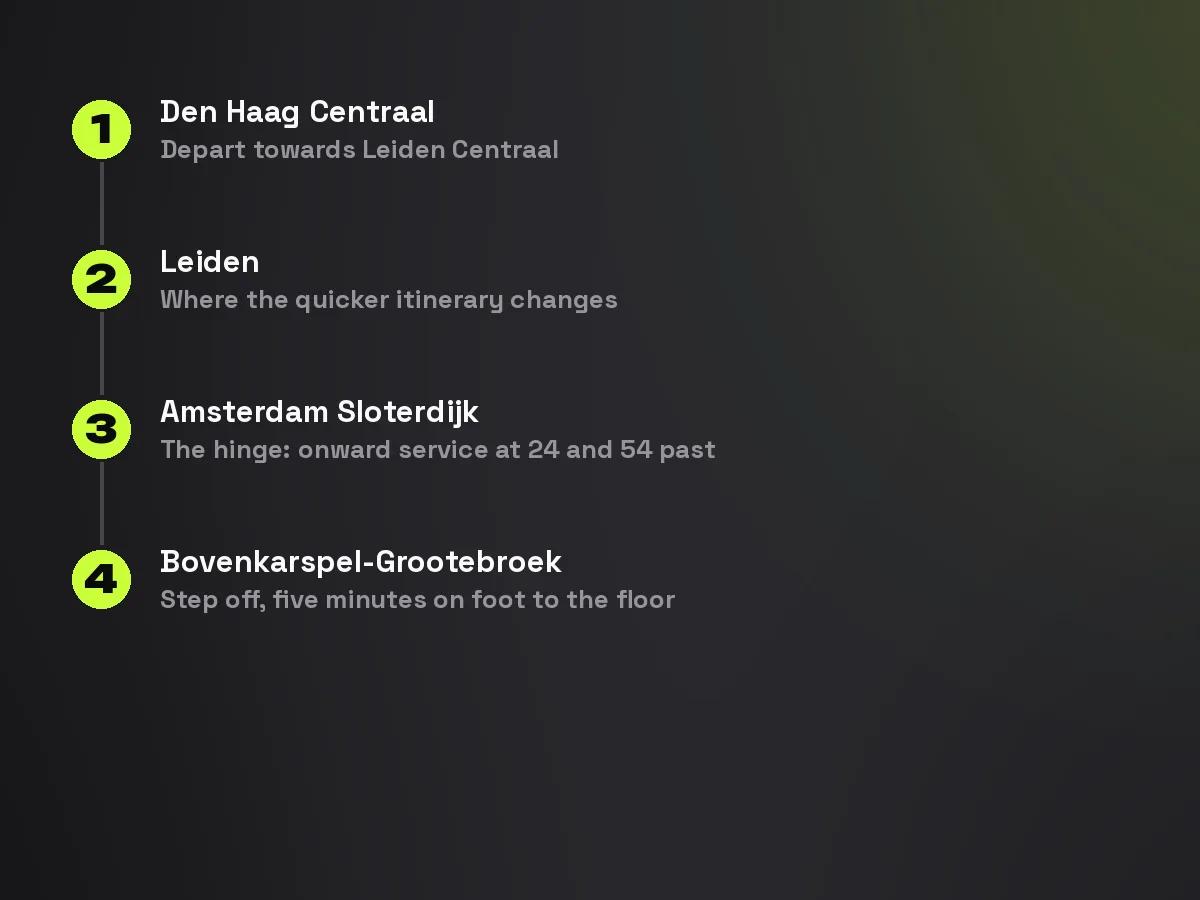
Book the block, then work the trains backwards We are open on weekdays from nine to five and work in two-hour blocks. Choose the block that suits you and count back from it to the 24-or-54 connection. Booking costs nothing up front and you can cancel free of charge up to 24 hours before. Book a warehouse visit
The call the day before is the real preparation
If a visit costs you a good five hours, you do not want to spend the two on the floor explaining who you are. That is why Patrick phones you the day before. That call is where we settle what will be ready for you.
The floor is arranged by brand and by grade, not by customer. We hold permanent stock of ten brands, grouped into four corners of the range: heritage, workwear alongside outdoor, sport with techwear, and a mixed stack for buyers who work more selectively. You can see which ones on our vintage wholesale page. With more than four hundred categories and fifteen to twenty tonnes moving through every month, nobody walks the whole hall in two hours. The corner that matches your trade is pulled out and set up by brand and grade before you arrive.
That is also why we work by appointment. The floor is yours for two hours, up to four people, with nobody else working a different category alongside you. What the rest of the visit looks like, from the door to the loading bay, is in our piece on what to expect from a warehouse visit.
Someone driving in from Amsterdam can answer that call in part and sort the rest out on the spot, because coming back costs them a morning. From The Hague, coming back costs another day like this one. The same conversation carries more weight from here.
What the phone settles, and what only the floor can settle
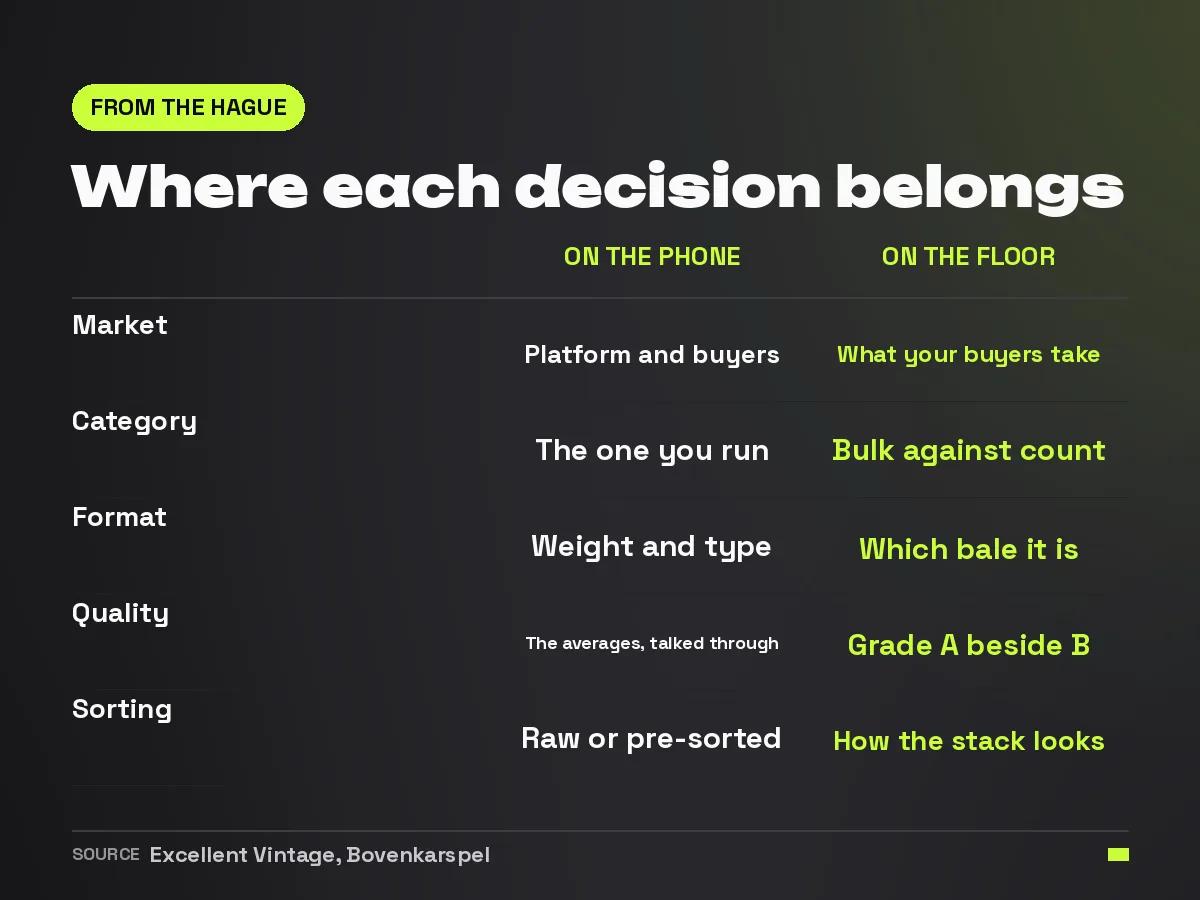
There is a clean line between decisions you can make over the phone and decisions that need something in your hands. Mixing the two up wastes the block.
The phone is for what you already know. Which platform you sell on and who buys from you. Which category you are running right now. What format you have in mind, because a 12.5 kg half bag is a different conversation from a 25 kg bag, a 45 kg bale or a 50 kg curon. Whether you are driving or taking the train. And whether you would rather buy raw or pre-sorted, a choice we pull apart in heavy bales versus sorted clothing. Every one of those answers comes out of your own books, not out of our hall.
The floor is for what your hands have to judge. How grade A and grade B actually differ inside your category, because that gap looks nothing alike on a pair of jeans and on a sweatshirt. How much room a category takes up against how many pieces it yields. And above all whether what is in front of you looks like something your buyers will take, which is a verdict nobody can deliver on your behalf. What the letters cover is set out in the guide to grading and grade A, B and C.
Averages belong to the first conversation. Inside a 45 kg bale the split between A and B sits around 70 to 30; a 25 kg bag of mix premium US sits higher, nearer 90 to 10. Those are averages across the intake rather than a specification for your lot, and you can go through them on the phone so you know roughly what you are buying. Whether your own buyers tolerate a minor flaw is something you learn only after you have sold a lot through.
Arriving by rail settles the transport question in advance
Will this fit in the car. That question does not need to eat into your two hours, and if you travel from The Hague by train it was answered when you bought the ticket.
You carry nothing heavy, and you do not need to. What you buy goes out as a shipment to your address; heavy bales and fast shipping are what this business runs on. Collecting in person at Bovenkarspel is also possible, later and by appointment, so you are never forced to settle it on the day.
Driving makes the trade-off more concrete, though shipping stays an ordinary option there too. Splitting a purchase between what rides home with you and what gets sent on is perfectly normal.
The paperwork is quick. You buy against your company registration number. If your company sits in the Netherlands, Dutch VAT goes on the invoice; hold a valid VAT number elsewhere in the EU and the VAT is reverse charged instead. Payment goes by transfer, by debit or credit card with no surcharge, or in cash on site. Whichever bale you choose, you buy it as it stands on the floor.
Ask Patrick what is on the floor this week Which categories have just landed, whether your format travels better with you or as a shipment, which block sits best against the 24-or-54 connection: send a message on WhatsApp. Patrick answers himself — no chatbot, no ticket queue. Message Patrick
Frequently asked questions
How long does it take to reach the vintage wholesaler from The Hague?
Budget a good five hours in all: close to two hours each way, two hours on the floor. The drive itself is 114 kilometres on the A4; by rail you land between one hour forty-three and close to two hours depending on your connection. Visits run on weekdays between nine and five.
Is there a direct train from The Hague to Bovenkarspel-Grootebroek?
Not on the day we checked. Every service we looked at out of Den Haag Centraal ran through Amsterdam Sloterdijk, where the onward train towards Hoorn and Bovenkarspel leaves at 24 and 54 minutes past. So judge an itinerary by which connection it catches, not by how many changes it has: two services leaving The Hague ten minutes apart arrived at the same minute.
What should I tell Patrick when he calls the day before?
The platform you sell on, the category you are running now, the format you have in mind, and whether you are driving or taking the train. With those answers the corner that suits you is pulled out by brand and grade in advance, so your two hours go on bales instead of explanation.
What happens if I miss the connection at Sloterdijk?
It costs you half an hour, because the next train towards Hoorn and Bovenkarspel does not leave for another thirty minutes. That is why booking the block before choosing the train matters more here than elsewhere: a missed connection eats a quarter of your time on the floor, or moves the whole visit.
The connection is the one variable you control
The arithmetic of the whole day fits on a line: 114 kilometres or two trains, two hours on the floor, and one moment in transit that shifts everything if you miss it. The kilometres are fixed, the block is fixed, and the traffic on the A4 is not yours to decide. The 24-or-54 departure out of Sloterdijk is the only point where your choice decides whether you walk in a few minutes before eleven or twenty past.
So it goes at the front of the plan rather than the back. And the call with Patrick the day before is part of the same logic: anything settled there does not have to come out of your two hours. If you would rather see how we work first, that is in our story; buyers weighing up the drive from elsewhere will find the routes from Rotterdam and Utrecht written up separately, and there is a longer guide for buyers travelling in from abroad.
Have Patrick set your corner out Say when you book which platform you sell on and which category you run, and that corner of the floor is standing ready by brand and grade when you walk in. Two hours, up to four people, no deposit. Reserve your slot
Ready to buy?
Visit our warehouse · no deposit required · free cancellation.